The Bosnian Flag – Symbol of Peace

The Bosnian flag is blue with a yellow isosceles triangle. The flag also features seven full stars and two half stars along the hypotenuse of the triangle (I just like using words like isosceles and hypotenuse).
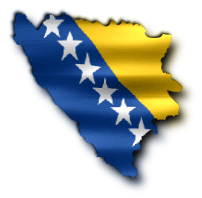
The colors of the Bosnian flag—blue, yellow and white—are usually associated with neutrality and peace throughout the world. In fact, the kings of neutrality and peace, Switzerland and Costa Rica, both feature at least one of these colors on their respective flags. The colors of the Bosnian flag may have also been inspired by those found on the flag of Europe as well as that of the United Nations.

The three points of the Bosnian flag’s isosceles triangle are thought to stand for the three constituent peoples of Bosnia and Herzegovina: the Bosniaks, the Croats, and the Serbs. The triangle is also meant to represent the map of Bosnia, which resembles a heart. Many people even call Bosnia the “Heart-Shaped Nation.”

The stars which run diagonally across the Bosnian flag represent Europe, and are meant to be infinite in number, thus continuing from top to bottom. Many people have speculated as to why the stars are infinite in number, but, much like the mystery surrounding how many licks it takes to reach the center of a Blow Pop, the world may never know—just kidding; I’m sure there’s a good reason behind the stars.

The Bosnian flag was created when the country won its independence from Yugoslavia in 1992. Before choosing the current design, other alternatives were proposed, including one which featured an olive branch. Other designs included the map of Bosnia as well as a lighter shade of blue.

Gadsden Flag T-Shirts – Don’t Tread On Me

The Gadsden flag: it’s a symbol of freedom, a sign of resistance, a warning shot fired across the bow of those that might think it fit to infringe upon the freedoms of the citizens of this great nation. It bears but few simple words, but within their meaning lie the force of a great hurricane, and all those that gaze upon it cannot help but understand its most singular message: Don’t Tread on Me. Those that carry the Gadsden flag, whether it be with their hands or in their hearts, believe in the principles upon which the United States of America was founded, and upon which she shall continue to thrive.
In light of these immutable truths, the United States Flag Store has decided to offer its customers the chance to not only own the Gadsden flag, but to wear it upon their chests as well. Created by our own team of local designers, these Gadsden flag t-shirts are available exclusively on our Website. Choose between six original designs, each one unique from the next, and which have been given such fitting names as Patriots, Guns, and Fire.

The Gadsden flag was created by Christopher Gadsden in 1775. At the time, Gadsden was taking part in the Second Continental Congress, which had just created the United States Navy to keep British ships from reaching the colonies. A small group Marines, which happened to carry yellow drums with a rattlesnake and the words “Don’t Tread on Me” painted upon them, was given the mission of accompanying the Navy on its first mission.

Whether Gadsden was inspired by the drums or in fact created them himself is the subject of some debate. However, it’s an undeniable fact that Gadsden soon presented the Navy’s commander with a flag bearing the same design, and, as the saying goes, the rest is history.

Celebrate the Gadsden and all that it stands for by picking up a Gadsden t-shirt today!

The Flag of Haiti: A Call to Action

By Kristi Ries

Unlike the country it represents, the official flag of Haiti is young, having been adopted in 1987. A tiny island country in the Western Caribbean, Haiti has existed for hundreds of years. Indigenous tribes who were later ‘discovered’ by the great Spanish explorer Christopher Columbus were the island’s first inhabitants. Following this, both Spain and France colonized what is now modern-day Haiti. Eventually, however, the island’s emerging multicultural population fought and won its independence in 1804. A new nation was born.

On the afternoon of January 12, 2010, the small nation’s history and life of its citizens was turned upside down. Haiti was struck by a magnitude-7.0 earthquake, the country’s most severe earthquake in more than two centuries. The epicenter of the quake was just off the Haitian capital Port-au-Prince. Entire communities have been leveled and countless lives have ended prematurely.

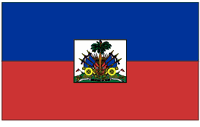
What this nation’s flag symbolizes and the feelings it evokes are what makes it so singularly powerful. It recognizes the country’s European heritage through its vibrant blue and red colors. This new design was based on a torn French Tricolore flag and features Haiti’s Coat of Arms centered in a white square.

For all who see and recognize it today, however, the flag of Haiti serves as a reminder that help is urgently needed and that a major humanitarian crisis is occurring as we go about our daily lives.

Once Americans are away from their television sets, laptops and radios, it is somehow easier to forget the overwhelming devastation to this impoverished Caribbean nation. Yet people all over the world are showing a unified front by displaying the flag of Haiti in office windows, on their cars or outside their homes. Numerous skyscrapers in major cities have been lit in the Haitian colors of blue and red to pay respect to the multitude of lives lost in the recent tragedy.

As the unbelievable destruction and rising death toll become more apparent, many organizations and individuals have come to Haiti’s aid. Displaying the Flag of Haiti is a quiet call to action; one that clearly declares ‘you are not forgotten or forsaken’ to those bereft of their homes, family, or worst of all—hope.

Visit the American Red Cross for information on donating money to Haiti.

Lapel Pins – Show Your Pride

By Kristi Ries

Does the lapel of your sport coat or blazer look a little bare these days? Have nothing to add to your school backpack or messenger bag? Maybe you could add a little decoration—and at that, one that has meaning as well—by adding a lapel pin or two. Lapel pins have become not just a subtle fashion statement, but also a fashion staple. From news anchors to sports analysts to business executives, many are showing their patriotism by wearing a US. Flag lapel pin.

You can showcase your political leanings (a donkey for Democrats, of course, and an elephant for Republicans), or pay homage to the 44th president of the United States, Barack Obama, with a commemorative pin memorializing his historical 2008 campaign and resulting win. Christians can show proud support of their religion when wearing the Christian lapel pin, which consists of a white flag with a cross symbol. Show your faith by wearing one to your next church service, outreach function, or school.
For military veterans and their families, there exists a bevy of pins, including all five areas of the armed forces: U.S. Army, U.S. Marine Corps, U.S. Air Force, U.S. Navy and U.S. Coast Guard. Troops’ family members can proudly display a Service Unity Lapel Pin, which features the U.S. Flag in the form of a ribbon and the emblematic navy blue star signifying a loved one in active service. Why not show support of your loved one who fights for our country’s freedom?

Lapel pins also serve as a sign of unity. Flag pins (as well as nearly any red, white and blue items) became extremely popular following the terrorist attacks of 911. As a loyal and proud American, your flag pin shows your allegiance to this nation and all of the values for which it stands—including liberty and justice for all.

Send a powerful message about your beliefs while adding a decorative enhancement to your wardrobe through these durable symbols of pride!