Flagpoles for Hurricane Season

Hurricane season means different things to different people. For some of us, hurricane season is simply that time of year when the weather man’s radar screen is full of bright colors swirling across places like Cuba and the Florida Keys. Sadly, for others, hurricane season is much more than swirling colors on a map; it’s a time when extra precautions must be taken to insure the safety of our families and possessions.

Hurricane

If you’re someone that lives in an area that’s prone to being hit by hurricanes, one such precaution that you might want to consider taking is that of buying a flagpole strong enough to resist the high winds that such a storm can produce. Standard flagpoles can bend and even snap in such conditions, leaving anything within striking distance at risk.

Our Hurricane Series Flagpoles are the perfect option. Due to their increased wall thickness and butt diameter, they can withstand up 255 MPH when unflagged and 150+ when flagged. Standard accessories include a cast aluminum cleat with mounting screws and a galvanized steel foundation sleeve. They’re also available with either an internal or external halyard.

Hurricane Series Flagpole

A durable flag is also essential to anyone living in an area with high wind conditions. Our sewn polyester flags are the toughest on the market today. Their open-weave design reduces fabric stress and is more resistant to high winds. However, due to the fact that they’re made of a heavier fabric, they require more wind to fly than would a flag made of, say, nylon. They also require more effort to take down and put up. We offer a six month warranty on these flags.

Christopher Gadsden – Creator of the Gadsden Flag

Christopher Gadsden lived a long a storied life. He was, among other things, deeply involved in the American Revolution. However, Gadsden may be best known for having designed the Gadsden Flag.

Christopher Gadsden

Gadsden was born in Charleston, South Carolina on February 16, 1724. His father, Thomas Gadsden, sent him to be educated at a school near Bristol, England. Upon returning the States in 1740, Gadsden became an apprentice in a Philadelphia court house, and when his parents died one year later in 1741, he inherited a sizable fortune.

Starting in 1745, Gadsden spent time serving as a purser on a British warship, and by 1747 he had saved enough money to buy back the land that his father, a chronic gambler, had lost more than a decade earlier.

Gadsden soon became a prominent merchant in Charleston, and a wharf that he built there still bears his name to this day. However, despite being busy with his mercantile ventures, Gadsden found time in 1759 to captain a militia company during an expedition against the Cherokees.

In 1757, he was elected to the Common House of Assembly, and in 1765 the Assembly made him one of its delegates to the Stamp Act Congress in New York City. During the Congress, Gadsden’s addresses caught the attention of Samuel Adams and the two began a long friendship; Gadsden eventually came to be known as the “Samuel Adams of the South”.

Upon returning to South Carolina, Gadsden became a member of a secret organization of American patriots known as the Sons of Liberty, and by 1774 he’d been elected as a delegate to the First Continental Congress.

One year later, in 1775, Gadsden was serving as a member of the Second Continental Congress when it created the United States Navy to stop British ships from reaching the Colonies. The Congress also ordered that a group of Marines be got together to accompany the new Navy on its first mission, and the first men enlisted happened to carry yellow drums with the image of a rattlesnake poised to attack and the motto “Don’t Tread on Me” painted upon them.

Gadsden Flag

Whether Gadsden was inspired by the drums or had designed them himself is to this day unclear. However, what is clear is that the commander of the Navy, Esek Hopkins, received a flag from Gadsden bearing the same imagery as the soldiers’ drums before disembarking on the first mission. The South Carolina congressional journals also record that Gadsden presented a copy of the same flag to the state legislature in Charleston.

Later in life, Gadsden held a number of positions in South Carolina’s state government, including Lieutenant Governor, and became a prisoner of war before dying of an accidental fall in 1805. He is buried in St. Phillip’s Churchyard in Charleston, South Carolina.

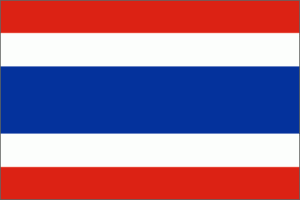
Flag of Thailand

by Sherri Smith

The first Thailand flag was created during the reign of King Rama II. This flag was chosen with the lucky symbol of a white elephant. The present Thailand flag, the Trai Rong or three colors was designed by King Rama VI. It was first used around 1920. The flag has five horizontal stripes in the colors red, white, blue, white and red, with the middle stripe being twice as wide as the other four. Red stands for nation, white represents religion, and the blue signifies the king. Nation-religion-king is an unofficial motto of Thailand.

Thailand Flag

The current flag was adopted on September 28, 1917 according to a royal decree in that year; however, didn’t become widely used until around the 1920s.

The Naval Ensign is similar to the National Flag except that is has a red circle in the middle of the flag and the circle reaches as far as the red stripes on the flag; both top and bottom. Within the circle stands a white elephant, in full regalia, facing the flagpole. This ensign was adopted in 1917 as well.

When the flag of Thailand is flown, it is often flanked by the two Royal flags of the King and Queen on each side. The Royal flags are flown slightly below the flag of Thailand. Thailand’s flag most closely resembles the flag of Costa Rica, which was adopted 11 years prior to Thailand’s. The difference is that the blue and red colors have been inverted.

Flag of Switzerland

by Sherri Smith

The flag of Switzerland is a red square with a white cross in the center of the flag. It was adopted from the flag of the Swiss canton of Schwyz (one of the first three Swiss cantons.) The flag was officially adopted as the flag of Switzerland on December 12, 1889; however, the design dates back to about 1480, which is long before Switzerland was even formed.

Flag of Switzerland

The flag of Switzerland stands for freedom, honor, and fidelity. An interesting thing to note is that the Swiss National Flag and the flag of the Vatican are the only square national flags. Additionally, for centuries, the Swiss people identified themselves with their cantons (regions). During the industrial age of the 19th and 20th centuries, there was huge migration inside Switzerland and many Swiss citizens could no longer identify with a specific canton, thus the national flag became more visible.

Another interesting fact is that when the International Committee of the Red Cross was founded to be a neutral institution to take care of the military or civil persons injured in war on the initiative of Henri Dunant and a Swiss general Dufour in 1864. Dufour proposed the reversal of the flag as an emblem. So the Red Cross flag is an inverted version of the flag of Switzerland.

The official use of the flag is to be displayed on federal, cantonal, and municipal buildings; however, there is no uniform pattern or regulation to its use. In private use, the flag is often shown as a display of patriotism and flown together with the cantonal and municipal flags.

Displaying the American Flag

by Kathy McCarthy

Whenever anyone displays an American Flag there is a certain protocol that should be respected. Follow these 8 helpful tips to make sure that your American Flag is properly displayed.

  1. The flag should only be flown when the weather is clear, unless the flag and its hardware are designed to withstand the elements.
  2. The flag should never be altered in any way. Never affix any letter, number or symbol to an American Flag.
  3. The flag should never be used as a wrapping or covering.
  4. The flag should not be used for any decoration in general, nor should it be used for any advertising purpose. It should also never be used as part of a costume or athletic uniform except when worn as a flag patch such as those found on uniforms of service personnel and members of patriotic organizations.
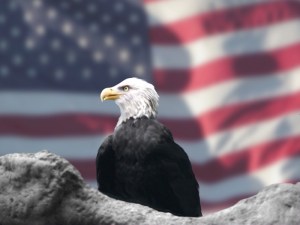
  5. Eagle and American Flag

  6. The flag should be always be lighted. It can be displayed in sunlight, but if it is to be displayed at night it must be lit with an appropriate flagpole light.
  7. The flag should never be displayed, lowered or dipped except when mourning a death or being used as a distress signal.
  8. The flag should never touch the ground. When lowering the flag it should be received by an attendant, properly folded and stored.
  9. The flag should be kept in good repair, and when a flag is so worn that it cannot be repaired, it should be destroyed with dignity by burning it.

By following these 8 suggestions, you can proudly fly your American Flag and honor those who bravely fought for the freedom that you enjoy today!

My Country, My Flag

by Kathy McCarthy

Whether you own a house or live in an apartment, you can always be proud of being an American by flying the American Flag. Whether you buy just the flag or a kit with all of the hardware and a pole, it’s pretty easy to fly your own flag. I know, because I just hung my first flag yesterday.

American Flag

I just moved into my first house. It’s a townhouse actually, but it’s all me. Last year I lived with a roommate, so I’m not really counting that place as my own. I grew up with my family  in a small community just outside of Sacramento, California. Though we lived in a neighborhood, our property was several acres. So every morning my Dad would carry the American Flag out to the front gate and place it on its hanger, and every evening my Mom would bring it in.

I never thought much of this little ritual until I moved out of my family’s house and no longer had a flag. I never realized that every day as I drove in an out of our driveway the flag reminded me of who I am and why I’m grateful to be an American.

I know that I have not sampled a lot of things that life has to offer just yet, but I do know enough to be grateful for all of the freedoms that I enjoy in my country. For example, I have not had to go to war, but many have, and I know that it’s to protect my rights, and me. When I see the flag it reminds me, and I am grateful.

Now I have hung my own flag in front of my house for all to see. I carry it out to hang it up in the morning, and I bring it in at nightfall. As I come and go throughout the day, I see it, and it reminds me that I am proud and grateful to be an American.

Indiana State Flag

The Flag of Indiana was originally designed and created by a man named Paul Hadley. The flag was officially adopted on May 31st, 1917 and interestingly enough, the Indiana Flag has remained completely unchanged ever since.

Indiana State Flag

The design of the flag is a bit peculiar- the Indiana Flag is very much unlike any other flag in the American Union.  The flag depicts a torch burning, emblazoned atop a blue background.  Around the torch are a number of stars – 13 in the outer ring of stars, and 19 stars in total.  The outer ring of stars on the Indiana Flag is meant to symbolize of course the 13 original American Colonies.  There are a total of 19 stars on the entire flag, which is representative of the idea that Indiana was the 19th state to enter into the United States of America.  There are also a number of rays projecting from the torch, which were originally intended to symbolize Indiana’s far-reaching influence.  The torch itself is meant to symbolize liberty and enlightenment, and placed directly about the torch sits the name of the state, “INDIANA”.

The Flag of Indiana was originally created in large part due to the celebration of the state’s centennial anniversary, when the Indiana General Assembly issued a resolution to create and adopt a state flag.  Until this time, the state of Indiana did not yet have a flag to call its own.  A contest was adopted and sponsored by the Daughers of the American Revolution, at the request of the Indiana lawmakers.  More than two hundred submissions were received for consideration by the Daughters, and upon further examination, Paul Hadley’s flag was chosen to be the winner.  The flag of Indiana was officially adopted the very next year by the state’s lawmakers on May 31, 1917.

Illinois State Flag

by Stacey Patrick

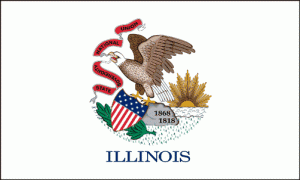
The Illinois Flag was originally designed by Lucy Derwint in 1912, and it consists of a very simple yet straightforward design. The background of the flag is solid white, and placed directly in the center, just as with many other state flags, sits the Great Seal of Illinois.

Illinois State Flag

The Illinois Flag was designed in the year 1912; however, it did not actually become the official state flag until a few years later in 1915. The flag was originally created in response to a contest held by the Daughters of the American Revolution. The contest was intended, of course, to have participants create potential designs for the Illinois Flag, a state that up until that time did not officially have its own banner.

The Great Seal of Illinois, which is emblazoned upon the flag,  features an eagle perched upon a rock holding a banner with the words “State Sovereignty” and “National Union”. The words “State Sovereignty” are placed below “National Union”, and interestingly enough, the word “Sovereignty” is intentionally written backwards, making it more difficult to read. Below the eagle on the seal sit the words “Aug. 26th 1818”, which marks the day that the first constitution was adopted in the state.

Farm Road in Illinois

The eagle is perched upon a grey rock, and on the rock appear two very important dates in Illinois history. The years “1818” and “1868” are displayed on the rock. In 1818, Illinois officially became a state, while 1868 marks the year that the Great Seal of Illinois was originally created. The name of the state, “ILLINOIS” sits directly beneath the Great Seal of Illinois on the flag. The flag of Illinois was finally passed through the House and Senate of Illinois on July 6, 1915.

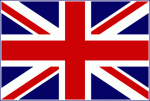
The Union Flag

The Union Flag is also known as the Union Jack. The flag is the national flag of the United Kingdom of Great Britain and Northern Ireland.

Union Flag

Other nations use some version of the Union Jack in their state flags. They are:

Additionally, you can find the Union Jack on the state flag of Hawaii and on both the 1910-1928 and 1928-1994 flags of South Africa.

Current Flag Days in the UK  – Union Flag should be flown on government buildings:

  • January 20 – Birthday of the Countess of Wessex
  • February 6 – Anniversary of the accession of Queen Elizabeth II
  • February 19 – Birthday of the Duke of York
  • Second Sunday in March – Commonwealth Day
  • March 10 – Birthday of Prince Edward, Earl of Wessex
  • April 21 – Birthday of Queen Elizabeth II
  • May 9 – Europe Day
  • June 2 – Anniversary of the coronation of Queen Elizabeth II
  • June (no fixed date) – Official Birthday of Queen Elizabeth II
  • July 17 – Birthday of the Duchess of Cornwall
  • August 15 – Birthday of the Princess Royal
  • Second Sunday in November – Remembrance Sunday
  • November 14 – Birthday of the Prince of Wales
  • November 20 – Anniversary of the Wedding of Queen Elizabeth II and Prince Philip, Duke of Edinburgh

Additionally, the Union flag should be flow in the following places on the specific days:

  • March 1 – Wales, for St. David’s Day
  • March 17 – Northern Ireland for St. Patrick’s Day
  • April 23 – England for St. George’s Day
  • September 3 – Scotland for Merchant Navy Day
  • The Day of the Opening of a Session of the Houses of Parliament, Greater London
  • The Day of the Prorogation of a Session of the Houses of Parliament, Greater London

Gadsden Flag: What’s Up With The Snake?

Whenever those Americans that don’t enjoy being “tread on” want to make their feelings known to anyone willing to listen, they’ll typically display the Gadsden Flag in some fashion. But what’s the deal with the rattlesnake? I mean, why not a lion or a bear? Personally, I’m much more afraid of spiders than any old rattlesnake.

Gadsden Flag

Well, folks, looks like we’ve got ol’ Ben Franklin to thank for the inspiration behind the Gadsden Flag, same as we’ve got him to thank for the lightning rod, Franklin stove, bifocal glasses, and, my own personal favorite, the flexible urinary catheter.

In 1754, during the time of the French and Indian War, Franklin published a woodcut of a snake chopped up into 8 sections in his Pennsylvania Gazette. This was meant to represent 8 different regions of the British colonies, with New England joined together to form the head and South Carolina bringing up the rear. Along with the image of the snake, Franklin also published the phrase “Join or Die”, which referred to his water polo team — just kidding, it obviously referred to the Union.

Join, or Die

As the American Revolution began to draw near, many people began using the rattlesnake as a symbol of the colonies, and even Paul Revere – yes, the famous “the British are coming” Paul Revere – got in on the act by adding the rattlesnake to the title of his paper, The Massachusetts Spy.

Finally, in December of 1775, Franklin published an essay in the Pennsylvania Journal. In the essay, he argued that the Colonies resembled a rattlesnake in that a rattlesnake never attacks without first giving a warning, or, in the words of Franklin, cautioning “against treading on her”.  However, according to Franklin, once in a fight, a rattlesnake never backs down. Also, Franklin believed that by keeping its fangs hidden inside its mouth, the rattlesnake wished to avoid any and all confrontations.

So those are the origins of the Gadsden Flag’s image of a mean rattlesnake. Stay tuned for more information on the Gadsden Flag!