
State Flags – Connecticut

CT

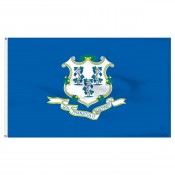
Just one week after Georgia was admitted into the Union, Connecticut became the fifth state to enter on January 9, 1788. Their state flag was adopted in 1897. On their state flag is a shield depicting three grapevinesCT Flag. These grapevines represent early English settlers in the state. Underneath the shield is a ribbon, written in Latin Qui Transtulit Sustinet, or He Who Transplanted Still Sustains, in English. This phrase is the state motto.
Unlike many of the previous states, Connecticut is not named after a person. This state is actually named after the Connecticut River, which that was named Quinnehtukqut by the Mohegans in the Algonquian language. This river was used by the Native Americans for many years who lived in the area.

The state’s capital is Hartford. A few historical events in Hartford include the first FM station to broadcast and The Boys and Girls Club which was founded in 1860. The city is only 18 square miles and houses 125,000 residents. Connecticut ranks the 48th largest state with just 5,544 square miles and 8 counties.

Presidential History: 43rd US President George W. Bush (2001-2009) was born in New Haven on July 6, 1946.

  • This state also has a Thames River, but not to be confused with the one in England!
  • One of the major industries in Connecticut is actually insurance with many insurance companies being founded. Because of this, Connecticut is known as the Insurance Capital of the World!

~CD

State Flags – Georgia

IMG_20150309_135339_649Georgia is the fourth state into the union. It became a state on January 2, 1788, right after the new year. Georgia is known as the Peach State due to a large amount of peaches that grow there (peaches became the official state fruit in 1995).

In my research, I learned that Georgia originally had a different state flag. Several versions, to be exact, but the most well-known version is the 1956-2001 flag.

The first flag consisted of the Confederate flag along with a blue background with the Great Seal of the State of Georgia. However, after flying for 45 years, the Georgia state flag was changed. The Confederate flag on the first state flag was controversial, reminding the people of Georgia of their darker days in history. The request to change the flag dates as far back as the 1980s. The request was to return to the pre-1956 design which was much like the then-current flag but with three stripes: two red, and one white.

The bill for a new flag was finally passed in January 2001. The new flag that would be flown over Georgia was designed by Cecil Alexander, an Atlanta based architect. The new flag consisted of a blue background along with the seal of the State of Georgia in a gold color. Around the seal are 13 white stars to represent the original 13 colonies. Underneath is a gold ribbon labeled “Georgia’s History” with five flags. The first flag is the original stars and stripes with just thirteen stars, next is one of the coat of arms designs. Then comes the 1920s flag, followed by the 1956-2001 flag, and a 2001-2003 version. Last but not least is the current flag of Georgia.

This 2001 incarnation of the state flag flew for just two years until 2003. While some were pleased with the new design, others were still not satisfied. Some felt it was an insult to their history and heritage. Finally, in May 2003, Governor Sonny Perdue signed House Bill No. 380 into law. The 2003 flag is reminiscent of the flag from the 1920s but the lower red stripe is longer and the blue is a little cut back as a result. This flag has finally won the favor of the people of Georgia.

Travel: Although Georgia is a coastal state, there are two islands to which you can actually drive: Tybee Island and Jekyll Island.

In addition to peaches, peanuts are also grown in this state.

~CD

State Flags – New Jersey

newjersey-printed-poly_1New Jersey places third into the union and as one of the original thirteen colonies. New Jersey is dubbed “The Garden State” and officially became a state on December 18, 1787.

The flag of New Jersey has a light yellow-brown background with part of the state seal in the center. The state seal features three plows inside a blue shield in between two women. The woman on the left is the Goddess of Liberty, who is holding a staff and the cap of freedom; on the opposite side is the Goddess of Agriculture, who holds the cornucopia full of food. Above the shield and the two woman is the head armor of a knight, a horse’s head, and blue filigrees. On the bottom is a ribbon which bears “”LIBERTY AND PROSPERITY” and “1776” (Random Fact: This state flag was adopted on March 26, 1896, a little less than 109 years after admission into the union).

New Jersey was given to James the Duke of York from his the brother, King Charles II of England. James later gave it to Sir George Carteret and Lord John Berkeley. James named New Jersey in honor of Carteret who was born in and was the former governor of Jersey, which is a British island in the English Channel.

trenton_battle_banner_06bThe Battle of Trenton was a small but important battle in the American Revolution, taking place in Trenton, NJ. In 1776, the day after Christmas and General George Washington’s Crossing of the Delaware, he led his Continental Army against Hessian soldiers. Very soon all the Hessians were captured with very little damage to our Army. This battle’s significance was its much-needed boost to the Continental Army’s morale. Reenactors come to Trenton each year to relive this victory.

eagle_01Today New Jersey boasts several bald eagle nests with action cams to protect this endangered species. Volunteers observe and collect helpful data, clocking in lots of hours noting courtship, mating, feeding, and other rituals.

Another fact: New Jersey is the 47th largest state in the United States with only 8,722 square miles.

Want more fun facts about New Jersey? Check out this website.