Canadian Gift Ideas

Looking for the perfect gift for your favorite Canadian? The United States Flag Store has the best Canadian flag gifts at the best prices. From patches and pins to hard hats and flag spinners, you’re sure to find a Canadian flag gift that fits your budget!

If you haven’t seen the United States Flag Store’s Country Spinner Flagpole Kit with Adjustable Brackets, this makes a perfect flag gift for any flag enthusiast. The kit includes a beautiful three-by-five foot polyester flag with metal grommets and a high-quality aluminum spinner that rotates so your flag won’t wrap around the pole. Adjustable aluminum brackets and EZ mount clips are also included. These kits are excellent for residential use inside or out and are available for as $19.50 each when you order ten or more kits!

If you’re looking for a smaller gift, the Canadian flag lapel pin or American-Canadian flag lapel pins are great choices. Available for as low as $0.75 each, these pins have an all-gold metal lacquered design, a metal clutch, and enamel finish. Even at a price this low, these pins are of better quality than many of our competitors!

The United States Flag Store has two fantastic Canadian flag decals. The decals are made of durable vinyl that is waterproof and printed with UV-blocking inks. The decals’ adhesive is nonpermanent, making them perfect for display on a car, trailer, boat, truck, or motorcycle. Choose from a basic Canadian flag or an oval decal with the letters “CDN” and Canadian flags on either side.

For your favorite Canadian construction worker, check out the United States Flag Store’s Canadian hard hat made by MSA. With a bright and attractive design, a superior finish, and MSA’s Fas-Trac suspension, this hard hat brings together Canadian pride and superior safety. These Maple Leaf hats are available for as low as $27.08 each: almost $9 off the list price!

Be sure to check out the United States Flag Store’s other Canadian flag gift ideas, including stickers, temporary tattoos, and patches to satisfy all your Maple Leaf needs!
Flag of Virginia

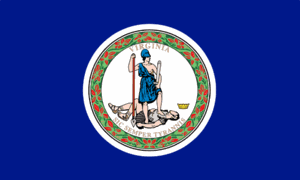
The Flag of the Commonwealth of Virginia was adopted on January 31, 1861 at the beginning of the United States Civil War. The flag is rectangular with a blue background. In the center of the flag is the seal of Virginia enclosed in a white circle. Virginia’s seal was designed by George Mason, known as the “Father of the Bill of Rights” and George Wythe, whose signature appears on the United States Declaration of Independence.

The seal depicted on the flag of Virginia features a woman, personifying Virtus, or virtue in ancient Roman times. Virtus is a symbol of peace, and she stands with her sword in its sheath resting her weight on a long spear, indicating a victorious battle. Her bare foot rests on Tyrannis, or tyranny, represented by a man in a purple robe and sandals with a fallen crown. The scene symbolizes the Virginia’s—and the United States’—defeat of the British government during the American Revolution. The broken chain in Tyranny’s left hand further emphasizes Great Britain’s defeat by the American Colonies. Virginia is the only state besides New York to include a crown in its flag.

The word “Virginia” appears on top of the seal, and the Latin phrase, Sic semper tyrannis, appears at the bottom. The motto literally means “Thus Always to Tyrants,” and describes the scene depicted on the seal. The phrase’s origins, like the image, date back to Roman times whe Marcus Junius Brutus assassinated the tyrant Julius Caesar. The phrase has been used to ill effect as well during notable U.S. assassinations. John Wilkes Booth shouted, Sic semper tyrannis, when he assassinated Abraham Lincoln at Ford’s Theatre on April 14, 1865. Timothy McVeigh wore a T-shirt with the phrase and a picture of President Lincoln when he was arrested after the Oklahom City bombing in April 1995. In Virginia, however, saying Sic semper tyrannis, is a common joke dating back to the Civil War and means “get your foot off my neck.”

NHL Flags

The NHL season is in full swing, and what better way to show your team spirit than with an NHL Flag from the U.S. Flag Store. The U.S. Flag Store’s great selection of National Hockey League flags are officially licensed by the NHL and made of the finest quality polyester for indoor or outdoor use.
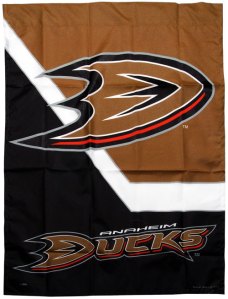
The NHL Banner Flags are printed on durable polyester and measure 27” x 37”. With a 2.5” pole sleeve, they can either be hung vertically from an outdoor flagpole or mounted on a wall inside for decoration.  The U.S. Flag store has thirty different NHL flags, so you’re sure to find your favorite team’s flag. Some flags are simple, like the Detroit Red Wings Banner Flag, featuring the red-winged wheel and a red and black background. Other flags are flashier and sure to stand out on your lawn. The Florida Panther’s Banner Flag, for example, features a panther lunging outwards, an NHL hockey puck, and a brightly colored background.

There’s no better way to show your team spirit on the go than with an NHL Car Flag. Designed to withstand wind and weather, these flags are made with a durable knit polyester fabric. Flags are double sided, measure 11.75” x 14,” and are mounted on a 20.5” vinyl pole. The U.S. Flag store tried many different suppliers, but finally found a flag that is suitable for highway driving. Keep in mind, however, that frequent highway driving significantly shortens the flag’s lifespan, so you might want to keep your flag inside the far when driving at high speeds. The U.S. Flag Store’s NHL Car Flags are an excellent choice and value: you might find flags like this at stores or other websites for up to $20 each. The U.S. Flag Store provides great value by purchasing directly from the manufacturer and providing these high-quality flags for only $13.95 each! Order yours today and support your favorite hockey team all season long!

Flag of Norway

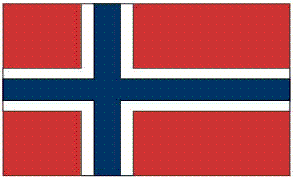
The flag of Norway was adopted on July 13, 1821. It is rectangular with a red background and a blue Scandinavian cross that is outlined in white.  The cross covers the entirety of the flag but the center of the cross is slightly to the left side of the flag.  The design and colors of the flag resemble the Dannebrog, or the flag of Denmark, except that the Norwegian flag features a blue and white cross while the Donnebrog is plain white.
The colors of the Norwegian are based on the Coat of Arms of Norway, which features a red shield with a golden lion holding an axe.  On top of the shield is a bold crown and a red escutcheon.  The Coat of Arms of Norway originated in the Middle Ages and is one of the oldest coats of arms in Europe.

The history of the Norwegian flag is somewhat unclear, although the flag may have originated during the reign of Inge Haraldsson in the early twelfth century.  During Inge’s rule, a flag with a red lion on a gold background was used.  In the late thirteenth century, Erik II of Norway flew a flag with a golden lion on a red background.  This flag is now known as the Royal Standard of Norway; it is used by the King of Norway and was officially adopted on November 15, 1905.

From 1536 until 1814, Norway united with the Kingdom of Denmark and used the Dannebrog, a red flag with a white Scandanavian cross. When Norway separated from Denmark in 1814, it continued to fly the Dannebrog, but also included the golden lion from its own coat of arms in the upper left corner of the flag.

Fredrik Meltzer, a member of the Norwegian parliament, designed the current flag of Norway. Although the Norwegian chambers approved the design, the King of Norway approved the flag for civilian use only. In 1899, after three consecutive chamber sessions, the flag was finally approved for use as the country’s national banner.

Flag of Belgium

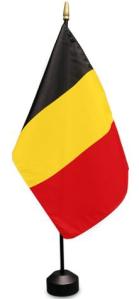
The flag of Belgium was adopted on January 23, 1831. The flag is rectangular with three vertical stripes: a black stripe on the left, a yellow stripe in the center, and a red stripe on the right. The official ratio of the Belgian flag is 13:15 (almost square, but not quite), but due to its unusual proportions, the flag is rarely produced this way and is usually seen in a 2:3 ratio.
The colors of the Belgian flag are based on the colors of Duchy of Brabant’s coat of arms, which features a black shield and a yellow lion with red claws and a red tongue.  The Duchy of Brabant was located in the historic “Low Countries,” and is now known as three present-day Belgian provinces: Flemish Brabant, Walloon Brabant, and Antwerp.  The colors of the Belgian flag are the same as those in the German flag and the vertical tricolor design of the flag is most similar to that of France.

Several flags preceded the current Belgian flag.  When Belgium was part of Lotharingia in the ninth century, the territory flew a rectangular flag with two horizontal red stripes, one across the top and one across the bottom, and a white area in the center.  When the area came under Spanish rule in the 1500s, a yellow stripe was added to the flag. During this time period, Belgium’s official colors became red, white, and yellow.

When Belgium was under Austria’s rule in the eighteenth century, the Emperor required Belgium to fly the Austrian flag, which was red and white.  Belgians were opposed to this, however, and citizens began wearing red, black, and yellow cockades, knots of colored ribbons to display national pride.

The Belgian Revolution began in August 1830 when a French flag was waved at the Brussels City Hall.  Shortly after this incident, some Belgian revolutionaries created a horizontal-striped red, yellow, and black flag at a fabric store.  By January of 1831, the stripes were changed to vertical and the flag was made official.

United States National Flag Day

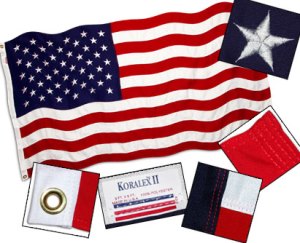
Flag Days exist all around the world, but the United States Flag Day commemorates Congress’s adoption of the 13-stripe, 13-star, red, white, and blue flag on June 14, 1777. The United States Flag Day’s beginnings date back to 1885, when nineteen-year old school teacher Bernard J. Cigrand placed an American flag on his desk and asked his students to write essays about the significance of the Stars and Stripes flag. Cigrand quickly became devoted to spreading the observance of the United States Flag Day nationwide. Finally, on May 30, 1916, President Woodrow Wilson called for national observance of Flag Day. Flag Day became official when President Truman signed an Act of Congress in 1949 that designated National Flag Day as June 14 of each year.

Although Cigrand is often credited with the creation of the United States Flag Day, other people have also contributed to its existence. In 1861, four years before Cigrand’s classroom Flag Day, the book Kansas: A Cyclopedia of State History credited George Morris of Hartford, Connecticut with suggesting the idea for a Flag Day. Hartford, Connecticut actually observed the suggested Flag Day in 1861 as a day for praying for the U.S. Army and the Government.

In 1888, Collier Township, Pennsylvania resident William T. Kerr founded and became the national chairman of the American Flag Day Association of Western Pennsylvania. Kerr led the organization for fifty years and attended President Truman’s signing of the official Flag Day Act in 1949.

In 1889, George Bolch celebrated Flag Day when he was the principal of a free kindergarten. Instead of recognizing Cigrand’s hometown of Waubeka, Wisconsin, as the official birthplace of the United States Flag Day, some recognize Philadelphia as Flag Day’s original city. In 1893, Elizabeth Duane Gillespie, President of the Colonial Dames of Philadelphia, tried to mandate the that all public buildings in Philadelphia fly the American Flag. Pennsylvania became the first state to make Flag Day official when they declared it a legal holiday in 1937.

Flag Day, although not a legal holiday, is celebrated across the country to varying degrees. Government buildings fly the flag at full mast and many towns organize parades, ceremonial flag raisings, and group recitations of the Pledge of Allegiance and the Star-Spangled Banner.

The Flag of Greece

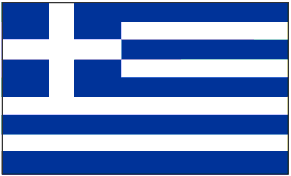
The origins of the Greek flag that we know today can be traced back to the Hellenic Revolution in 1821 during which the Greeks declared their independence from the Ottoman Empire. The First National Assembly at Epidaurus adopted the current design, the “sea” flag, differing from the land flag (a white cross on a blue backdrop) and the merchant marine flag (a blue cross on a white background).

The origins of the Greek flag’s two components, a cross and stripes, are difficult to trace.  Both elements have ancient historical connotations, but there are no records from the National Assembly at Epidaurus explaining the exact reasons for the flag’s key features.

There have been dozens of versions of the Greek flag since the early 19th century, but the cross has always been a central feature.  Many versions of the Greek flag feature only a cross (no stripes), sometimes with a coat of arms or crown at the center of the cross displaying allegiance to a particular leader.  The cross on today’s Greek flag occupies the region in the top left corner, and is a white cross with a blue background, much like a mini-version of the old Greek land flag.  The cross, although Greece is now a democracy, demonstrates the Greek people’s devotion to and respect for the Greek Orthodox Church.  During the Ottoman rule, the Greek Orthodox Church helped the Greeks to retain their language, religion, and ethnic identity and Christianity is still the predominant religion among Greeks.

The Greek flag has nine blue and white stripes and there are two popular beliefs regarding the number nine.  There are nine letters in the Greek word for freedom, eleytheria.  There are also nine syllables in the phrase, “Eleftheria i Thanatos,” which translates as “Liberty or Death,” and was the motto during the Hellenic Revolution against the Ottoman Empire in 1821.   And despite popular beliefs, some simply believe that the design of the Greek emulates other prominent flags, such as the British East India Company’s 17th-century flag or the U.S. flag.

The blue and white colors of the flag symbolize the blue water and white-capped waves of the sea that surround the Greek peninsula.  According to Greek mythology, Aphrodite, the Goddess of Love, emerged from the waves of the Aegean sea.

Indiana State Flag

The Flag of Indiana was originally designed and created by a man named Paul Hadley. The flag was officially adopted on May 31st, 1917 and interestingly enough, the Indiana Flag has remained completely unchanged ever since.

Indiana State Flag

The design of the flag is a bit peculiar- the Indiana Flag is very much unlike any other flag in the American Union.  The flag depicts a torch burning, emblazoned atop a blue background.  Around the torch are a number of stars – 13 in the outer ring of stars, and 19 stars in total.  The outer ring of stars on the Indiana Flag is meant to symbolize of course the 13 original American Colonies.  There are a total of 19 stars on the entire flag, which is representative of the idea that Indiana was the 19th state to enter into the United States of America.  There are also a number of rays projecting from the torch, which were originally intended to symbolize Indiana’s far-reaching influence.  The torch itself is meant to symbolize liberty and enlightenment, and placed directly about the torch sits the name of the state, “INDIANA”.

The Flag of Indiana was originally created in large part due to the celebration of the state’s centennial anniversary, when the Indiana General Assembly issued a resolution to create and adopt a state flag.  Until this time, the state of Indiana did not yet have a flag to call its own.  A contest was adopted and sponsored by the Daughers of the American Revolution, at the request of the Indiana lawmakers.  More than two hundred submissions were received for consideration by the Daughters, and upon further examination, Paul Hadley’s flag was chosen to be the winner.  The flag of Indiana was officially adopted the very next year by the state’s lawmakers on May 31, 1917.

Solar Powered Flag Light

When passing by a court house or post office, you might stop some times and gaze at the giant flag waving proudly out front. Regardless of what your feelings are about the government and politicians, or any current event going on in our country, there’s still something humbling about that red, white, and blue symbol of freedom. We should all take a moment no and then to admire the US flag, and to make sure our children and grand children know what the United States flag stands for.

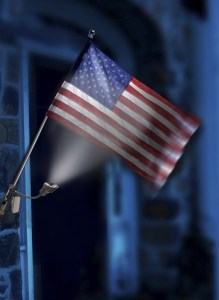
Solar Powered Flag LightProud Americans will often show their stubborn respect for this nation’s history by displaying that flag in his or her own home. But sometimes, that’s just not enough. If you look at a US flag posted outside a government building, you’ll notice that the flag is lit up, even at night.

So, when you really want to show your American pride to your neighbors and passing cars, install a solar powered flag light.

Solar Powered Flag Lights are a Low Cost Alternative to a Porch Light

Maybe American pride alone isn’t reason enough to install a flag light, but there are other benefits to consider as well. Solar powered porch lights can be installed quickly and easily onto any flagpole,  in your yard as well as on your porch, deck, pool, or patio area.

Although the light generated from a solar powered flag light is not enough to annoy your neighbors, it is just bright enough to create after hour lighting in the location of your preference. And, obviously, this outdoor lighting will not run up your utility bill because it is solar powered.

Show off Team Spirit with a Solar Powered Flag Light!

Having a sports rivalry battle with your neighbor? Proudly display your favorite sports team flag in your front yard, accentuated with a solar powered flag light, to remind everyone that your team is the greatest!