
The original flag of Guatemala was adopted on August 17, 1871, and the current version was adopted in 1968. The flag is rectangular and divided into three vertical fields. The left and right fields are sky blue and the center field is white with the Guatemalan coat of arms in the center.

The blue and white colors on the flag of Guatemala represent the original colors used by the Federal Republic of Central America: a republican democracy that spanned what is now Costa Rica, Nicaragua, Honduras, El Salvador, Guatemala, and the Mexican state of Chiapas. The blue stripes on the side of the flag also represent the Pacific Ocean and the Caribbean Sea, the two large bodies of water that border Guatemala. The white symbolizes peace and purity.
In 1968, the Guatemalan coat of arms was added to the center of the flag. The coat of arms contains five main elements. The bird is the Resplendent Quetzal, and is a species distinct to Central America and also symbolizes liberty. The scroll contains the phrase, “Libertad 15 de Septiembre de 1821,” meaning “September 15, 1821 is that date of Central America’s independence from Spain.” The crossed rifles with bayonets represent the Guatemalan people’s willingness to defend their country by force if necessary. The crossed swords represent honor and the laurel branches, common to many coats of arms, signify victory.
Guatemala used several different flags between its independence from Spain in 1821 and the adoption of its current flag. When Guatemala was part of the Federal Republic of Central America (1825-1838), it flew a blue and white tricolor flag, but with horizontal stripes instead of vertical stripes. After the dissolution of the Federal Republic, Guatemala flew the same tricolor but with a different coat of arms in the center until 1851. When a pro-Spanish faction took over Guatemala in 1851, red and yellow stripes were included in the Guatemalan flag until 1871.
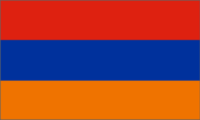 The colors on the
 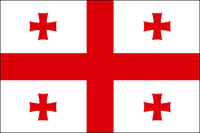 The
The 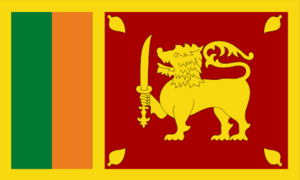
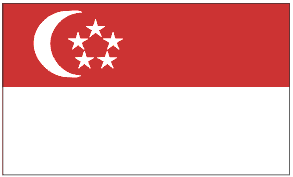

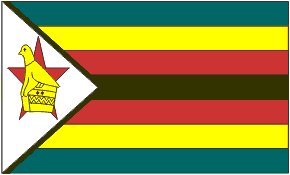 The flag of Zimbabwe was adopted on April 18, 1980, when Zimbabwe’s status as an independent nation was officially recognized. The flag is a rectangular shape with seven horizontal stripes of green, yellow, red, and black. From the stripes are in mirror image order and are arranged in the following order from top to bottom: green, yellow, red, black, red, yellow, green. On the left side of the flag is a white triangle with a black border. Inside the white triangle is a soapstone bird behind a red star.
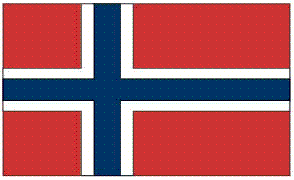 The flag of Norway was adopted on July 13, 1821. It is rectangular with a red background and a blue Scandinavian cross that is outlined in white. The cross covers the entirety of the flag but the center of the cross is slightly to the left side of the flag. The design and colors of the flag resemble the Dannebrog, or the flag of Denmark, except that the Norwegian flag features a blue and white cross while the Donnebrog is plain white.
 Flag Blog