Flag of Thailand

by Sherri Smith

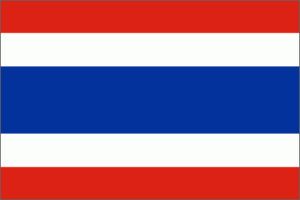
The first Thailand flag was created during the reign of King Rama II. This flag was chosen with the lucky symbol of a white elephant. The present Thailand flag, the Trai Rong or three colors was designed by King Rama VI. It was first used around 1920. The flag has five horizontal stripes in the colors red, white, blue, white and red, with the middle stripe being twice as wide as the other four. Red stands for nation, white represents religion, and the blue signifies the king. Nation-religion-king is an unofficial motto of Thailand.
Thailand Flag

The current flag was adopted on September 28, 1917 according to a royal decree in that year; however, didn’t become widely used until around the 1920s.

The Naval Ensign is similar to the National Flag except that is has a red circle in the middle of the flag and the circle reaches as far as the red stripes on the flag; both top and bottom. Within the circle stands a white elephant, in full regalia, facing the flagpole. This ensign was adopted in 1917 as well.

When the flag of Thailand is flown, it is often flanked by the two Royal flags of the King and Queen on each side. The Royal flags are flown slightly below the flag of Thailand. Thailand’s flag most closely resembles the flag of Costa Rica, which was adopted 11 years prior to Thailand’s. The difference is that the blue and red colors have been inverted.
Flag of Switzerland

by Sherri Smith

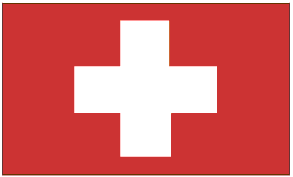
The flag of Switzerland is a red square with a white cross in the center of the flag. It was adopted from the flag of the Swiss canton of Schwyz (one of the first three Swiss cantons.) The flag was officially adopted as the flag of Switzerland on December 12, 1889; however, the design dates back to about 1480, which is long before Switzerland was even formed.

Flag of Switzerland

The flag of Switzerland stands for freedom, honor, and fidelity. An interesting thing to note is that the Swiss National Flag and the flag of the Vatican are the only square national flags. Additionally, for centuries, the Swiss people identified themselves with their cantons (regions). During the industrial age of the 19th and 20th centuries, there was huge migration inside Switzerland and many Swiss citizens could no longer identify with a specific canton, thus the national flag became more visible.

Another interesting fact is that when the International Committee of the Red Cross was founded to be a neutral institution to take care of the military or civil persons injured in war on the initiative of Henri Dunant and a Swiss general Dufour in 1864. Dufour proposed the reversal of the flag as an emblem. So the Red Cross flag is an inverted version of the flag of Switzerland.

The official use of the flag is to be displayed on federal, cantonal, and municipal buildings; however, there is no uniform pattern or regulation to its use. In private use, the flag is often shown as a display of patriotism and flown together with the cantonal and municipal flags.

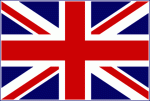
The Union Flag

The Union Flag is also known as the Union Jack. The flag is the national flag of the United Kingdom of Great Britain and Northern Ireland.

Union Flag

Other nations use some version of the Union Jack in their state flags. They are:

Additionally, you can find the Union Jack on the state flag of Hawaii and on both the 1910-1928 and 1928-1994 flags of South Africa.

Current Flag Days in the UK  – Union Flag should be flown on government buildings:

  • January 20 – Birthday of the Countess of Wessex
  • February 6 – Anniversary of the accession of Queen Elizabeth II
  • February 19 – Birthday of the Duke of York
  • Second Sunday in March – Commonwealth Day
  • March 10 – Birthday of Prince Edward, Earl of Wessex
  • April 21 – Birthday of Queen Elizabeth II
  • May 9 – Europe Day
  • June 2 – Anniversary of the coronation of Queen Elizabeth II
  • June (no fixed date) – Official Birthday of Queen Elizabeth II
  • July 17 – Birthday of the Duchess of Cornwall
  • August 15 – Birthday of the Princess Royal
  • Second Sunday in November – Remembrance Sunday
  • November 14 – Birthday of the Prince of Wales
  • November 20 – Anniversary of the Wedding of Queen Elizabeth II and Prince Philip, Duke of Edinburgh

Additionally, the Union flag should be flow in the following places on the specific days:

  • March 1 – Wales, for St. David’s Day
  • March 17 – Northern Ireland for St. Patrick’s Day
  • April 23 – England for St. George’s Day
  • September 3 – Scotland for Merchant Navy Day
  • The Day of the Opening of a Session of the Houses of Parliament, Greater London
  • The Day of the Prorogation of a Session of the Houses of Parliament, Greater London

Ireland (Irish) Flag

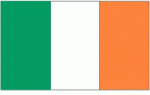
The national flag of Ireland has three vertical stripes with the colors of green (at the hoist), white, and orange. As such, it’s often known as the tricolor. The green is said to represent the Gaelic tradition, the orange is for supporters of William of Orange, and the white in the center signifies a lasting truce between the green and the orange; thus living in peace.

Irish FlagThe flag was previously the flag of the Irish Free State and it was adopted in 1919 unilaterally during the war of independence by the Irish Republic. Subsequently, the Irish Free State also adopted the flag and later it was given constitutional status in 1937 by the Constitution of Ireland. Many nationalists feel the flag is the national flag of Ireland and as such is flown (controversially) in Northern Ireland by nationalists and the Gaelic Athletic Association.
Some protocols for the Irish Flag

  • The flag should never touch the ground, trail in water, or become tangled in any obstacles.
  • When the flag has become worn or frayed, it should no longer be used.
  • It should be displayed in the open only between sunrise and sunset, except for its use during certain events and then only for the duration of the vent.
  • The flag should never be defaced.
  • It should always be treated with respect.
  • The flag should not be draped on cars, trains, boats, or other modes of transportation.
  • It should not be carried flat, rather it should be aloft and free; except when used to drape a coffin.

It is the general practice to fly the national flag daily at all military posts and from a restricted number of significant state buildings. The European flag is flown alongside the national flag on all official buildings and in most locations where the Irish flag is flown over buildings. The national flag is often flown at half-mast on the death of a national or international figure on all prominent government buildings equipped with a flag pole. When the national flag is flown at half-mast, no other flag should be flown at half-mast.

Flag of Spain

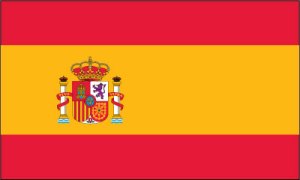
The Flag of Spain is defined in the Spanish Constitution of 1978 as consisting of three horizontal stripes — red, yellow, and red. The yellow stripe is twice as wide as the red stripes. The origin of the current flag is from the Naval Ensign of 1785. Its use is pretty limited.

Spanish Flag

The National Flag is used for the state and war flags and must be charged with the Spanish coat of arms. The original version was adopted in 1785 but the current version was adopted on October 5, 1981. This flag is the more commonly used flag in Spain.

Flag Protocol: The flag can only be flown from public buildings, private homes, ships, businesses, town squares, or official ceremonies horizontally. Although the flag should be flown from sunrise to sunset (like most other countries), Spanish Government Offices in Spain and abroad must fly the flag 24-7 with the flag being properly illuminated at night. The flags cannot be spoiled or damaged in any way.

When the Spanish flag is flown with other flags, the order should be the national flag, the flags of foreign states, the flag of the European Union, international NGOs, military and government standards, autonomous communities’ flags, city flags, and any others.

When mourning activities are planned, the flag can be flown at half-mast or a black ribbon can be attached to the flag that is permanently attached to a staff. During a funeral ceremony, the flag is allowed to be draped over the casket of government officials, soldiers, and persons designated by an act of the President. Those flags are then folded and presented to the family before burial

Jamaican Flag

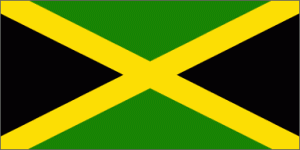
The Jamaican flag was adopted on August 6, 1962, the original Jamaican Independence Day. It was then that Jamaica gained its independence from the British-protected Federation of the West Indies.

Jamaican Flag
Jamaican Flag

The flag features a diagonal cross which divides the flag into four sections, two of which are green and two of which are black. The black is said to symbolize the strength and creativity of the people, which has allowed them to overcome great obstacles. The yellow stands for sunshine and Jamaica’s natural wealth. The green is for the lush and rich vegetation of the island. This current design was the result of a national competition where ideas were sent in from the public. These colors are all Pan-African colors and are used to pay tribute to Jamaica’s significant African heritage.

Jamaican flag etiquette requires that primary flag etiquette be used. It should always be the primary flag flown and in good condition. The Jamaican government provides the following etiquette:

Code for use of the Jamaican Flag
• The Jamaican flag should never be allowed to touch the ground or floor. It should not be flown or used only for decorative purposes on anything that is for temporary use and is likely to be discarded, except on state occasions.
• The flag should never be smaller than any other flag flown at the same time.
• When the flag becomes worn and must be replaced, burn it.
• Do not place any other flag above or to the right of the Jamaican flag, except at foreign embassies, consulates and missions.
• Do not raise any foreign flag publicly, unless the Jamaican flag is also flown, except at foreign embassies, consulates and missions.
• The flag shouldn’t be draped over vehicles, except on military, police and state occasions.”

The Venezuelan Flag

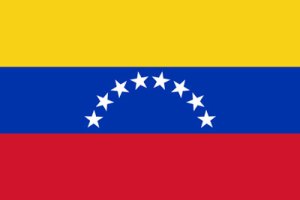
The Flag of Venezuela was officially adopted on March 12, 2006; however, it dates back to 1811 and the nation’s struggle for independence. The design includes a horizontal tricolor of yellow, blue, and red. Modifications added a set of stars, changed the placement of the stars, and the number of stars, as well as adding an optional coat of arms in the upper-left corner.

Venezuelan Flag
Venezuelan Flag

The flag is pretty much one that was designed by Francisco de Miranda. His flag was also the inspiration for the flags of Columbia and Ecuador. The original design was first flown on March 12, 1806 in Jacmel, Haiti during the final leg of Miranda’s voyage to Venezuela. The flag was first flown on Venezuelan soil on August 3, 1806 at Ka Vela de Coro.  Until August 3, 2006, Flag Day was celebrated on March 12. Since then, it has been celebrated on August 3rd.

Traditionally, the color yellow represents wealth of the land, the blue is for courage, and the red is for independence from Spain. The stars represent colonial provinces of Barcelona, Barinas, Caracas, Cumana, Margarita, Merida, Trujillo, and Guayana.

Caracas, Venezuela
Caracas, Venezuela

In 1954, the Law of the National Flag, Coat of Arms, and Anthem added the Coat of Arms to the flag. The coat was not incorporated into the Civil or Maritime Flag as they are intended for non-governmental purposes. The flag is to be flown every day by legally registered public institutions from 7:00 am to 6:00 pm.

Five Stars for United States Flag Store

I really enjoy browsing the United States Flag Store! Do not let the name fool you; there are decorative and international flags too. I used to think flags were only for political enthusiasts. The United States Flag Store has something for everyone. Flags are not simply patriotic; they can be whimsical and fun too!

Decorative Flag

The United States Flag Store introduced me to an entirely new view of flags. There is an extensive selection to choose from. You can select a flag or banner to express your enthusiasm for football, NASCAR, holidays, seasons, and so much more. You can also custom design a banner or flag to your liking. How fun is that? Decoration for your home designed by you.

I found the quality of the decorative flags from the United States Flag Store to be impeccable. It featured aesthetically pleasing appliqué and embroidery. The colors are very striking and attract lots of attention. What is better than that? Your house can be the best decorated on the block with a flag or banner from the United States Flag Store.

You can also purchase accessories for flags and banners. It is truly one-stop shopping at the United States Flag Store. Isn’t it frustrating when your favorite store sells an item and without the accessories to accompany it? That was not a problem shopping at the United States Flag Store. A banner flagpole kit was the perfect accessory to make my yard look great. The kit included everything I needed to display my banner flag.

In addition to amazing selection, accessories, and superior quality – the prices are very reasonable. You will be just as impressed if not more as I am with this internet retailer. Overall, I give the United States Store a five-star rating for selection, quality, and price. I recommend to anyone looking for a unique decorative addition to their home visit the United States Flag Store.