College Football 2012

NCAA Football season is officially here! Show your support for your favorite college football team with a great flag from the United States Flag Store. All flags from the United States Flag Store are manufactured in the United States from top-quality materials and available at unbeatable prices. Read on to learn more about some of the football flags available at the United States Flag Store.

Banner flags are designed to hang vertically, making them perfect for displaying outside your house. Manufactured from heavy-duty, weather-resistant nylon or polyester, these flags are durable and feature vibrant colors. Choose from the following sports teams:

  • Syracuse University
  • Indiana University
  • Purdue University
  • Notre Dame (old-fashioned or fighting Irish)
  • San Diego State University
  • Stanford University
  • Georgia Tech
  • University of Louisville
  • University of Minnesota
  • Seton Hall University
  • St. John’s University
  • Wake Forest University
  • Xavier University
  • University of Cincinnati

These great flag are available at discounted prices as low as $15.30, so order yours now to show your college football pride!

If you’re looking for a horizontal flag, check out the outdoor NCAA sports flags from the United States Flag Store. These flags are larger than the banner flags, measuring 3 feet by 5 feet and are officially licensed by the NCAA. Flags are made of durable polyester so they are suitable for outdoor use and come with attached D-rings for easy hanging. Here are just some of the NCAA teams you can choose from:

  • Texas A & M
  • University of Michigan
  • Michigan State University
  • Ohio State University
  • University of Kentucky
  • Penn State University
  • University of South Carolina
  • University of Florida
  • Louisiana State University
  • University of Oklahoma
  • University of Georgia
  • University of Missouri
  • University of Maryland
  • Auburn University
  • University of Tennessee

These flags are available at the United State Flag Store’s website for just $28.95. Order yours today!

Fall Decorative Banners and Flags

Back-to-school season is here and fall is just around the corner. Celebrate the season with a decorative flag or banner flag from the United States Flag Store. All decorative and banner flags from the United States flag store are made of the highest quality materials and are available at unbeatable prices. Here are just a few of the terrific fall flags available online.

Whether you’re a teacher or just love the back-to-school season, the School Banner Flag is the perfect outdoor décor. The flag features a yellow border with a chalkboard in the center. The letters A B C D E F and numbers 1 +1 scroll across the top of the flag while a globe, crayons, apple, textbooks, and a ruler decorate the rest of the banner. This flag is available from the United States Flag Store for just $16.95.

The School Days Banner Flag is another great back-to-school flag. This flag features a ruler at the top, textbook at the bottom, and a background of crayons. A shiny red apple with an “A+” appears in front of the crayons along with a No. 2 pencil. Order this great flag from the United States Flag Store for just $16.95.

The Rustic Birdhouse Flag is perfect for any nature or bird lover. The flag’s images include falling autumn leaves and a wooden birdhouse. A bright red cardinal and finch appear in front of the birdhouse, which is decorated with an American flag. This beautiful flag is available at the United States Flag Store for only $21.00

The Rusts of Autumn Flag is a great banner to transition between summer and fall. The flag features a black background with a border of autumn colors. Fall mums and sunflowers are featured on the flag and the text “WELCOME” is displayed vertically. This beautiful flag is available for only $20.99 at the United States Flag Store’s website.

These are just a few of the beautiful decorative flags available at the United States Flag Store to celebrate the back-to-school season and the arrival of fall. Visit the website for the complete selection!

Flag of Colorado


In memory of the victims of last week’s violent shooting in Aurora, Colorado, stand united with our friends and neighbors in Colorado by flying the Colorado state flag.

The flag of the state of Colorado was adopted on June 5, 1911. The flag is rectangular with three horizontal stripes. The top and bottom stripes are blue and the middle stripe is white. Just to the left of the flag’s center point is a block letter red “C” that is filled with a gold circle.

Andrew Carlisle Johnson designed Colorado’s state flag during the year of the flag’s adoption. Previously, the flag of Colorado featured the state seal on a blue background. When the flag was originally adopted, the block letter C with the gold circle was smaller, and the entire graphic fit inside the white stripe. In 1964, the specifications for the flag were changed and the diameter of the gold disc is as large as the white center stripe.

The details of the Colorado state flag hold significance for the residents of this state. The blue stripes symbolize the big, clear blue skies of Colorado. The white stripe represents snow on the mountaintops of Colorado, some of which lasts all year round. The gold disc symbolizes the Colorado sunshine and the red C represents the color of some of Colorado’s soil.

Flag of Hawaii

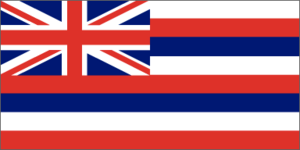
The flag of Hawaii was adopted on December 29, 1945. The flag is somewhat of a combination of the British flag and the flag of the United States of America. The flag is rectangular and has eight horizontal stripes that alternate in red, white, and blue colors. The Union Flag of the United Kingdom appears in the upper left corner of the flag. The flag of Hawaii is unique in that it is the only state flag in the United States to feature the Union Flag in its design.

Although the flag’s design is simple, the horizontal stripes are symbolic to the state of Hawaii. Each of the eight stripes symbolize one of Hawaii’s major islands: Hawai’I, O’ahu, Kaua’I, Kaho’olawe, Lana’i, Maui, Moloka’I, and Ni’ihau. The order of the stripes is white, red, blue, white, red, blue, white red, and these colors were standardized in 1843. The Union Flag acknowledges the British Empire’s influence on the state.

Although the flag was not adopted until 1945, the flag’s origins date back to the early 1800s when Hawaii was ruled by King Kamehameha I. According to one story, the King flew a British flag—the Red Ensign with the Union emblem in the upper left corner and a red background—that was the British explorer George Vancouver gave him as a symbol of friendship with King George III. When Kamehameha’s advisor told him that the Union flag could bring Hawaii into foreign conflicts, he stopped displaying the flag, and in 1816, commissioned his own flag. The 1816 flag of Hawaii, most likely designed by one of the Hawaiian Navy commanders, evolved into the current Hawaiian flag. The flag’s design is based on the British East India Company’s flag, which features the Union flag in the upper left corner with red and white horizontal stripes.

State Flag of Alaska

The flag of Alaska was adopted on July 9, 1927, more than three decades before Alaska became an official state of the U.S. The flag is simple but elegant. The flag is rectangular and feature a dark blue night sky background. Towards the bottom left corner of the flag, the Big Dipper constellation is pictured with gold stars. The North Star, also in gold, is depicted in the upper right corner.

In January 1927, the Alaska Department of the American Legion decided to create an initiative for a state flag, but, instead of allowing adults to design the flag, the Legion asked Alaskan children in grades seven through twelve to submit designs for the flag. Designs were first judged locally, and then 142 designs were submitted to Juneau for the final competition.

Although most of the children’s designs featured polar bears, Alaska’s seal, the midnight sun, the northern lights, or gold pans, the judges decided that the design created by Benny Benson, a thirteen-year-old child who lived at the Jesse Lee Home for Children in Seward Alaska’s design should represent the Alaskan territory. The design of Alaska’s current state flag has remained unchanged since Benson’s designed was adopted. Benson received $1000 for the flag as well as an engraved watch.

Benson also described the symbolism of the flag himself. According to Benson, the blue background represents not only the Alaskan sky, but also the forget-me-not, a flower native to Alaska that is now the state’s official flower. The North Star symbolizes Alaska’s future as well as the fact that Alaska is the northernmost state in the Union. Finally, the Big Dipper symbolizes the strength of Alaska and its people.

Flag of the State of Idaho


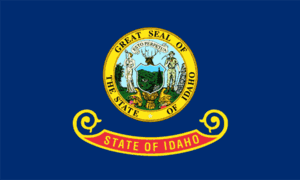
The flag of the state of Idaho was adopted on November 2, 1957. The flag is rectangular with a blue background. The seal of the state of Idaho appears in the center of the flag. Below the seal, a red banner with gold trim appears with the text “STATE OF IDAHO.”

Although the Idaho state flag was not adopted until the second half of the twentieth century, the first Idaho state banner was flown in the Philippines during the Spanish American War in 1898. Just before the First Idaho Volunteer Infantry deployed for the Philippines in 1898, a group of Idaho women presented the first Idaho state flag, which was made by skilled needle-worker in Chicago.

The first flag of Idaho was very similar to the current state flag, containing a blue background and the Idaho state seal in the center. Unlike the current version of the flag, the state seal on the original flag did not include the gold circular border with the text “Great Seal of the State of Idaho” written inside the border. Instead of the text “STATE OF IDAHO” in the red banner at the bottom, the text “1st Idaho Volunteers” appeared on the original flag.

The seal that appears in the center of the Idaho state flag was adopted in 1863 and modified several times before Idaho became an official state in 1890. The seal contains a gold circular border with the text “Great Seal of the State of Idaho” and a white star, representing Idaho as a new light among the U.S. states. Inside the border, a woman representing justice and a Miner, representing Idaho’s chief 19th-century industry are depicted in the foreground. Other images, including those in the seal’s inner shield, contain many images significant to the state of Idaho. These images include a man plowing a field, a pine tree, two cornucopias, the state flower, wheat, and an elk. The Latin text Esto perpetua, or “It is forever,” also appears at the top of the seal.

American Flags for Memorial Day, Flag Day, and Independence Day


The United States Flag Store is your one-stop shop for American flags to help you and your family celebrate Memorial Day, Flag Day, and Independence Day. The United States Flag Store is the largest online vendor of flags and flagpoles and offers top-quality flags at unbeatable prices. Read on for details about some of our fantastic American flags.

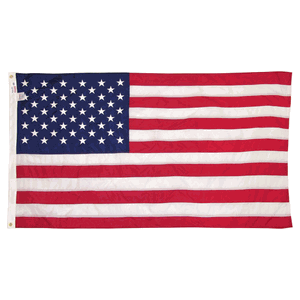
The Koralex II American Flags made by Valley Forge are some of the best American flags available. Koralex II gives American flags the traditional look of coarse cotton, but, unlike cotton flags, they are fade and fray resistant. Like all Valley Forge flags, the Koralex II American Flags are 100% U.S. made. Designed for outdoor use, these flags have nylon or canvas headings, brass grommets, and the larger flags have reinforced headings with thimble or D ring ends. These great flags are available as small as 3 feet by 5 feet for only $24.70 or as large as 20 feet by 38 feet for $808.55.

If you’re looking for value, a nylon flag from the United States Flag Store offers you a savings of 15% or more when compared to equivalent nylon flags from competitor companies. All nylon flags from the United States Flag Store are 100% U.S. made and reflect top-notch quality standards. Flags sizes range from 16 inches by 24 inches to 12 feet by 18 feet. Discounts are available for ordering in quantities of two or more.

Pleated fans are a beautiful to show your patriotic spirit in your windows and doorways. The pleated fans available at the United States Flag Store feature canvas headings and brass grommets for durability and easy hanging. The pleated fans from the United States Flag Store are made from durable and thick 600-denier polyester and they feature sewn stripes and appliquéd stars on both sides. You won’t find the “pleated effect” fans sold by competitors at the United States Flag Store, either: these fan feature generous pleats that look beautiful and elegant when displayed inside or out.

Looking for more flags and flagpoles? Visit the United States Flag Store’s website for the complete selection!

State Flag of Iowa

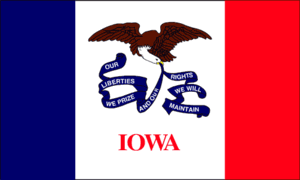
The flag of Iowa was adopted on March 12, 1921. The flag is rectangular with three vertical stripes: the stripe on the left is blue, the stripe on the right is red, and the larger center stripe is white. A bald eagle appears in flight in the white stripe, holding a blue ribbon with the following white text: “Our liberties we prize and our rights we will maintain.” The word “IOWA” is also included towards the bottom of the white stripe in red capitol letters.

Although the state of Iowa was admitted to the Union on December 28, 1946, it was not until the United States entered World War I that Iowans felt the need for a state flag. It was expected that Iowans would fight in state regiments, as in previous wars, and Iowans finally desired a banner to designate their respective units. Fortunately, the Iowa Society of the Daughters of the American Revolution was interested in designing a state flag.

On May 11, 1917, members of the Society as well as Mrs. Dixie Gephardt, the flag’s designer, presented the flag before the State Council on National Defense. The Council approved the flag, after which the Daughters of the American Revolution manufactured and presented Iowa flags to each of the Iowa National Guard regiments. Unfortunately, shortly after the flag was approved, the U.S. War Department adopted a policy assigning soldiers to military regiments without regard to state residency, and the Iowa flags were not used during the war. Still the Iowa flag was used by the State National Guard and is still used today.

State Flag of Montana

The flag of the state of Montana was originally adopted in 1905. The flag is rectangular with a blue background. The seal of Montana, which was adopted in 1865, is centered on the flag. The seal depicts the beautiful landscape of Montana, complete with mountains, plains, forests, the Great Falls, the Missouri River, and a big sky. The seal also contains important symbols of Montana’s farming and mining industry: a plow, a pick, and a shovel. The state’s territorial motto, Oro y Plata, is written on a banner at the bottom of the seal, which means “Gold and Silver” in Spanish. The text “MONTANA” appears across the top of the flag in gold letters.

The flag of the State of Montana was created in 1898, when the First Montana Infantry volunteers were training for the Spanish American War at Fort Harrison. Although the men had planned to carry a 45-star United States flag into battle, Colonel Kessler, the head of the First Montana Infantry, thought the troops needed a special flag to represent their state. The flag the men carried looked like the current Montana state flag, but instead of the word “MONTANA” across the top, the text “1st Montana Infantry U.S.V.” was stitched above the seal.

After the Spanish American war, Colonel Kessler gave the flag to the Governor, who displayed the banner throughout the state. The residents of Montana began to consider the banner an appropriate representation of their state, and in 1905, the Montana State Legislature officially adopted the first state flag of Montana: a blue banner with the Montana state seal in the center. The text “MONTANA” was added to the flag in 1981.


Flag of Oklahoma

The state flag of Oklahoma was adopted on April 2, 1925. The flag is rectangular with a blue background. In the center of the flag is buffalo-skin shield traditional to the Native American Osage tribe. The shield contains six brown crosses and seven eagle fathers. A Native American peace pipe and an olive branch appear in front of the shield. The text “OKLAHOMA” appears below the shield in white letters.

The flag of Oklahoma is unique to the state and the elements of the flag are significant. The buffalo-skin shield represents the Osage tribe, a group of Native Americans that originated in the Ohio River valley, but moved west to Oklahoma during the mid-1600s. Throughout the 1700s, the Osage tribe was the dominant Native American tribe in the area of the United States that is now Arkansas, Missouri, Kansas, and Oklahoma. Today, the Osage tribe mainly resides in Osage County, Oklahoma.

Six brown crosses—the Native American symbol for stars—appear on the shield and represent high ideals. The Native American peace pipe, or calumet, and the olive branch represent both the Native American and European symbols for peace. The blue background of the flag commemorates the Choctaw, the first Native American Nation to wave an official flag. The Choctaw Nation also served in the Confederate Army during the Civil War. The text “OKLAHOMA,” that appears in white letters below the shield was added to the flag in 1941.

The current flag of Oklahoma is quite different from the state’s original banner, which was adopted in 1911, four years after Oklahoma became an official state in the Union. The original flag was rectangular with a red background. A white, five-pointed star with a blue border appeared in the center of the flag. The number “46” appeared in blue in the center of the star, representing Oklahoma’s entry into the Union as the 46th state.