Flag of South Sudan

South Sudan is the newest country in the world, having declared its independence from Sudan on July 9, 2011. Many countries adopt a flag after becoming an independent nation, but South Sudan actually adopted its official flag exactly six years before its independence day. The flag of South Sudan was adopted on July 9, 2005, following the end of the Second Sudanese Civil War.

The flag of South Sudan is rectangular with three large horizontal stripes: the top stripe is black, the middle stripe is red, and the bottom stripe is green. Two thinner white stripes appear between the larger colored fields. A blue triangle with a gold star in the center appears on the left side of the flag.

The colored stripes on the flag refer to the Pan-African colors. These colors appear in the flags of many African nations and are also the official colors of the Universal Negro Improvement Association and African Communities League (UNIA).

In the flag of South Sudan, the black stripe represents the people of South Sudan; the red stripe represents the blood of all the South Sudanese that fought for their country’s freedom; and the green stripe represents the geographical land and resources of South Sudan. The smaller white stripes on the flag represent the country’s desire for peace.

The blue triangle on the left side of the flag stands for the Nile River, which flows through South Sudan. The gold star in the center of the triangle stands for unity among the people of South Sudan. It also alludes to the Star of Bethlehem, and the relatively large number of Christians residing in South Sudan.

The flag of South Sudan is very similar to the flag of Kenya, which borders South Sudan. Prior to the current flag’s adoption in 2005, the flag of South Sudan was the official banner of the Sudan People’s Liberation Movement, which fought the Sudanese government from 1983 until 2005.
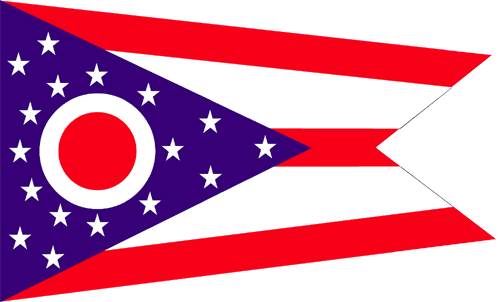
Flag of Ohio

The flag of the state of Ohio is one of the most unique state flags of the United States because it is the only state flag in the nation that is not rectangular. John Eisemann designed the flag of the state of Ohio for the Pan-American Exposition, a world’s fair in Buffalo, NY, in 1901. The flag was officially adopted in 1902.

The flag of the state of Ohio is a non-rectangular, swallow-tailed shape. The top and bottom hems of the flag taper inwards towards the flag’s fly end and a triangular portion of the flag is removed from the fly end. Although the only state flag of the U.S. to use this shape, this swallow-tailed element of the flag is common military units.

Like most state flags, the design of the flag of the state of Ohio holds great significance in terms of Ohio’s admittance to the Union, the people of Ohio, and the state’s natural elements. The flag has five large horizontal stripes: the top, bottom, and middle stripes are red and the stripes in between the red stripes are white. This not only bears similarity to the flag of the United States, but also represents Ohio’s roads and rivers.

The large blue triangle with white stars inside that appears on the left side of the flag is another feature of the Ohio flag that reflects the design of the U.S. flag. The blue triangle also symbolizes Ohio’s hills and valleys. The white stars on the Ohio state flag are divided into two groups: there are thirteen stars on the left side of the flag and four, more widely spaced stars on the right. The thirteen stars represent the thirteen original colonies of the United States. The other four stars, when combined with the thirteen, add up to seventeen stars, representing Ohio’s admittance to the Union as the seventeenth state.

Finally, the white circle with the red center in the middle of the blue triangle is truly unique to Ohio. The white circle represents the letter “O” for Ohio. Adding the red center alludes to Ohio’s nickname, the “Buckeye State.” Not only the name of the Ohio State University sports teams, the buckeye refers to the Ohio state tree, which produces nuts that resemble a buckeye.

Flag of the State of Georgia

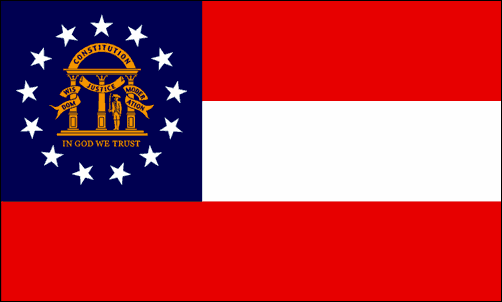
The current flag of Georgia.

The adopted flag of the U.S. state of Georgia is the newest state flag in the United States and has a very interesting story behind its development. Adopted just over eight years ago, on May 8, 2003, the flag is based off of the design of the Confederate States of America’s first national banner.

The current flag of Georgia, like the U.S. flag, is rectangular and includes a blue field in the upper left corner. The blue field includes the state of Georgia’s coat of arms and thirteen white stars. The coat of arms consists of three pillars, which represent the three branches of state and federal government: executive, legislative, and judicial. An American soldier with a drawn sword, dressed in a Revolutionary War uniform, stands between the pillars, symbolizing the state’s courage to defend the constitution.

Two phrases also appear in the blue field. “Wisdom, Justice, and Moderation,” Georgia’s state motto, appear on a banner around the pillars. “In God We Trust,” is written below the seal, but these words are not actually part of the official Georgia seal. The thirteen stars around the seal signify Georgia’s inclusion in the original thirteen U.S. colonies.

The rest of the flag consists of three horizontal stripes: the top and bottom stripes are red and the middle stripe is white.

Controversy over the state of Georgia’s previous flag, which was used from 1956 until 2001, ultimately led to the flag’s repeal and the design of a new flag. The flag adopted in 1956 prominently featured the Southern Cross, a prominent symbol of the Confederate States of America. Although proponents of the flag claimed that the Georgia state flag was designed to commemorate the Civil War Centennial, others took offense. The flag was adopted at the height of the American Civil Rights Movement, and white supremacy groups were using the Confederate flag as a symbol of racial protest.

Although pressure to adopt a new state flag increased throughout the second half of the twentieth century—especially before the 1996 Olympic Games, which were held in Atlanta—the flag was not replaced until 2001. In that year, the state legislature adopted a replacement flag that featured Georgia’s state seal above smaller versions of Georgia’s previous flag. The current flag of Georgia was adopted in 2003.

Rules for Flying the U.S. Flag

Purchasing an American flag, no matter how large or small requires understanding of proper flag regulations. Although not difficult to follow, many Americans are unaware of the federal laws that ensure all American flags are treated with dignity and respect. Below are the most important rules that govern the use of the American flag, according to the United States Flag Code.

  1. The American flag is customarily displayed only from sunrise to sunset. A flag may be displayed during darkness if the flag is properly illuminated
  2. The flag is always raised quickly and lowered slowly.
  3. Only all-weather or weather-resistant flags should be flown during sever weather to avoid damaging—and thus making unusable—less durable flags.
  4. The main administration buildings of every public institution should fly an American flag on the premises.
  5. Polling locations should display the American flag on or near the premises on election days.
  6. Schools should display the American flag on or near the premises when school is in session.
  7. In a procession with other flags, the flag should appear in the front of the line, on the flag’s own right (observer’s left).
  8. The American flag should never be draped over anything, such as a car, train, boat, statue, or monument, and should never be used on a parade float.
  9. When used indoors, the union of the flag should appear at the flag’s own right (observer’s left). If the flag is on display during a speaker’s presentation, the flag should be displayed either on a pole at the speaker’s right or above and behind the speaker. If other flags are on display, they should appear to the speaker’s left, and only the flag of the United States should appear on the speaker’s right.
  10. When a flag is displayed above the middle of a street, the union should be to the north on an east-west street or to the east on a north-south street.

It’s also important to note that the Flag Code cannot cover all possible flag-waving situations. When practices are in question, the following overarching rule should be followed: “No disrespect should be shown to the flag of the United States of America.”

Valley Forge Flags

The United States Flag Store is the largest and most complete vendor of Valley Forge flags, flagpoles, and accessories. With the widest variety and largest quantities of Valley Forge flags and flag accessories in their inventory, the United States Flag Store is your number one online store for these high-quality American-made flags.

Valley Forge flags are special for several reasons. In addition to serving as one of the oldest and most widely regarded makers of American flags, Valley Forge flags are completely American-made. The company is also a major supplier of American flags to the United States government, and Valley Forge flags have been raised and flown in major American events since World War II, including at the Battle of Iwo Jima, at the liberation of the Nazi Concentration Camps, in Normandy on D-Day, and on the first moon landing.

The Valley Forge Flag Company has remained a family-owned business since its beginnings in 1882. The company began its industry by manufacturing burlap sacks and began manufacturing American flags and other surplus during World War I. In 1932, due to increasing demand for American flags, the Valley Forge Company opened a small factory in Spring City, Pennsylvania. To this day, the Valley Forge Flag Company operates under the mission to manufacture United States flags that are 100% American-made. The Valley Forge Flag Company is committed to educating the American people and flag sellers about the importance of American-made flags and helped found the Flag Manufacturers Association of America.

Valley Forge flags are available in three materials from the United States flag store: cotton, nylon, and Koralex. The Valley Forge Best Cotton American Flags are made of heavyweight 2×2 ply mercerized cotton. The cotton flags feature vibrant colors and reinforced fly ends, and are designed for outdoor use. Valley Forge Nylon American Flags are a lower cost alternative to the traditional cotton flag but are a cut above traditional nylon flags. Valley Forge nylon flags feature sewn stripes, embroidered stars, and reinforced fly ends for an elegant look. Valley Forge Koralex American Flags are another great alternative to traditional cotton flags because they have the appearance of cotton but are more fray and weather resistant.

Etiquette for Flying the U.S. Flag

When you purchase and fly the Flag of the United States of America, you are committing to adhering to certain standards of respect for the flag, or rules of etiquette. The Flag of the United States should be treated with utmost respect at all times, and if a flag becomes unsuitable for use, it should be disposed in a proper manner. Here are some of the most important rules regarding flag etiquette.

The Flag of the United States should always be flown with the union–the blue and white “stars” field–at the flag’s own right (the observer’s left). Flying the flag upside down is a standardized signal of distress. Flying the flag backwards is disrespectful.

The flag should never be used for purposes other than flying. Therefore, the flag should not be used in any advertisements; as a costume or article of clothing; or as a covering for a table, desk, or podium. The only exception to this rule is that a flag patch may be worn on uniforms of certain government personnel, including those in the military, fire fighting, and police forces.

The flag should never touch the ground or be dipped to any person or other object. There are specific instructions for folding the U.S. flag. Instructions for folding, which requires two people, can be found here.

The United States flag should be kept as clean as possible. If the flag becomes damaged, or if it has been used in an inappropriate manner, it should be destroyed in a dignified flag burning ceremony.

When the Flag of the United States is displayed with other flags, such as flags of other states or organizations, the United States flag should be the first flag raised and the last flag lowered. The U.S. flag should be at the top of the pole if it is flying with other flags.  If the flags are on separate poles, no flags should fly higher than the United States flag, and the U.S. flag should be on its own right (the observer’s left). The United States flag should not be smaller than any of the other flags. When the U.S. flag flies with flags of other countries, each flag should be on a separate pole, all the flags should be raised and lowered at the same time, and all flags should fly at the same height.

Half-Mast, Special Flag Days, and Continuous Display of the U.S. Flag

The Flag of the United States can be found flying on the sites of government buildings and also outside residential homes. In general, the U.S. flag is raised quickly at sunrise and lowered ceremoniously at sunset. There are of course, exceptions to this rule: residences and public places, for example, can display the flag during darkness if the flag is properly illuminated. There are also certain days throughout the year that are special flag flying days or when the flag should be flown at half mast.

To achieve a patriotic effect, there are some government buildings that display the flag continuously. These are:

  • The Washington Monument (Washington, D.C.)
  • The White House (Washington, D.C.)
  • United States Marine Corp Memorial (Arlington, VA)
  • Flag House Square (Baltimore, MD)
  • Fort McHenry National Monument and Historic Shrine (Baltimore, MD)
  • On the Green (Lexington, MA)
  • The National Memorial Arch at Valley Forge State Park (Valley Forge, PA)
  • At United States Customs Ports of Entry

There are also special flag flying days, or days of celebration when United States citizens are encouraged to display their flags at full mast. These days include:

  • President’s Day (the third Monday in February)
  • United States Flag Day (June 14), celebrating the adoption of U.S. flag in 1777
  • Veteran’s Day (November 11), a celebratory day to honor our veterans

There are other days when the flag should be flown at half mast. In general, flags should be flown at half mast from sunrise to sunset. The exception to this rule is Memorial Day, when the flag is flown at half mast until noon, and then raised to full mast until sunset. Half mast days include:

  • Peace Officers Memorial Day (May 15)
  • Memorial Day (the last Monday in May)
  • Patriot Day (September 11)
  • Pearl Harbor Remembrance Day (December 7)

The President of the United States or a United States governor has the power to declare the United States flag to be flown at half mast. To honor the death of a state or national figure, the flag is flown at half mast for the following durations:

  • Thirty days following the death of the President or former president
  • Ten days following the death of the Vice President, Chief Justice, retired Chief Justice or Speaker of the House.
  • The time between the death and burial of a former Vice President, Associate Supreme Court Justice, military secretary, and a state governor.
  • The day of and day after the death of a congressperson.

If a community deems appropriate, the U.S. flag can also be flown at half mast to honor the death of important local government, religious, social, or youth leaders, teachers and coaches, or other community figures.

To get the most current updates about when the flag should be flown at half mast, visit http://www.halfstaff.org.

Flag of Kansas

The flag of the state of Kansas was adopted by the Kansas State Legislature on May 21, 1927. The flag features a blue background with the Great Seal of the State of Kansas in the center. The Kansas state crest is appears above the seal and the state’s name is printed in block letters below the seal.

The Great Seal of the State of Kansas was adopted on May 25, 1861 and tells the story of Kansas’s development. A farmer, two horses and a plow, and a cabin are depicted in the seal’s foreground, reflecting the importance of agriculture in Kansas’s economy, society, and history. The journey many Americans made to Kansas from the American east during the nineteenth century is depicted behind the agricultural scene with a train of oxen and wagons moving westward. Kansas’s Native American population is represented in the background of the seal with two Native Americans hunting buffalo on horseback. A river and a steamboat are also pictured in the seal’s background, representing Kansas’s participation in interstate commerce. The state’s motto, Ad astra per aspera, or “through hardships to the stars,” is written at the top of the seal in Latin. The Kansas state seal also includes thirty four stars, representing Kansas’s admission to the Union as the thirty-fourth state on January 29, 1861. Around the entire scene are the words, “Great Seal of the State of Kansas, January 29, 1861.”

Kansas’s state crest is featured at the top of the flag and consists of a sunflower resting on top of a gold and blue bag. The flower is Kansas’s state flower and also symbolizes fearlessness and openness. The blue and gold bar represents the Louisiana Purchase, of which the area that is now Kansas was a part.

The Kansas State Flag was flown for the first time in 1927 at Fort Riley to honor the troops stationed at Fort Riley and the Kansas National Guard.

Flag of Alabama

The flag of the state of Alabama was adopted by Alabama’s state legislature on February 16, 1895. The flag is rectangular and features a crimson cross in front of a white background. The cross on Alabama’s flag is the St. Andrew’s cross, which runs diagonally from corner to corner on the state’s banner.

There are three proposed theories attempting to explain the origin of Alabama’s flag. The most commonly accepted explanation for the flag’s design is that it resembles the flag of the Confederate States of America, which was adopted in 1865. The flag of the Confederate States of America features a blue St. Andrew’s cross with white stars in front of a red background.

A second proposed theory regarding the design of Alabama’s flag is that it is similar to a banner flown by the seventh Alabama Cavalry during the American Civil War. The cavalry was part of Rucker’s Brigade and was led by Edmund Rucker, who resided in Montgomery after the Civil War. Rucker’s Brigade flew a white banner that featured a red St. Andrew’s cross decorated with blue-green stars. The flag was made from the “best dresses” of several Confederate women, including the wedding dress of Lorenzo Leedy, a Mississippi widow.

Finally, it’s important to note that the flag of Alabama resembles two other important state and country flags. The Alabama flag closely resembles the United Kingdom’s Union Flag and the flag of the state of Florida, of which Alabama was originally a part.

Before the adoption of Alabama’s current flag in 1895, Alabama flew a much different two-sided banner. In 1861, the Alabama Secession Convention set out to design the state’s first official flag, and several Montgomery women created the double-sided design. The flag is rectangular with a blue background. One side of the flag features the “Goddess of Liberty” holding a sword in one hand and a blue flag in her other hand. The text at the top of this side of the flag reads “Independent Now and Forever.” The other side of the flag features a rattlesnake and a cotton plant. Underneath the image are the Latin words Noli Me Tangere, or “Touch Me Not.”

Flag of the State of Missouri

Support the state of Missouri and victims of the tornado that wreaked havoc on Joplin and neighboring areas by flying the Missouri State Flag this month.

Before 1913, Missouri did not have an official state flag. In 1908, however, the Daughters of the American Revolution set out to form a committee to create and design a flag for Missouri. Marie Elizabeth Oliver, who was the head of this committee and also the wife of Missouri State Senator Robert Burnett Oliver, ended up designing the official state flag. The flag of the State of Missouri was adopted on March 22, 1913, nearly 92 years after Missouri joined the Union the 24th state.

The Missouri State Flag contains important features that express national patriotism and also a sense of state pride and individuality. The background of the flag of Missouri contains three horizontal stripes: the top stripe is red, the middle stripe is white, and the bottom stripe is blue. The red, white, and blue colors obviously pay homage to the flag of the United States of America. In the Missouri state flag, however, the colors also have specific meanings representing core values of the United States and of the people of Missouri. The red stripe represents valor; the white stripe stands for purity; and the blue stripe represents justice, vigilance, and permanence.

In the center of the flag is the Great Seal of the State of Missouri. In the center of the seal is the Missouri coat of arms, which has special symbolic meaning. The crescent moon in the top left corner of the coat of arms reminds Missourians that their state was only the second state formed from the Louisiana Purchase and also reminds state residents that they have the power to make their future better than their past. The grizzly bear at the bottom of the seal represents the strength and courage of people of Missouri. Above the shield is a large star surrounded by 23 smaller stars, representing the hardships Missourians endured before the state was able to join the Union. There are also 24 stars on the outer edge of the seal.

The seal also contains two important Latin mottoes. The first phrase, “United We Stand, Divided We Fall,” reminds the people of Missouri of the importance of the United States. The second phrase, “Let the welfare of the people be the supreme law,” reminds Missourians that the state government’s purpose is to improve the lives of its residents.