Flag of Singapore

The flag of Singapore was adopted on December 3, 1959, when Singapore became a self-governing nation within the British Empire. When Singapore gained true independence on August 9, 1965, the flag was officially declared that national banner. The flag is rectangular and divided into two horizontal fields: the top half is red and the bottom half is white. On the left side of the red field is a crescent moon facing five small white five-pointed stars.
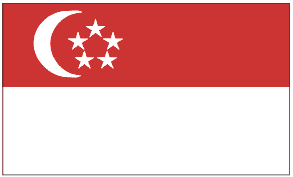
The flag of Singapore’s colors and images have symbolic meaning. The red represents “universal brotherhood and equality of man.” The white stands for “pervading and everlasting purity and virtue.” The crescent moon, an important Islamic symbol, represents a young country ascending towards greatness. The stars represent five important national ideals: democracy, peace, progress, justice, and equality.

In the nineteenth and first half of the twentieth century, Singapore was under British rule and part of the Straits Settlements, which included Singapore, Malacca, and Penang. During this time, Singapore used a Blue Ensign that included a British flag in the upper left corner and a red and white symbol on the right side with three crowns on it. During World War II, Singapore was controlled by Japan and flew the Japanese flag.

After World War II ended, Singapore began developing its own flag. The flag was designed in 1959 in just two months and represents a compromise between a several religious and political views. The flag committee initially wanted a flag with an entirely red background, but eventually decided against it because of red’s communist implications in the 1950s. After deciding on a red and white flag, Singapore needed to distinguish itself from countries such as Indonesia, Poland, and Monaco, countries that also flew red and white flags. The Chinese constituency in Singapore advocated for five stars, like the flag of the People’s Republic of China; the Muslim constituency wanted a crescent moon. The inclusion of both symbols represents both populations in Singapore.

Christmas Flags

Thanksgiving is almost here, and before you can think twice, you’ll be decorating your house for Christmas. Why not get started on your decorations shopping early with the U.S. Flag Store’s beautiful selection of Christmas Flags? All of the U.S. Flag Store’s Christmas Flags are vibrantly colored and beautifully appliquéd and embroidered. Christmas flags are made from the best quality polyester are made to withstand winter weather. Flags are designed meticulously and individually tested for quality and durability.

If you’re looking for Christmas trees or greens, the U.S. Flag store has a beautiful selection of tree and poinsettia flags. The Woodland Tree Christmas Flag, for example, includes an image of an outdoor Christmas tree, complete with presents underneath, snow in the background, and mistletoe overhead. The Poinsettia Topiary Christmas Flag features a poinsettia plant in a Christmas tree design. The bright red and green colors stand out beautifully on the flag’s black background.

If you enjoy whimsical flags, the U.S. Flag Store will not disappoint. Sure to be a holiday favorite, the Winter Pal’s Greetings Decorative Banner Flag features four cartoon characters—a reindeer, a snowman, a penguin, and polar bear—donned in winter hats and scarves in front of a red and green background. The Santa Christmas Flag features a “Ho, Ho, Ho!” written in candy canes, an adorable Santa image and bright white snowflakes on a black background. This cute flag is sure to put you and your neighbors in the holiday spirit!

When you’re browsing flags, be sure not to miss the BreezeArt Penguin and Pal Banner Flag. This adorable snowy flag features a chubby penguin—dressed in a Christmas hat and scarf—holding a miniature Christmas tree in a pot. The penguin’s pal, a little red bird, sits on the very top of his hat.  Best of all, this great design is available in a smaller garden flag and magnetic mailbox cover.

The U.S. Flag Store’s Christmas flags are a great way to display your Christmas and holiday spirit. Order yours today!

Flag of Algeria

The flag of Algeria was adopted on July 3, 1962, when the country gained independence from France. The flag is rectangular and divided vertically into two fields.  The left field has a dark green background and the right field has a white background.  Intersecting the two fields, in the center of the flag, is a red star and crescent.

The colors of the Algerian flag have symbolic meaning. As with many countries, the white symbolizes peace.  The green part of the flag represents nature.  The star and crescent were widely used in parts of the ancient Mediterranean regions and also in parts of Asia.  Today, the star and crescent combination is most commonly recognized as the emblem of Islam, and the star and crescent appear on the Algerian flag for these reasons.  Although the star and crescent are often green, the red star and crescent on the Algerian flag represent the blood of the many soldiers that were killed fighting for Algeria’s independence from France between 1954 and 1962.

The detailed history of the Algerian flag is somewhat unclear. The colors in the flag—white, red, and green—are used in the flags and emblems of many Islamic nations.  The best explanation of the Algerian flag’s design is that it is a combination of two flags used in what is now the country of Algeria.  The flag of the Algerian Regency, which governed the area from the sixteenth until the nineteenth century, had a red background with a white star and crescent in the center.  In the nineteenth century, Prince Abdel Kadir, an Algerian Islamic scholar and political and military leader, led a French resistance movement flying a flag with two vertical stripes, one green and one white.  It is also possible that Messali Hadj, an Algerian nationalist, designed the Algerian flag in the late 1920s.

Flag of Bulgaria

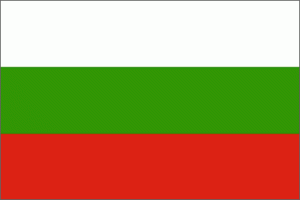
The current flag of Bulgaria was adopted in 1991 when Bulgaria’s Constitution was readopted, although the original Bulgarian flag was adopted when Bulgaria gained independence following the Russo-Turkish War.  The flag is rectangular with three horizontal stripes: a white stripe on the top, a green stripe in the middle, and a red stripe on the bottom.

The red and white stripes on the Bulgarian flag represent the pan-Slavic colors: red, white, and blue.  When the Bulgarians designed their flag, however, they chose a green stripe in place of the traditional pan-Slavic blue to represent freedom.

Since the Bulgarian flag’s adoption in 1879, the flag has existed in two versions: with and without the emblem of the People’s Republic of Bulgaria.  In 1879, after Bulgaria gained its independence during the Russo-Turkish War, the Tarnovo Constitution mandated that the Bulgarian flag consist of a horizontal tricolor with white, green, and red stripes. When Bulgaria was under the rule of the Bulgarian Communist Party and known as The People’s Republic of Bulgaria, the country used a horizontal tricolor flag with the emblem of the People’s Republic of Bulgaria placed on the left corner of the white stripe.

The emblem of the People’s Republic of Bulgaria depicts a rampant lion surrounded by a wreath of wheat. Above the lion is a red five-pointed star.  Below the lion are the dates 681 and 1944.  Asparunkh, ruler of the Bulgar tribe during the 7th century, founded the First Bulgarian Empire in 681. The Fatherland Front, a Bulgarian resistance movement that led to the start of the People’s Republic of Bulgaria, took control over Bulgaria in 1944, at the end of the World War II.

In 1991, the new Constitution of Bulgaria again mandated that the flag of Bulgaria be a simple horizontal tricolor of white, green, and red; and the emblem of the People’s Republic of Bulgaria was removed.

Flag of Catalonia

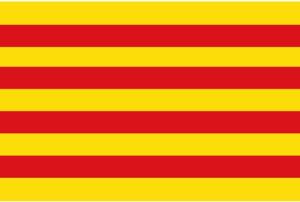
The flag of Catalonia is known as the senyera (“signal flag” in Catalan) and is one of the oldest European flags still in use today. The flag is a rectangular shape with four red horizontal stripes equally spaced on a golden background.

The colors of the flag of Catalonia have their roots in the coat of arms of the Crown of Aragon, which consists of a golden shield with four red stripes and a jeweled crown on top.  According to a legend from the fourteenth century, in 897, when Barcelona was under siege by the Moors, King Charles the Bald drew four red stripes with his blood-drenched fingers as an act of gratitude on the Count of Barcelona’s golden shield. Although scholars debate the legend’s validity, the red blood and golden shield depicted in the tale influenced the colors for the Crown of Aragon’s coat of arms.  The red and golden colors are used in the flags of four of Spain’s autonomous communities: Catalonia, Aragon, the Balearic Islands, and Valencia.

The origin of the actual senyera is, again, debated as scholars argue over whether the flag has its roots in the Catalan or Aragonese region of Spain.  The Gran Encyclopedia Catalana argues that the senyera first appeared in the tomb of Ramon Berenguer II, a count of Barcelona who died in 1082.  Advocates for the Aragonese theories argue, however, the flag was first found in the seal of Alfonso II of Aragon in 1159.

Catalonia is an autonomous community of Spain, one of seventeen self-governing regions in the country. Catalonia is in the northeast region of Spain and is bordered by France to the north. The area consists of four provinces: Barcelona (the capitol), Girona, Lleida, and Tarragona.  Although the history of this region dates back to the eighth century, Catalonia has only been an autonomous region since August 9, 2006.

Flag of Zimbabwe

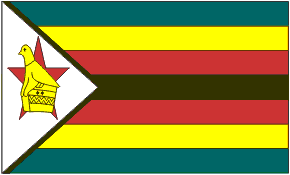
The flag of Zimbabwe was adopted on April 18, 1980, when Zimbabwe’s status as an independent nation was officially recognized.  The flag is a rectangular shape with seven horizontal stripes of green, yellow, red, and black.  From the stripes are in mirror image order and are arranged in the following order from top to bottom: green, yellow, red, black, red, yellow, green.  On the left side of the flag is a white triangle with a black border.  Inside the white triangle is a soapstone bird behind a red star.
The colors of the flag of Zimbabwe have symbolic meaning similar to many African countries that use the pan-African colors.  The green stripes symbolize the products of the agricultural and farming areas of Zimbabwe.  The yellow stripes symbolize Zimbabwe’s mineral resources.  The red stripes toward the center of the flag symbolize the blood of the many Zimbabweans that fought in the First and Second Chimurenga wars.  Chimurenga means “revolutionary struggle” in Shona, a Bantu language.  The First Chimurenga was fought between 1896 and 1897 against the British colonial rule and the second was fought between 1966 and 1980 against the Rodesians, a white minority regime in Zimbabwe.  Finally, the black stripe on the flag symbolizes the Zimbabweans’ native African heritage and ethnicity.

The triangle and images inside it also have symbolic meaning.  The white triangle symbolizes peace.  The red star represents the Zimbabweans’ hope and optimism for the future, but it also stands for the country’s socialist ideals.  The Zimbabwean bird in front of the red star is a depiction of a soapstone bird and is the national emblem of Zimbabwe.  The bird was carved on the walls of the ancient Great Zimbabwe in the eleventh, twelfth, and thirteenth centuries.  The walls on which the bird is carved formed the largest ancient stone construction in Zimbabwe.  The bird is a bateleur eagle and can be found on the Zimbabwean flag and coat of arms.

Flag of Norway

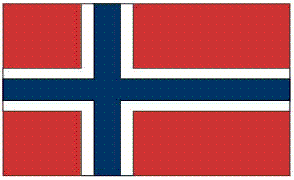
The flag of Norway was adopted on July 13, 1821. It is rectangular with a red background and a blue Scandinavian cross that is outlined in white.  The cross covers the entirety of the flag but the center of the cross is slightly to the left side of the flag.  The design and colors of the flag resemble the Dannebrog, or the flag of Denmark, except that the Norwegian flag features a blue and white cross while the Donnebrog is plain white.
The colors of the Norwegian are based on the Coat of Arms of Norway, which features a red shield with a golden lion holding an axe.  On top of the shield is a bold crown and a red escutcheon.  The Coat of Arms of Norway originated in the Middle Ages and is one of the oldest coats of arms in Europe.

The history of the Norwegian flag is somewhat unclear, although the flag may have originated during the reign of Inge Haraldsson in the early twelfth century.  During Inge’s rule, a flag with a red lion on a gold background was used.  In the late thirteenth century, Erik II of Norway flew a flag with a golden lion on a red background.  This flag is now known as the Royal Standard of Norway; it is used by the King of Norway and was officially adopted on November 15, 1905.

From 1536 until 1814, Norway united with the Kingdom of Denmark and used the Dannebrog, a red flag with a white Scandanavian cross. When Norway separated from Denmark in 1814, it continued to fly the Dannebrog, but also included the golden lion from its own coat of arms in the upper left corner of the flag.

Fredrik Meltzer, a member of the Norwegian parliament, designed the current flag of Norway. Although the Norwegian chambers approved the design, the King of Norway approved the flag for civilian use only. In 1899, after three consecutive chamber sessions, the flag was finally approved for use as the country’s national banner.

Flag Pins

Looking for a way to wear your pride on your lapel, hat, or uniform? The United States Flag Store offers many different United States, international, and military flag pins at unbeatable prices.  Each flag pin  gold metal lacquered design with a baked-on enamel finish and a clutch pin. Pins that display single flags feature an image of one waving flag and double flags feature a United States flag along with the other chosen flag.

If you’re looking to display your patriotic spirit, the United States Flag store offers several different United States flag pins that you can wear with pride on your lapel, hat, or uniform.  Standard United States flag pins are available for as low as $0.40 each when you purchase them in bulk and feature beautiful images of the United States flag waving in the air.  A wide selection of military flag pins and double pins—those with one U.S. flag and another state, military, or international flag next to each other—are also available in beautifully lacquered designs.

The United States Flag store also sells lapel pins for all fifty U.S. states.  These beautiful pins display your state’s flag waving proudly in the air and are available for as low as $0.75 each when your order in bulk.

If you’re looking to display your international pride and diplomacy, then take a look at the United States Flag Store’s incredible selection of international flag pins.  Countries represented include: Argentina, Australia, Brazil, Canada, China, Chile, Cuba, Germany, France Greece, Ireland, India, Israel, Italy, Jamaica, Japan Kenya, South Korea, Mexico, Philippines, Poland, Russia, Scotland, Spain, Sweden, Switzerland, Thailand, and the United Kingdom. Pins for other countries can be ordered upon request.

Want a special, customized pin?  The United States Flag Store will create custom lapel pins to promote your company, club, church, or organization.  These beautiful custom pins are individually designed to fit your organization’s needs and are available in enamel, pewter, silver, and gold. Your organization can either submit artwork for your pin or work with an artist to create a custom design.  For questions about this great service, email customart@onlinestores.com.