Military Patches

If you’ve already bought a U.S. Flag Store Military Flag to honor your loved one in the Service but are looking for another way to show your support, then check out the U.S. Flag Store’s Military and POW Patches. For as little as $1.99, you can show your support for your loved one serving by stitching or ironing one of these patches onto your coat or bag.  All Military and POW patches are beautifully embroidered and have a vinyl backing.
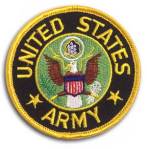
If you’re looking for classic logos, the U.S. Flag Store sells traditional circular and rectangular U.S. Military Patches.  You’ll have your choice of a patch with the Air Force, Army, Coast Guard, Marine Corps, or Navy logo.  Each embroidered circular patch is three inches in diameter, has a vinyl backing for durability, and beautiful gold trim.  These great patches are just $1.99—33% off the list price.  Discounts are available for buying five or more patches, so order some patches for your friends and family as well!

The rectangular military patches are of the highest quality and very detailed in their design.  These 3½” x 2¼” patches are machine embroidered, enabling exact duplication of the finest details of the military logos.  Choose from the Air Force, Marine Corps, Army, Coast Guard, or Navy emblems.  The Army and Coast Guard patches also include the year each service branch began, 1775 and 1790, respectively.  These patches are just $2.49 each and can be sewn or ironed onto clothing.

The POW/MIA Patch is black and white and includes a silhouette of a man’s head in front of a watchtower and barbed wire fence.  The text “POW/MIA” and the motto, “You Are Not Forgotten,” are also included on the patch.  The embroidered POW patch is 3” by 2¼” and has a vinyl backing.  At just $1.99 each and with discounts available for buying five or more, this POW patch is a great way to muster your family and friends’ support for you during this most stressful time.

These military patches are truly a great, affordable way for you and your family and friends to show your support for your loved one in the U.S. Armed Services.  So start wearing your pride on your sleeve and order your patches today!

Flag of Poland

The flag of Poland was adopted on August 1, 1919. It is a simple flag consisting of a rectangle divided into two horizontal fields, a white field on the top and a red field on the bottom.

Red and white have been important colors in Poland since its first royal arms banner in the Middle Ages.  This banner represented the Kingdom of Poland under the rule of King Ladislaus the Elbow-High and was a red cloth with a white eagle in the center.  This banner was not only used in battle but also as a symbol of the Polish royalty.

Later, in the sixteenth century, during the Polish-Lithuanian Commonwealth, the two countries combined their symbols.  Fortunately, both countries used coats of arms that consisted of white figures with red backgrounds: Poland’s coat of arms featured a white eagle and Lithuania’s was a white knight on horseback.  During this time, the Polish-Lithuanian Commonwealth also flew a red-and-white striped banner that included two, three, or four horizontal stripes.

Beginning in the eighteenth century, with the reign of August II, soldiers wore colored ribbons or knots, called cockades, to signify their nation’s color. Polish soldiers wore white knots, but by the second half of the 1700s, soldiers began wearing red and white ribbons to honor their country.  Finally, as a result of an uprising against the Russians in November 1830, the Sejm, or Polish house of government declared red and white as the national colors of Poland.

The flag of Poland is always flown on government buildings, including the House of Parliament and the Presidential Palace.  The flag is flown on other public buildings for the first three days of May: May 1 is May Day (formerly Labor Day), May 2 is Poland’s Flag Day, and May 3 is Constitution Day.  The flag is also flown on November 11 to honor Poland’s Independence Day.

Flag of Uruguay

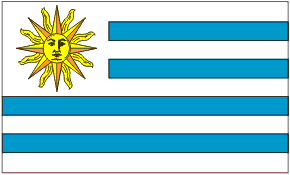
The flag of Uruguay first adopted on December 16, 1828. The flag consists of a white rectangular background with blue horizontal stripes and a sixteen-ray “Sun of May” in the upper left corner.

The elements of the flag of Uruguay have historical and political significance. Joaquín Suárez de Rondelo, who was the Head of State of Uruguay in 1828, designed the flag. The flag adopted in 1828 and had seventeen stripes until July 11, 1830, when a new version of the flag was adopted with only nine stripes. The nine stripes represent the nine counties existing at the time Uruguay became an independent nation.

The “Sun of May,” has been a national emblem of Uruguay since the nineteenth century.  It was an important political symbol during the May Revolution, a series of events occurring between May 18 and May 25, 1810 that ultimately resulted in the overthrow of Viceroy Baltasar Hidalgo de Cisneros, the Spanish ruler who was governing Argentina and Uruguay.  The May Revolution established a local government in Argentina, and began Argentina’s battle for independence. In addition to the symbol’s use during the May Revolution and on the Argentine and Uruguayan flags, the symbol was also used on the first Argentine coins.

Uruguay has two other national flags in addition to the national banner. The Flag of Artigas pays homage to José Gervasio Artigas, the Uruguayan “father of independence.”  The Flag of Artigas is rectangular two blue horizontal stripes, one across the top and one across the bottom, and a white stripe in the center.  There is a red diagonal stripe crossing the flag from the upper left corner to the bottom right corner. The Flag of Treinta y Tres celebrates the founding of Uruguay following its victory over a Brazilian revolutionary group. The Flag of Treinta y Tres is similar to the Flag of Artigas: it consists of a horizontal flag with three stripes, a blue stripe on the top, a white stripe in the center, and a red stripe along the bottom.  In the center of the white stripe, the flag reads: Libertad o Muerte (liberty or death).

Flag of Israel

The flag of Israel was officially adopted on October 28, 1948, five months after Israel became an independent state. The flag consists of a white rectangle with two blue horizontal stripes, one on the top of the flag and one on the bottom, and a blue six-pointed star in the center.

The Israeli flag was designed in 1891 for the Zionist movement, a Jewish political nationalist group that advocates for a self-determined Jewish community and to have an independent and sovereign Jewish nation. The design of the flag is reminiscent of the Jewish tallit, or prayer shawl, which is traditionally white with blue stripes. The six-pointed star, called the Magen David or “Shield of David,” is made up of two equilateral triangles juxtaposed on top of one another. Although it is traditional belief that King David used this six-pointed star during his rule of Israel in Biblical times, the star developed its more modern origins as a Jewish symbol in Prague during medieval times and was the First Zionist Congress’s symbol just before the turn of the twentieth century.

The flag’s blue color is not standardized, but mandated by the Israeli government to be a “dark sky-blue,” and the exact blue hue varies between flags. When the flag was first created, Israelis used tekhelet, a blue dye that was used by members of the upper class, consequentially becoming associated with wealth and royalty. Just as the entire flag is reminiscent of the Jewish prayer shawl, the blue color of the flag also has biblical origins: the Bible commands Israelites to have one of the threads in the tallit be a sky blue so that, upon looking at the shawl, they will think of God in the heavens.

The white and blue colors in the flag are significant in other ways as well. An Australian Jewish poet, Ludwig August Frankl, wrote in a poem, “Judah’s Colors:” “Blue and white are the colors of Judah; white is the radiance of the priesthood, and blue, the splendors of the firmament.” The white is also frequently interpreted to symbolize light, honesty, and peace, and the blue to symbolize trust, loyalty, wisdom, and faith.

Flag of Comoros

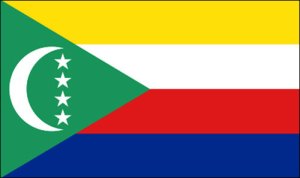
The flag of Comoros was designed in 2001 and adopted on January 7, 2002.  The flag consists of a green triangle on the left side of the flag. Inside the green triangle is a white crescent and four white stars.  The remainder of the flag consists of four stripes, one each in yellow, white, red, and blue.

Comoros is officially referred to as the Union of Comoros and consists of four main islands: Grande Comore, Mohéli, Anjouan, and Mayotte.  The archipelago is located off the eastern coast of Africa in the Indian Ocean between Mozambique and Madagascar.  Each of the stripes on the flag represents the main color of the flag for one of these islands.  The blue stands for the flag of Grande Comore, the red for the flag of Anjoun, and yellow for the flag of Mohéli.  The white stands for Mayotte, which is actually administered by France.

The green area, white crescent, and white stars have been used in every former flag of Comoros.  With the exception of the Comoros state flag used from 1976 until 1978 during the Ali Soilih Regime, all flags of Comoros have consisted of a simple green rectangle with the white crescent and stars.  The only variations in the flag have been in the orientation of the crescent and stars.  This motif represents Islam, the archipelago nation’s most prominent religion.  The crescent and stars also served as an important motif from 1975 through 2002, during which Comoros sought independence from France.

Today, the islands of Comoros are still troubled, experiencing more than twenty coups or attempted coups in the last eight years in addition to presidential assassinations and other forms of political unrest.  Mayotte is still administered by France, and Anjouan and Mohéli occasionally express desire to secede from Comoros and re-attach to France.  The nation also experiences extreme poverty: approximately half of its citizens earn less than $1.25 per day.

Flag of Antigua and Barbuda

The flag of Antigua and Barbuda was adopted on February 27, 1967 when Antigua became independent of the British-governed West Indies. The flag features two red isosceles triangles that form a “V” shape.  In the center of the V is a white triangle underneath a blue stripe.  Above the blue stripe is a layer of black with a rising sun in the center of the layer.

To develop a design for the flag, the Antiguan government held a competition in 1966, offering five hundred dollars and the national flag design to the winner.  Reginald Samuel, a high school art teacher, sculptor, and painter living in Antigua, won the competition for the flag design, and his drawing was chosen from over six hundred entries.  According to the Museum of Antigua and Barbuda, Samuel designed the flag in only a half an hour, meeting the deadline at the very last moment.  In 1966, the Antiguan government displayed Samuel’s design for the flag, along with the Antiguan national anthem, coat of arms, and slogan outside the country’s administration building.  This original exhibit is still viewable at the Museum of Antigua and Barbuda.

The design of the flag has great symbolic meaning.  The rising sun represents the dawn of a new era, one in which the islands of Antigua and Barbuda are free and independent.  The red represents the energy of the people of Antigua and Barbuda and also the blood shed by the country’s forefathers.  The “V” shape formed by the red sections also represents “Victory at last.”  The gold sun, the black stripe at the top of the flag, the blue in the middle, and the white at the bottom represent the sun, soil, ocean, and sand, respectively.  In more symbolic terms, the blue symbolizes hope and the black symbolizes the African heritage of the country’s citizens.

Until 1994, the sun on the flag of Antigua and Barbuda would often have up to twenty full points, as Reginald Samuel did not specify how many points the sun should have.  Antigua consists of six parishes and a “sister” island, Barbuda; and as of 1994, the rising sun was required to contain seven full points, one for each of the parishes and one for Barbuda.

Flag of Western Samoa

The flag of Western Samoa was officially adopted on February 24, 1949.  The flag is a rectangular shape with a red background and blue rectangle in the upper left corner.  Inside the blue area is the Southern Cross constellation with four large white stars and one smaller white star.

The red and white have been traditional colors of Samoa since the Samoan king Malietoa Laupepa, and the Southern Cross links Samoa to other countries surrounding it in the Southern hemisphere.  The Western Samoan flag, however, has experienced drastic changes over the last century.  In 1900, the Samoan Islands were separated into two parts as a result of the Tripartite Convention: American Samoa (Eastern Samoa) and German Samoa (Western Samoa).  Under German rule, the Samoan flag was similar to the German flag:  a rectangular shape with three horizontal lines, one each in black, white, and red.

The Germany-style flag was used until August 29, 1914 when New Zealand troops seized Western Samoa from Germany.  When New Zealand first seized control of Western Samoa, the flag of New Zealand was used.  This flag consists of a blue background with the British Union flag in the upper left-hand corner and four stars of the Southern Cross on the right side. This flag was used until July 30, 1922.  Three years later, on January 16, 1925, Western Samoan adopted a new flag consisting of a red background, the British Union flag in the upper left-hand corner, and a picture of three palm trees inside a white circle on the right-hand side.

On May 26, 1948, Western Samoa adopted a flag similar to its current flag except that the Southern Cross only contained four stars, just like the New Zealand flag’s Southern Cross.  On February 24, 1949, the five-star version of the Samoan flag was adopted and Western Samoa gained independence from New Zealand in 1962.

Flag of Latvia

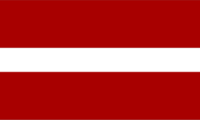
The flag of Latvia was officially re-adopted on February 27, 1990, after the Soviet Union banned its use from 1940 until 1990.  The flag consists of a red rectangle with a white horizontal strip in the center.  The red symbolizes the Latvian people’s willingness to give their lives to defend their liberty and freedom.  The white stripe’s origins come from a legend in which a wounded Latvian leader had wrapped a white sheet around his body.  The sheet became stained with blood on the edges while the center of the sheet remained white.  As the legend goes, at the next battle, this sheet was used as the Latvian flag.

The exact colors and proportions of the Latvian flag were set on November 18, 1918, when Latvia became an independent nation.  The flag was officially adopted for the first time in 1922 and was used until 1940 when the Soviet Union gained control of Latvia.  The Latvian flat is flown on several days during the year including: Lithuanian Independence Day (February 16), Estonian Independence Day (February 24), Constitution Day/Labor Day (May 1), Renewal of Independence Day (May 4, 1990), Lacplesis Day (November 11), and Independence Day (November 18, 1918).  The flag is also flown at half-mast in mourning on the following days: in memory of victims of communist genocide (Marcy 25, June 14, and the first Sunday in December), the beginning of the Soviet Union’s control of Latvia (June 17), and in memory of the Holocaust victims (July 4).

Latvia also uses four other official flags: the Presidential Standard, the Standard of the Prime Minister, the Standard of the Speaker of the Saeima, and the Standard of the Minister of Defense.  All of these flags use a white background with a double-lined red cross.  This red cross, with a white line running through it, represent the pattern of the Latvian National Flag.  The Presidential Standard, the Standard of the Prime Minister, and the Standard of the Speaker of the Saeima all feature the Latvian coat of arms: the Presidential flag features the coat of arms in the center, the Prime Minister flag features the coat of arms in the upper left corner, and the Speaker flag features the coat of arms in the upper right corner.  The Standard of the Minister of Defense features soldier insignia in the upper left corner.

Flag of Hong Kong

The flag of Hong Kong, officially called the Regional Flag of the Hong Kong Special Administrative Region of the People’s Republic of China, was adopted on April 4, 1990 at the Third Session of the Seventh National People’s Congress.  Although adopted at this landmark session, the flag was not officially raised until seven years later, on July 1, 1997, during the handover ceremony, signifying Hong Kong’s sovereignty transfer from Great Britain to the People’s Republic of China.

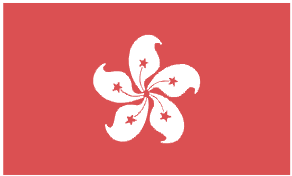
The flag of Hong Kong features a red rectangle with a five-petal white flower in the center.  Each of the five petals has a red star in the middle.  The red background represents Hong Kong’s allegiance to the People’s Republic of China, which has a red flag.  Red is also a festive color for Chinese people, used at celebrations in addition to patriotic events.  The flower depicted on the flag is the Bauhinia blakeana, a species that originated in Hong Kong in the late nineteenth century.  The flower grows on an evergreen tree but looks similar to an orchid.  It contains five thick, purple-red flowers and has a fragrant smell.  The five white stars on the inside of the flower petals also signify Hong Kong’s allegiance to the People’s Republic of China, as the flag of the People’s Republic also contains five stars.

The strategic combination of the flower—symbolizing Hong Kong—and the red background and white stars—symbolizing the People’s Republic of China—illustrates China’s “one country two systems” idea.  This idea, posing that China would be socialist, but other large cities, including Hong Kong, Macau, and Taiwan, could have capitalistic systems was introduced by Deng Xiaoping, a leader of the People’s Republic of China during the 1980s.  According to this principle, Hong Kong can retain its capitalistic systems for fifty years after its reunification with China.  This was negotiated with British Prime Minister Margaret Thatcher in 1984 and took effect in 1997.  The People’s Republic of China has not made clear what will happen to Hong Kong when the agreement expires in 2047.

Flag of Italy

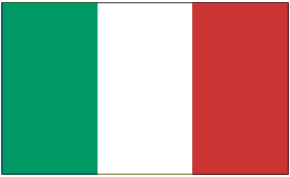
The flag of Italy was officially adopted on June 19, 1946.  The flag is a rectangular shape consisting of three vertical stripes in green, white, and red.  In Italy, the flag is called Il Tricolore, referring to the tricolor design of the flag.

The exact meaning of Il Tricolore‘s colors is not certain.  The first Italian tricolore flag was adopted on January 7, 1797 during the Cispadane Republic.  Between 1797 and 1803, the flag’s colors remained the same, but the design of the flag underwent several design changes as the Italian rule changed hands rapidly.  During the Cispadane Republic, the stripes were horizontal and the flag included the Italian coat of arms.  During the Cisalpine Republic of 1798, the stripes shifted to vertical orientation and the coat of arms was removed.  At the turn of the century during Napoleon’s rule of the Italian Republic, the flag featured a red background and a green square within a white lozenge.

In the nineteenth century, during the Italian resurgence, or Risorgimento, the Italian tricolore remained a symbol of the Italian people.  During this period, between 1848 and 1861, many coats of arms were incorporated into the Italian flag, including the Savoyan coat of arms (from the Kingdom of Sardinia), the Habsburg Lorraine coat of arms (from the Grand Duchy of Tuscany), and the Bourbon coat of arms (from the Kingdom of Two Sicilies).  Although the flag underwent at least seven variations during this thirteen-year period, on April 15, 1861, the Italian flag that incorporated the Sardinian coat of arms was declared the Kingdom of Italy’s official flag and was used until 1946.  During World War II, however, the Italian Social Republic flew a Nazi-era flag, featuring the Italian tricolore with a silver eagle, for military and propaganda use.

In 1946, Italy became a republican nation and officially adopted the plain tricolore.  Today, although the colors have deep historical roots, some attribute them to the country’s green plains, the beautiful snow-white Alps, and the blood of those who fought for Italy’s independence.  Another more religious interpretation attributes the green to hope, the white to charity, and the red to faith.