
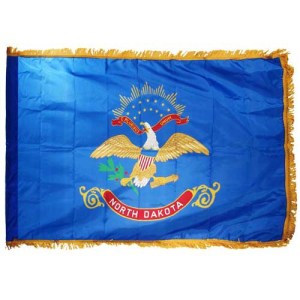
North Dakota became the 39th US State on November 2, 1889 when President Benjamin Harrison signed a bill creating the Dakota Territory. Around the end of the 1870s, people wanted the Dakota Territory to enter Union as both a single state and as two states. The Dakota Territory successfully became North and South Dakota in 1889.
North Dakota’s state flag was adopted in 1911, about 22 years after the state’s admission into the Union. The flag was introduced by Colonel John. H. Fraine. The state flag is a dark blue with bald eagle in the center, holding an olive branch in its right talon and arrows in its left talon. The eagle is grasping a gold lined red ribbon in its beak, which reads E Pluribus Unum, which is Latin for “Out of one, many”. There are two symbols of the original thirteen territories on this flag: one is a shield of thirteen stripes on the eagle’s chest and thirteen yellow stars above its head, with a fan shaped design above the stars. Underneath the eagle is a small red scroll which says “North Dakota” and yellow scrolls swirling outside of it. In 1951, a state flag commission had been established to consider changing the state flag because it “too closely resembled the coat of arms of the United States of America and that the flag was not symbolic of North Dakota”. However, the legislation was rejected.
State Flower: While North Dakota’s state flower is the Prairie Rose, the state actually grows the most sunflowers than any other state.
Theodore Roosevelt: The 26th President of the United States was very important to the state of North Dakota. He spent some of his younger years in the state and helped found the national park system. In fact, there is a national park named after him that was established in 1978.
-CD
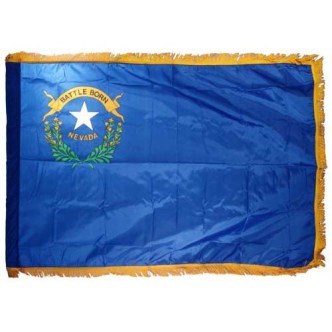 ve to reproduce. The winner was Louis Schellbach III, who kept the blue background of the original flag but the previous use of the state’s coat of arms was now replaced by a wreath
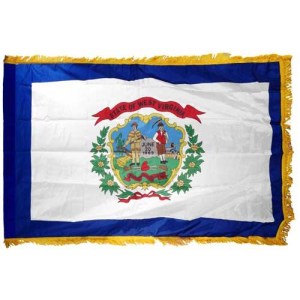 hite with a navy blue border surrounding it. In the center is the coat of arms of West Virginia, while a wreath of rhododendron (the state flower) is on the lower half of the coat of arms. Above it is a red ribbon, reading the words “State of West Virginia”. Inside the coat of arms stands two men and in between them is a rock which has the date of West Virginia’s admission (June 20, 1863) inscribed and the state’s motto, Montani Semper Liberi, meaning “Mountaineers are always free”.
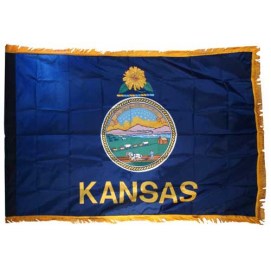 Kansas’ state flag was adopted on May 21, 1927. It had been flown at Fort Riley for the first time to honor the troops and the Kansas National Guard. The flag is a navy blue and has the state seal emblazoned in the middle. This seal depicts the rising sun in the East while life, of covered wagons, livestock, and farming, go on in the left hand corner and below. In the sky are 34 stars, each symbolizing a state at the time the seal was created during Kansas’ entry into the Union. Above the stars is a gold ribbon, reading Ad Astra Per Aspera, the state’s motto, meaning “to the stars through difficulties”. Underneath the state seal is the word “Kansas” in yellow and atop the seal is a sunflower sitting on a twisted blue and gold bar. This bar is said to symbolize the Louisiana Purchase in which the land Kansas was in was also acquired from. The sunflower is also Kansas’ state flower.

 Flag Blog