Flag of Brazil

The modern flag of Brazil was officially adopted on November 19, 1889; however, the current version was adopted on May 12, 1992. The flag is rectangular shaped and has a green background with a large yellow rhombus in the center.  In the center of the rhombus is a blue circle containing 27 white five-pointed stars representing various constellations.  The blue circle also contains a white banner with the Brazilian national motto, Ordem e Progresso (Order and Progress), written in green capital letters.

Professor Raimundo Teixeira Mendes, President of the Positivist Apostolate of Brazil, designed the Brazilian flag, along with Miguel Lemos and Manuel Pereira Reis.

The green and yellow colors of the Brazilian flag symbolize the Royal House of Braganca, ruled by Emperor Pedro I, and the Royal House of Habsburg, ruled by Empress Leopoldina.  Emperor Pedro himself, however, attributed the green color for spring and the yellow color for the precious gold metal.  The blue circle in the center of the flag, along with its constellations, represent the early morning sky over Rio de Janeiro on November 15, 1889, the day Brazil declared independence.  Like the United States flag, the stars also used to represent each Brazilian state; however, Brazil also includes a star for its federal district, Sigma Octantis.

The constellations in the flag represent groupings of neighboring states as follows.

  • Crux Australis represents Southeastern Brazil: Sao Paulo, Minas Gerais, Rio de Janeiro, Espirito Santo, and also the northeastern state Bahai.
  • Scorpius represents Northeastern Brazil: Sergipe, Alagoas, Pernambuco, Paraiba, Rio Grade de Norte, Ceará, Maranhao, and Piauí.
  • Triangulum Australe represents Southern Brazil: Rio Grande do Sul, Parana, and Santa Catarina.
  • There are four lone stars representing Amazonas, Pará, Coiás, and the Brazilian Federal District.
  • Hydra’s two stars represent Mato Grosso do Sul and Acre.
  • Canis Major represents the Northern states of the Amazon: Rondônia, Tocantins, Roraima, and Amapá, and also Mato Grosso.

The Brazilian national motto, Ordem e Progresso, comes from Auguste Comte’s positivistic motto: L’amour pour principe et l’ordre pour base; le progres pour but (Love as a principle and order as the basis; progress as the goal).  Several members of the military coup that helped Brazil gain independence were followers of Comte and advocated for the motto’s inclusion on the flag.
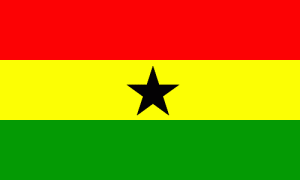
Flag of Ghana

The flag of Ghana was first introduced in 1957, when Ghana declared its independence from the United Kingdom. The flag is a rectangular shape consisting of three horizontal stripes, one each of red, yellow, and green, and contains a black five-pointed star in the center of the yellow stripe.  It was flown until 1959, when Ghana united with Guinea to form the Union of African States.  During this time, Ghana flew a Union flag, which looked like the previous flag, except for the addition of an additional star.  When Mali joined the union, a third star was added to the flag.  In 1966, the Union disintegrated, and Ghana reinstated its original 1957 flag.

The flag of Ghana is special because the nation was only the second African nation, after Ethiopia, to adopt the red, yellow, and green pan-African colors, and was designed by a woman, Theodosia Salome Okoh.  The pan-African colors, although widely used, have symbolic meaning for Ghana.  The red symbolizes the blood of those who died for Ghana’s struggle for independence.  The gold signifies the wealth of the Ghana’s natural mineral resources and the green symbolizes the rich forests.  The black star in the center of the gold stripe commemorates Ghana’s establishment as the first twentieth-century independent African nation.

A few other versions of Ghana’s flag exist, but all of them contain the national flag within it.  The Presidential flag is simply the Ghana national flag with gold fringe. The Ghana naval flag consists of a white rectangle with a red cross and the Ghana national flag in the upper left corner.  The air force flag of Ghana is a blue rectangle with the Ghana national flag in the upper left corner, but also contains a red, yellow, and green roundel in the lower right corner.  The civil aviation is identical to the air force flag, but a black five-pointed star replaces the roundel in the lower right corner.

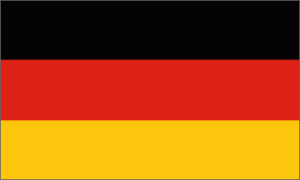
Flag of Germany

The flag of Germany was adopted on May 9, 1949. The flag is officially called the Bundesflagge, or federal flag; however this term is mostly used by governmental authorities or in official notices.  The flag is sometimes referred to poetically as the Schwarz-Rot-Gold, or black-red-gold or by sailors as the Adenauer.  The most common name for the German flag is the Deutschlandfahne, or simply Germany flag.

The German flag is a simple rectangle with three horizontal stripes that are black red and gold.  This tricolor flag, although officially adopted just sixty years ago, was used several times throughout German history.  In 1848, it was adopted as a German flag during the revolution and the Frankfurt Parliament government, but it was banned four years later.  On August 11, 1919, the tricolor flag became the official flag of the Weimar Republic, but it was again banned on March 12, 1933 to be replaced with the Third Reich flag.  Finally, the flag was officially adopted as the flag of the Federal Republic of German on May 9, 1949.  From 1959 until 1989, during the Cold War, the flag represented the German Democratic Republic.  During these thirty years, the flag included the German coat of arms, a yellow shield with a black eagle.

Similar versions to the current German have also existed.  In 1866, after the Prussians dominated North Germany, the government adopted a black, white, and red striped flag.  This was used during the German Empire until the end of World War I.  The black, white, and red colors were also used during the Third Reich, although not always in the strict horizontal stripe pattern.  These color variations have developed powerful associations with the German people.  Since World War II, the black-red-white color scheme is largely associated with the Nazi regime and the horrors of that time, while the black-red-gold pattern represents German unity and the freedoms enjoyed by the people of modern Germany.

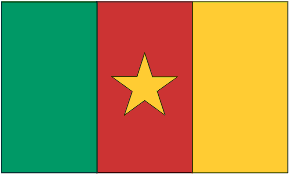
Flag of Cameroon

The flag of Cameroon was officially adopted on May 20, 1975. The flag is rectangular with three vertical columns featuring the Pan-African colors green, red, and yellow.  In the center of the red stripe is a five-pointed yellow star. Cameroon was the second modern African state to adopt these colors in their flag.

The first version of the Cameroonian flag was created in 1957, and contained just the green, red, and yellow stripes without the five-pointed star.  The Pan-African colors of green, yellow, and red represent the French tricolore and have symbolic meaning.  The green symbolizes hope for the future and also represents the southern forests.  The yellow symbolizes prosperity and also represents the northern savanna.  The yellow also represents the sun, which is the Cameroonian people’s source of happiness.  The red symbolizes unity.

The star in the center of the red stripe also symbolizes unity.  After World War I, the League of Nations divided the Cameroonian territory between France and Britain.  In 1960, the French Cameroon succeeded in gaining independence from France and became the Republic of Cameroon.  In 1961, after the government of Southern Cameroon decided to join Cameroon to form a federal government, the Cameroonian flag contained two yellow stars, placed in the upper part of the flag’s green stripe.  In 1972, Cameroon formed a unitary government and the two stars were replaced with a single yellow star in the center of the red stripe.

Cameroon is often nicknamed “Africa in miniature” for its geographical and cultural diversity.  Cameroon is bordered by Nigeria, Chad, the Central African Republic, Guinea, Gabon, Congo, the Atlantic Ocean and the Gulf of Guinea.  The country’s landscape contains deserts, mountains, rainforests, beaches, and savannas, and is home to more than two hundred ethnic groups.

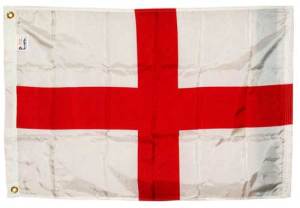
Flag of England: The St. George Cross

The English St. George’s cross was adopted in the 16th century. The flag is rectangular and features a red cross on a white background.  The flag has been an emblem of England since the Middle Ages and the Crusade era.  The modern British flag, although embellished with a blue background and other red stripes, still contains this basic red cross.

Saint George (ca. 275-April 23, 303) was a Roman soldier and priest and is now a Christian martyr.  He is one of the most venerated saints in the Catholic, Anglican, Eastern, Orthodox, and Oriental Orthodox churches.  The Legend of Saint George took place in “Silene,” where a plague-bearing dragon lived in a large pond.  To keep the dragon from attacking, the townspeople fed the dragon sheep, but when the sheep failed they drew lots to feed the dragon someone’s child.  The lot fell on the king’s daughter.  As the daughter stood by the pond, dressed as a bride to be fed to the dragon, Saint George rode past, tamed the dragon and saved the king’s daughter.  The king’s daughter and Saint George brought the dragon into the village where Saint George told the townspeople that he would slay the dragon if everyone agreed to become baptized Christians.  The townspeople consented, Saint George slew the dragon, and the king built a church on the site of the dragon’s death.

During the Crusades, the English flag was a white cross on red while the French flag was a red cross on white.  During a meeting between Henry II of England and Philip II of France in 1188, the two powers agreed to exchange flags.  Adoption of the exchange was not unified; however, some French continued to carry the red cross on the white background and this red cross became the typical symbol of the Crusade.

St. George’s flag is flown at the Church of England and also at sporting events, particularly during cricket and rugby matches.  The City of London flies the St. George Cross with a red sword in the upper left corner.  The Royal Navy also flies the St. George Cross with the modern British flag in the upper left corner.

Flag of Slovenia

The flag of Slovenia was adopted on June 27, 1991. It is a rectangular flag with three horizontal stripes of white, blue and red.  In the upper left corner is the coat of arms, a blue shield with a red border featuring the triple-peaked Triglav Mountain, the sea, and three yellow stars.

The colors of the Slovenian flag were not derived from the Russian flag, like the flags of Serbia and Bulgaria, but from the Serbian coat of arms.  The first Slovenian coat of arms originated in the early 13th century when Slovenia’s geographical area included the Carniola province and parts of Styria, Koroska, and Istria.  During this time, the coat of arms was a red eagle on a silver background.  During the fourteenth century, the color of the eagle and the background changed several times, including the colors blue, red, silver, and gold.  In 1836, Emperor Ferdinand I officially changed the coat of arms back to the original blue eagle on a silver background, this time with a gold and red crescent on the eagle.

In 1848, the red and blue colors from the coat of arms became the colors of the Slovenian flag with the addition of white instead of gold and silver.  This tricolor flag was used until the end of World War I in 1918, although the Austrian rulers that controlled Slovenia during this time did not recognize the flag’s authority.  When Slovenia joined the Kingdom of Serbs, Croats, and Slovenes after World War I, the flag was banned.

During Word War II, from 1941-1945, the Slovenians on the Axis side used the tricolor flag with the coat of arms.  The Slovenians on the Allies side used the tricolor flag with a red five-pointed star or a zigzag line representing mountains.

After World War II through the end of the Cold War, the Slovenia used the tricolor flag with a five-pointed star.

United States National Flag Day

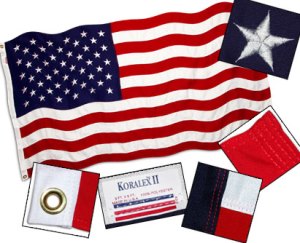
Flag Days exist all around the world, but the United States Flag Day commemorates Congress’s adoption of the 13-stripe, 13-star, red, white, and blue flag on June 14, 1777. The United States Flag Day’s beginnings date back to 1885, when nineteen-year old school teacher Bernard J. Cigrand placed an American flag on his desk and asked his students to write essays about the significance of the Stars and Stripes flag. Cigrand quickly became devoted to spreading the observance of the United States Flag Day nationwide. Finally, on May 30, 1916, President Woodrow Wilson called for national observance of Flag Day. Flag Day became official when President Truman signed an Act of Congress in 1949 that designated National Flag Day as June 14 of each year.

Although Cigrand is often credited with the creation of the United States Flag Day, other people have also contributed to its existence. In 1861, four years before Cigrand’s classroom Flag Day, the book Kansas: A Cyclopedia of State History credited George Morris of Hartford, Connecticut with suggesting the idea for a Flag Day. Hartford, Connecticut actually observed the suggested Flag Day in 1861 as a day for praying for the U.S. Army and the Government.

In 1888, Collier Township, Pennsylvania resident William T. Kerr founded and became the national chairman of the American Flag Day Association of Western Pennsylvania. Kerr led the organization for fifty years and attended President Truman’s signing of the official Flag Day Act in 1949.

In 1889, George Bolch celebrated Flag Day when he was the principal of a free kindergarten. Instead of recognizing Cigrand’s hometown of Waubeka, Wisconsin, as the official birthplace of the United States Flag Day, some recognize Philadelphia as Flag Day’s original city. In 1893, Elizabeth Duane Gillespie, President of the Colonial Dames of Philadelphia, tried to mandate the that all public buildings in Philadelphia fly the American Flag. Pennsylvania became the first state to make Flag Day official when they declared it a legal holiday in 1937.

Flag Day, although not a legal holiday, is celebrated across the country to varying degrees. Government buildings fly the flag at full mast and many towns organize parades, ceremonial flag raisings, and group recitations of the Pledge of Allegiance and the Star-Spangled Banner.

Decorative Banner Flagpoles and Garden Flag Poles

It’s June, and you’ve planted your garden, but what makes it your garden without some personalized touches?  Here’s the solution: order a Garden Flag and Flagpole from the U.S. Flag Store!  The Flag Store has dozens of styles to choose from for both flags and flagpoles, so you’re sure to find the perfect one for you and your garden.

Whether your style is classy or whimsical, the Flag Store’s Monogram Garden Flags are the perfect personalized touch for your garden.  The Flag Store offers gorgeous, detailed designs with embroidered letters in the center.  Patterns include a blue and green Stately Scroll, black and white Classical Elegance, and brown and blue Chocolate Elegance.  At only $14.99 you can’t go wrong!

If you’re a sports fan, check out the Flag Store’s NFL Team Flags.  These 15” x 10.5” NFL flags are officially licensed, beautifully appliquéd, and made of 100% high-quality, durable nylon.  These flags are only $11.99 and include a pole hem for easy hanging.  If you’re a NASCAR fan, the Flag Store sells eight different NASCAR Garden Flags.  These flags are double sided and made of 150-denier polyester.  At only $9.50, these flags are a great way to display your racecar enthusiasm!

If showing your patriotic spirit is your passion, then take a look at the Flag Store’s Patriotic Garden Flags.  Flags come in all different styles, from the traditional U.S. flag to the 13-star Betsy Ross flag to flags with bald eagles or even beach scenes and fireworks.  These flags are as low as $8.99, so order yours today!

If you have a family member or friend in the U.S. Armed forces, be sure to check out the Flag Store’s great selection of Armed Forces flags.  Whether your family member is in the Army, Navy, Marine Corp, Air Force, Coast Guard, or has received a Purple Heart, you’ll find the perfect flag for your garden here.

While you’re shopping, be sure to check out the Flag Store’s great selection of Special Occasion and Holiday, Summer, and Fall and Winter Garden Flags.  And don’t forget to order a flagpole or holder!

Summer Banner Flags

Are you having a summer party this season?  Or do you need a bold way to show Dad you care on Father’s Day?  Or just wanting to celebrate summer? Then you need a Summer Banner Flag from the U.S. Flag Store!  All Summer Banner flags are made of high-quality polyester and feature either appliquéd or embroidered designs.  Flags are popular sellers in the summer and retail stores sell flags like these for up to $30.  Luckily, you can find flags at the Flag Store for as low as $17.95!
If you’re having a party, check out the Flag Store’s new Aloha Banner Flag.  Shaped like a Hawaiian shirt, this flag even has a floral lei on top!  If wine is your specialty, the Flag Store even has a Wine Banner Flag featuring a bottle of wine, a glass, and big purple grapes for only $17.95.  The Flag store also has a festive Pool Party Flag, complete with an image of a swimming pool, diving board, sailboat, beach ball, and sandals.

Need a Father’s Day gift?  Try a Father’s Day Banner Flag!  The new Best Dad Banner Flag features a power drill, screw driver, and other tools and says “Best Dad Lives Here” across the top and bottom.  What better way to show your dad he’s appreciated!  For younger kids, check out the “Beary Special Dad” Banner Flag, featuring poppa bear and baby bear and plenty of big red hearts.

If you just need a way to celebrate summer, the Flag Store has you covered, with plenty of Summer Banner flags.  Designs include all things summer: bugs, bees, butterflies, strawberries, flowers, fish, and much more.  And if you’d just rather be fishing, then you need to order the Flag Store’s “I’d Rather Be Fishing” Banner Flag, complete with a big-mouth fish!

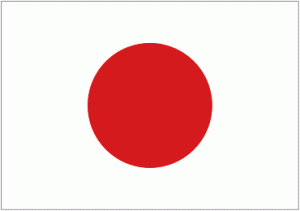
Flag of Japan

The flag of Japan is simple, but rich with historical and social significance. Japan’s national flag is a white rectangle with a large red circle or disk in the center.  The official name for the flag is Nisshoki, or sun mark flag in Japanese; however, the flag is commonly known as HInomaru, or simply, sun disk.

In 1870, two proclamations by the Daijo-kan, the governing body of the Meiji Era, provided a design for the national flag of Japan. On February 27, 1870, the flag was adopted as the national flag for merchant ships; on October 27, 1870, the flag was adopted as the national flag for the Navy.

The red sun disk has been used for centuries on daimyos and samurai flags.  Using this historical and social connotation, the government of the Meiji Era in the nineteenth and twentieth centuries exploited this image by using it in the armed forces, on propaganda posters, in textbooks, and in films as an emblem of patriotism and national pride.  Japanese citizens were required by law to display the flag on national holidays and any other government-mandated occasion.  After World War II, the American military occupying Japan restricted the flag’s use.

Due to its exploitation in propaganda schemes, the Japanese flag has differing connotations. Although many Japanese feel strongly about the flag’s use, viewing it as a symbol of a strong nation, to others, the flag is a reminder of extreme nationalism.  Use of the flag is a sensitive, unresolved topic in schools and arguments about the flag’s presence have caused protests and lawsuits.

Arguments about the flag’s presence came to the forefront in 1999, when a Hiroshima school principal committed suicide because he could not resolve a disagreement between teachers and his school board about the flag’s use.  Following this incident, the Japanese government passed The Law Regarding the National Flag and National Anthem, officially recognizing the Hinomaru as the national flag of Japan.