State Flag of Indiana

The flag of the state of Indiana was adopted on May 31, 1917. The flag is rectangular with a blue background and features a gold torch. Thirteen gold stars surround the flag in a circular shape and five gold stars make up an inner semicircle. Just above the torch is one more star and the word, “INDIANA,” in gold lettering.

The symbolism of the Indiana state flag is relatively simple, although very meaningful. The torch symbolizes liberty and enlightenment, and the six rays around the torch’s flame represent the broadness and expansiveness of these values. As with other state flags that include thirteen stars, the thirteen gold stars that encircle the torch represent the thirteen original colonies of the United States. Indiana was the nineteenth state to enter the Union; and the five stars in the semicircle on the lower half of the flag symbolize the five states that entered the Union before Indiana. The star at the top of the torch, the largest star on the flag, stands for Indiana.

Although Indiana became a member of the United States in 1816, the state did not have a flag until its residents celebrated the Indiana Centennial in 1916. In anticipation of the centennial, the Indiana General Assembly requested that the Daughters of the American Revolution Indiana Chapter sponsor a contest for the state flag’s design.

After more than two hundred submissions were submitted, Paul Hadley, an artist living in Mooresville, Indiana, won the design contest, as well as a cash prize of one hundred dollars. The state flag was officially adopted on May 31, 1917, with the addition of the word “INDIANA” to Hadley’s original design. Since the flag’s adoption in 1917, the flag’s design has remained unchanged with the exception of a 1955 statute that standardized the flag’s dimensions.
State Flag of Maryland

The Flag of Maryland

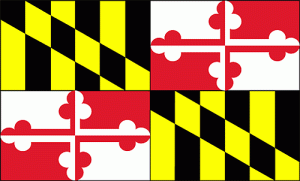
The flag of the state of Maryland was adopted on November 25, 1904. The Maryland flag is rectangular and divided into four fields. The top left and bottom right fields feature the coat of arms of the Calvert Family and the top right and bottom left feature the coat of arms of the Crossland family.

Maryland is the only state in the United States to use a British coat of arms for its state flag. The two coats of arms represent the banner of George Calvert, 1st Baron Baltimore, who was a British politician, colonizer, and Parliament member in the seventeenth century. Calvert became interested in establishing colonies in Newfoundland, and, after realizing Newfoundland’s weather was unsuitable for English settlers, began drafting a royal charter to colonize what is now the state of Maryland. Although Calvert died several weeks before the charter was sealed, Calvert is historically recognized as the founder of Maryland.

George Calvert’s son, Cecilius Calvert, 2nd Baron Baltimore founded the colony of Maryland. From Maryland’s founding until the Civil War, only the gold and black Calvert coat of arms was used to represent Maryland. During the Civil War, Maryland remained in the Union; however, many of Maryland’s citizens chose to fight with the Confederate Army of Northern Virginia and began using the Crossland coat of arms as their secession banner.

After the Civil War, Maryland’s citizens began flying flags that included both coats of arms, in an effort to reconcile conflicted feelings. The flag of Maryland that is used today was first flown on October 11, 1880 at a parade marking the 150th anniversary of Baltimore’s fouding. It was later used on October 25, 1888 at Gettysburg during a ceremony dedicating monuments to the Maryland regiments that fought for the Army of the Potomac. Maryland’s state flag was officially adopted on November 25, 1904.

The flag of Maryland’s colors and symbols are used prominently throughout the state. The city of Baltimore and the counties of Baltimore, Howard, Calvert, and Worcester all have coats of arms and/or flags that incorporate one or both of the flag of Maryland’s coats of arms. The University of Maryland, Loyola University Maryland, and Johns Hopkins University, the Maryland’s sports teams all use the colors or symbols of the Maryland flag in some way as well.

One Life: One Flag Memorial

From September 8 through September 12, over 3,000 flags will wave in New York City as a tribute to those who lost their lives in the terrorist attacks of September 11, 2001. The flags are located in Manhattan’s Battery Park, just three blocks from the World Trade Center Memorial Museum. The memorial is free and open to the public.

The theme of the memorial is “One Life: One Flag,” and the memorial’s designers encourage visitors to reflect upon the enormous loss of human life that occurred on September 11, 2011.

The memorial contains 2,976 Flags of Honor and Flags of Heroes, all American flags representing someone who died in the attacks. The memorial also includes 96 international flags, one flag for each country who lost a citizen on September 11.

Annin Flagmakers have manufactured all the flags for this event. Annin Flagmakers are the oldest and largest makers of flags in the United States. Two brothers, Benjamin and Edward Annin founded the company in 1847 on Fulton Street in New York City. Aside from being the premier maker of flags in the United States, remaining family owned for over 150 years, and employing over 500 Americans, Annin’s New York City roots make them a particularly appropriate sponsor for the “One Life: One Flag” memorial.

Annin Flagmakers, the Healing Field Foundation, and the Flag of Honor Project collaborated to create the “One Life: One Flag” field.

Co-sponsors of the “One Life: One Flag” memorial include:

Collavino Construction Company

Con Ed

Foley Caterpillar

Haks Engineering

Kaiser Aluminum Corporation

Joe Tex Transportation/Logistics

National Independent Flag Dealers Association

New Jersey Manufacturer’s Insurance

USA Rigging Supply

“One Life: One Flag” volunteer organizations include:
Fort Dix

Fort Hamilton Military Base

Lakehurst Naval Base

International Brotherhood of Electrical Workers

McGuire Air Force Base

Tuesday’s Children

We Remember

We remember those who perished and the families left behind.

We remember the first responders who bravely raced to the rescue of others.

We remember those who courageously fight the wars on terrorism and those who gave their lives.

Flag of Arkansas

The flag of the state of Arkansas is a U.S. state flag with a very interesting history and meaning behind it. The current state flag of Arkansas is rectangular with a red background. In the center of the flag is a large white diamond with a blue border. Twenty-five white stars appear inside the blue border. In the center of the white diamond, the word “Arkansas” appears in blue capital letters, with one blue star above and three blue stars below it.

Although the current version of the Arkansas state flag was adopted on March 16, 1924, Willie Kavanaugh Hocker designed Arkansas’s first state flag in 1912. In this year, the Daughters of the American Revolution’s Pine Bluff chapter decided to hold a contest to develop a design for Arkansas’s state flag. Willie Hocker, who was also a member of the Pine Bluff chapter, won the contest.

The original design for the Arkansas state flag is similar to the current version, but in the original version, only three stars appear, all in one line, in the center of the white diamond. The word “Arkansas” was not included in the original design. Arkansas’s Secretary of State Earle Hodges requested that Hocker add the state’s name to the flag, and Hocker complied, rearranging the stars so that one blue star appeared above “Arkansas” and two appeared below the name. The Arkansas state legislature adopted this version of the flag was adopted on February 26, 1913.

In 1923, for only one year, a fourth star was added above the state’s name. These four stars represented the Confederate States of America, and the three countries Arkansas has been part of: Spain, France, and the United States. In 1924, the Arkansas State legislature moved the fourth star below the word Arkansas, and rotated it so that the top point of the star faces downward.

The flag’s images have deep symbolic meaning. The diamond in the center of the flag represents that Arkansas, before recent diamond discovers in America’s Rocky Mountain region, was the only state in the United States that contained known quantities of diamonds. The twenty-five stars inside the diamond’s blue border represent Arkansas’s admission to the Union as the twenty-fifth state.

The four inner stars’ meanings are more complicated. The star above the word “Arkansas” is now said to represent the Confederate States of America. The three stars below Arkansas have three separate representations. First, the three stars represent the three states Arkansas has been a part of: Spain, France, and ultimately the United States. Second, the three stars represent the year 1803, when the Louisiana Purchase made present-day Arkansas part of the United States. Finally, the three stars also recognize that Arkansas was the third state admitted to the Union from the Louisiana Purchase’s territory.

September 11 Memorial Flags

Our lives changed forever on the morning of September 11, 2011, when terrorist attacks devastated New York City’s Twin Towers, the Pentagon in Washington DC, and flight 93 in Shanksville, Pennsylvania. Since September 11, 2011, countless troops have died in Iraq, Afghanistan, and other war zones around the world.

Each year, on September 11, we honor the victims of the September 11 attacks and those troops who have sacrificed their lives for our safety. Since September 11, Americans have become increasingly patriotic and Online Stores has supported Americans in the military by donating flags, flagpoles, and pins, among other items.

This year will mark the tenth anniversary of the September 11 attacks. Cities around the country are planning memorial events to honor the victims of the attacks and American troops in combat. Online Stores has a variety of beautiful September 11 memorial flags to help you make the day more meaningful.

The USA 9/11 Flag

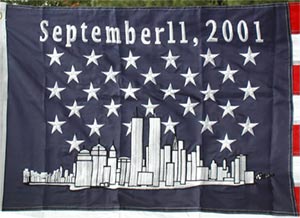
The USA 9/11 flag is designed based upon the United States flag. Instead of the traditional blue, fifty-star Union field, however, the USA 9/11 flag features an embroidered image of the New York City Skyline with the Twin Towers, white stars, and the date, September 11, 2011. The flag is 3’x5’ with sewn stripes and durable brass grommets.

Always remember....

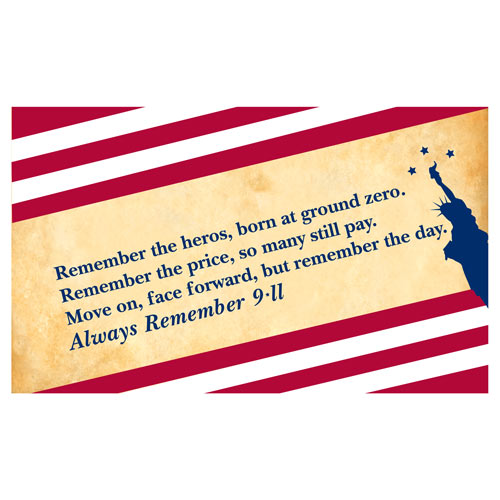
The 9/11 Always Remember flag is a beautiful way to honor the victims of the September 11 attacks. The nylon flag features red and white stripes at the top and bottom, a blue image of the Statue of Liberty, and the following poem:

Remember the heroes,
born at ground zero.
Remember the price,
so many still pay.
Move on, face forward,
but remember the day.

Always Remember 9-11

This flag is available in the large 3’x5’ size and a vertically oriented garden size.

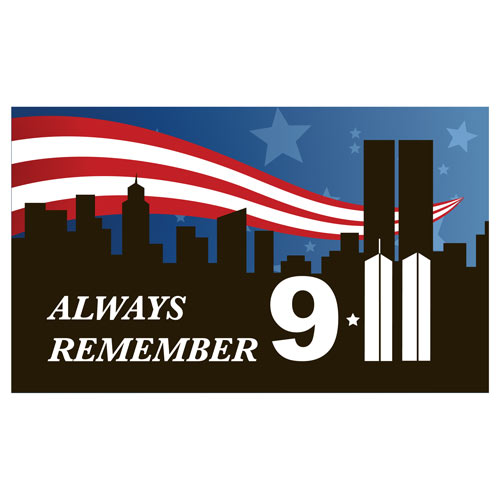
The 9/11 Remembrance flag features bold images of the New York City and Twin Towers skyline, red and white stripes disappearing into the horizon, and blue stars in the background. The words “Always remember 9/11” appear in the foreground of the flag, with the “11” designed to look like the Twin Towers. This flag is also available in 3’x5’ or garden size.

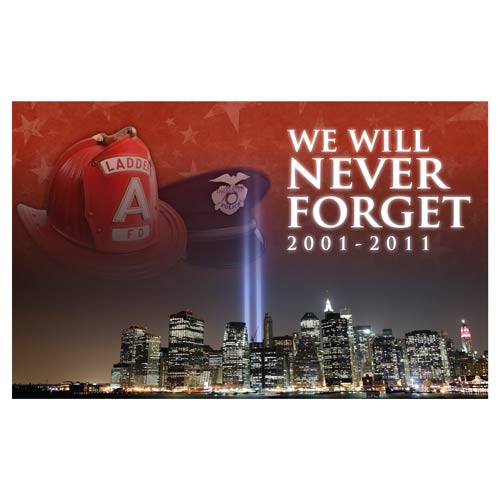
The 9/11 We Will Never Forget flag is specifically designed to honor the 10-year anniversary of the September 11 attacks. The nylon flag features a photograph of the New York City skyline in the foreground and images of a police hat and firefighter’s hat in the upper left corner. The text “We Will Never Forget 2001-2011” appears in the upper right corner in bold white letters. This flag is made from top quality fabrics and can be used inside or outdoors.

Flag of South Sudan

South Sudan is the newest country in the world, having declared its independence from Sudan on July 9, 2011. Many countries adopt a flag after becoming an independent nation, but South Sudan actually adopted its official flag exactly six years before its independence day. The flag of South Sudan was adopted on July 9, 2005, following the end of the Second Sudanese Civil War.

The flag of South Sudan is rectangular with three large horizontal stripes: the top stripe is black, the middle stripe is red, and the bottom stripe is green. Two thinner white stripes appear between the larger colored fields. A blue triangle with a gold star in the center appears on the left side of the flag.

The colored stripes on the flag refer to the Pan-African colors. These colors appear in the flags of many African nations and are also the official colors of the Universal Negro Improvement Association and African Communities League (UNIA).

In the flag of South Sudan, the black stripe represents the people of South Sudan; the red stripe represents the blood of all the South Sudanese that fought for their country’s freedom; and the green stripe represents the geographical land and resources of South Sudan. The smaller white stripes on the flag represent the country’s desire for peace.

The blue triangle on the left side of the flag stands for the Nile River, which flows through South Sudan. The gold star in the center of the triangle stands for unity among the people of South Sudan. It also alludes to the Star of Bethlehem, and the relatively large number of Christians residing in South Sudan.

The flag of South Sudan is very similar to the flag of Kenya, which borders South Sudan. Prior to the current flag’s adoption in 2005, the flag of South Sudan was the official banner of the Sudan People’s Liberation Movement, which fought the Sudanese government from 1983 until 2005.

Flag of Ohio

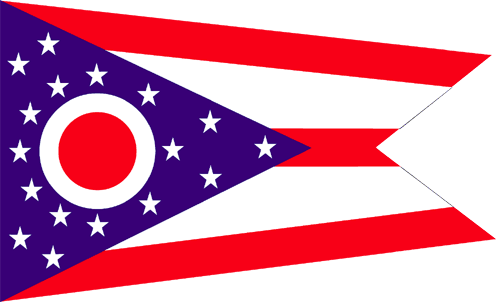
The flag of the state of Ohio is one of the most unique state flags of the United States because it is the only state flag in the nation that is not rectangular. John Eisemann designed the flag of the state of Ohio for the Pan-American Exposition, a world’s fair in Buffalo, NY, in 1901. The flag was officially adopted in 1902.

The flag of the state of Ohio is a non-rectangular, swallow-tailed shape. The top and bottom hems of the flag taper inwards towards the flag’s fly end and a triangular portion of the flag is removed from the fly end. Although the only state flag of the U.S. to use this shape, this swallow-tailed element of the flag is common military units.

Like most state flags, the design of the flag of the state of Ohio holds great significance in terms of Ohio’s admittance to the Union, the people of Ohio, and the state’s natural elements. The flag has five large horizontal stripes: the top, bottom, and middle stripes are red and the stripes in between the red stripes are white. This not only bears similarity to the flag of the United States, but also represents Ohio’s roads and rivers.

The large blue triangle with white stars inside that appears on the left side of the flag is another feature of the Ohio flag that reflects the design of the U.S. flag. The blue triangle also symbolizes Ohio’s hills and valleys. The white stars on the Ohio state flag are divided into two groups: there are thirteen stars on the left side of the flag and four, more widely spaced stars on the right. The thirteen stars represent the thirteen original colonies of the United States. The other four stars, when combined with the thirteen, add up to seventeen stars, representing Ohio’s admittance to the Union as the seventeenth state.

Finally, the white circle with the red center in the middle of the blue triangle is truly unique to Ohio. The white circle represents the letter “O” for Ohio. Adding the red center alludes to Ohio’s nickname, the “Buckeye State.” Not only the name of the Ohio State University sports teams, the buckeye refers to the Ohio state tree, which produces nuts that resemble a buckeye.

Flag of the State of Georgia

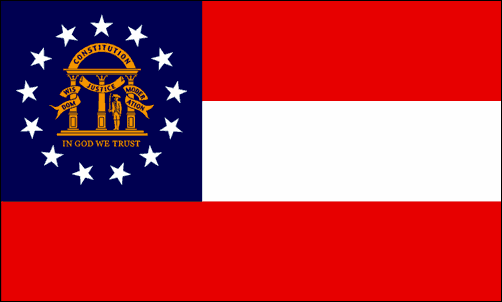
The current flag of Georgia.

The adopted flag of the U.S. state of Georgia is the newest state flag in the United States and has a very interesting story behind its development. Adopted just over eight years ago, on May 8, 2003, the flag is based off of the design of the Confederate States of America’s first national banner.

The current flag of Georgia, like the U.S. flag, is rectangular and includes a blue field in the upper left corner. The blue field includes the state of Georgia’s coat of arms and thirteen white stars. The coat of arms consists of three pillars, which represent the three branches of state and federal government: executive, legislative, and judicial. An American soldier with a drawn sword, dressed in a Revolutionary War uniform, stands between the pillars, symbolizing the state’s courage to defend the constitution.

Two phrases also appear in the blue field. “Wisdom, Justice, and Moderation,” Georgia’s state motto, appear on a banner around the pillars. “In God We Trust,” is written below the seal, but these words are not actually part of the official Georgia seal. The thirteen stars around the seal signify Georgia’s inclusion in the original thirteen U.S. colonies.

The rest of the flag consists of three horizontal stripes: the top and bottom stripes are red and the middle stripe is white.

Controversy over the state of Georgia’s previous flag, which was used from 1956 until 2001, ultimately led to the flag’s repeal and the design of a new flag. The flag adopted in 1956 prominently featured the Southern Cross, a prominent symbol of the Confederate States of America. Although proponents of the flag claimed that the Georgia state flag was designed to commemorate the Civil War Centennial, others took offense. The flag was adopted at the height of the American Civil Rights Movement, and white supremacy groups were using the Confederate flag as a symbol of racial protest.

Although pressure to adopt a new state flag increased throughout the second half of the twentieth century—especially before the 1996 Olympic Games, which were held in Atlanta—the flag was not replaced until 2001. In that year, the state legislature adopted a replacement flag that featured Georgia’s state seal above smaller versions of Georgia’s previous flag. The current flag of Georgia was adopted in 2003.

Rules for Flying the U.S. Flag

Purchasing an American flag, no matter how large or small requires understanding of proper flag regulations. Although not difficult to follow, many Americans are unaware of the federal laws that ensure all American flags are treated with dignity and respect. Below are the most important rules that govern the use of the American flag, according to the United States Flag Code.

  1. The American flag is customarily displayed only from sunrise to sunset. A flag may be displayed during darkness if the flag is properly illuminated
  2. The flag is always raised quickly and lowered slowly.
  3. Only all-weather or weather-resistant flags should be flown during sever weather to avoid damaging—and thus making unusable—less durable flags.
  4. The main administration buildings of every public institution should fly an American flag on the premises.
  5. Polling locations should display the American flag on or near the premises on election days.
  6. Schools should display the American flag on or near the premises when school is in session.
  7. In a procession with other flags, the flag should appear in the front of the line, on the flag’s own right (observer’s left).
  8. The American flag should never be draped over anything, such as a car, train, boat, statue, or monument, and should never be used on a parade float.
  9. When used indoors, the union of the flag should appear at the flag’s own right (observer’s left). If the flag is on display during a speaker’s presentation, the flag should be displayed either on a pole at the speaker’s right or above and behind the speaker. If other flags are on display, they should appear to the speaker’s left, and only the flag of the United States should appear on the speaker’s right.
  10. When a flag is displayed above the middle of a street, the union should be to the north on an east-west street or to the east on a north-south street.

It’s also important to note that the Flag Code cannot cover all possible flag-waving situations. When practices are in question, the following overarching rule should be followed: “No disrespect should be shown to the flag of the United States of America.”

Valley Forge Flags

The United States Flag Store is the largest and most complete vendor of Valley Forge flags, flagpoles, and accessories. With the widest variety and largest quantities of Valley Forge flags and flag accessories in their inventory, the United States Flag Store is your number one online store for these high-quality American-made flags.

Valley Forge flags are special for several reasons. In addition to serving as one of the oldest and most widely regarded makers of American flags, Valley Forge flags are completely American-made. The company is also a major supplier of American flags to the United States government, and Valley Forge flags have been raised and flown in major American events since World War II, including at the Battle of Iwo Jima, at the liberation of the Nazi Concentration Camps, in Normandy on D-Day, and on the first moon landing.

The Valley Forge Flag Company has remained a family-owned business since its beginnings in 1882. The company began its industry by manufacturing burlap sacks and began manufacturing American flags and other surplus during World War I. In 1932, due to increasing demand for American flags, the Valley Forge Company opened a small factory in Spring City, Pennsylvania. To this day, the Valley Forge Flag Company operates under the mission to manufacture United States flags that are 100% American-made. The Valley Forge Flag Company is committed to educating the American people and flag sellers about the importance of American-made flags and helped found the Flag Manufacturers Association of America.

Valley Forge flags are available in three materials from the United States flag store: cotton, nylon, and Koralex. The Valley Forge Best Cotton American Flags are made of heavyweight 2×2 ply mercerized cotton. The cotton flags feature vibrant colors and reinforced fly ends, and are designed for outdoor use. Valley Forge Nylon American Flags are a lower cost alternative to the traditional cotton flag but are a cut above traditional nylon flags. Valley Forge nylon flags feature sewn stripes, embroidered stars, and reinforced fly ends for an elegant look. Valley Forge Koralex American Flags are another great alternative to traditional cotton flags because they have the appearance of cotton but are more fray and weather resistant.