Canadian Flag

The National Flag of Canada, which is also known as the Maple Leaf, was adopted in 1965 and marked the first time a national flag had been officially adopted in Canada to replace the Union Flag. The Canadian flag wasn’t without controversy. The Canadian Red Ensign had been used “unofficially” since the 1890s and was even approved in 1945 by Order-in-Council for use in places where it made it desirable to fly a distinctive Canadian flag.

canadian flag

It wasn’t until 1964 when Prime Minister Lester B. Pearson put together a committee to resolve the flag issues, thus setting off a serious debate about a flag change. The final selection was designed by George F.G. Stanley and John Matheson. Their maple leaf design was based upon the flag of the Royal Military College of Canada.

The Maple Leaf flag made its debut on February 15, 1965 and that date is now Canada’s National Flag of Canada Day; celebrations occur annually. Although there is not a law that dictates the official use of the Canadian Flag, there are some guidelines to follow. The flag can be displayed on any day on buildings operated by the government, airports, diplomatic offices, military, and by citizens during any time of the day. When flying the Canadian flag, it must be on its own pole and cannot be inferior to other flags, except for (in descending order) the Queen’s Personal Standard, the Governor General’s Standard, any of the Personal Standards of the members of the Canadian royal family, or flags of the Lieutenant Governors.
Japan Flag

The national flag of Japan is called Nisshoki, meaning sun flag; however, it is more commonly known as Hinomaru, meaning sun circle. The flag was officially adopted by the civil ensign with Proclamation 57 on February 27, 1870 during the Meiji Restoration. It wasn’t adopted nationally though, until August 13, 1999 by the Law Concerning the National Flag and Anthem.

japan flagJapan’s flag protocol calls for the flag to be flown from sunrise until sunset; however, a business or school is allowed to fly the flag from their opening to closing hours. The Cabinet Prime Minister of Japan is the official with authority to place the flag at half-staff.
The flying of the Japan flag is primarily limited to buildings associated with national and local governments, such as city halls. It is rarely connected with private homes or commercial businesses; although that is changing somewhat as time goes by and some citizens are advocating for exhibiting the flag on Japanese holidays.

When flying another country’s flag with the Japanese flag, Japan’s flag should take the position of honor and the other country should be flown to the right at the same height. If more than one other foreign flag is presented, the arrangement is in alphabet order prescribed by the United Nations.

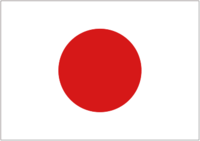
Japan’s flag has a red circle within a middle of a white flag. The red circle symbolizes the sun and Japan is said to be “The Land of the Rising Sun.” The white of the flag denotes honesty and purity while the red “sun” signifies brightness, sincerity, and warmth.

Australia Flag

The Australian flag came into being on January 1, 1901 after the federation of the Australian States into the Commonwealth of Australia. The Commonwealth Blue Ensign was decided upon as a result of a competition from the public. And even though it was selected in 1901 and gazetted in 1903, it did not receive Royal assent and adoption until 1954 in the Flags Act of 1953.

australia flag

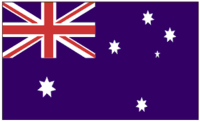
The current Australia Flag consists of three components:

  • The Union Jack is in the upper left part of the flag which represents Australia’s historical link to Great Britain.
  • The Southern Cross is in the second quarter and fourth quarter of the flag. The stars represent the Southern Cross constellation which is a significant navigational feature of the southern hemisphere.
  • The Commonwealth Star or Star of Federation is the star central in the third quarter of the flag. The seven points of the star designate the six states and the combined territories of the Commonwealth.

Each of the six states of Australia has their own official state flag; the common feature being a blue ensign defaced with the badge of the state. The flags of the territories are more unique and individual in nature and they don’t have the blue ensign background like the states.

There are other flags in Australia besides the “official” flag:

  • The Queen’s Personal Flag for Australia
  • The Govern General’s Flag
  • The Eureka Flag
  • The Republican Movement
  • The Flag of Aboriginal Australia

According to the Australian government, “The Australian National Flag is Australia’s foremost national symbol. It was first flown in 1901 and has become an expression of Australian identity and pride.

The Australian National Flag flies over the federal and state parliaments. The flag is paraded by our defence forces and displayed around the country at sporting events and by service organisations, schools, community groups and private citizens.”

Vatican Flag

Just like most other people, at first glance I would have never imagined that there was a flag specific to Vatican City. This is not the case however, as the current Vatican flag has been in place for over 70 years. The flag of the Vatican was originally adopted on June 7, 1929 by then Pope Pius XI. The flag was created as part of the treaty recognizing Vatican City as an independent state.

vatican flag

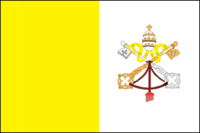
The Vatican flag is one of the most unique flags of any country or state in the entire world – in fact, there is only one other flag in the world like it. The Vatican flag consists of two vertical bands, one yellow and the other white. The interesting thing to note, however, is that the Vatican flag is actually square – one of only two flags in the world like this (the other being Switzerland).

On the right side of the Vatican flag sits the traditional Vatican City Coat of Arms, emblazoned upon a white background. The Vatican City Coat of Arms is a very symbolic representation of both the papacy and the Holy City. For example, there are two crossed keys displayed on the coat of arms; one gold and the other silver. The keys are symbolic of Matthew 16: 18-19, where God promises the keys of heaven to Saint Peter. Also displayed on the Vatican City Coat of Arms is the traditional tiara of the Papacy, a three-tiered crown. The three tiers of the crown are meant to symbolize the three functions of the priest; supreme priest, supreme pastor, and supreme teacher. Finally, displayed upon the top of the tiara is the traditional golden cross, representative of course of the crucifixion of Jesus Christ. All in all, the flag of the Vatican is perhaps one of the most symbolic and meaningful flags of any country in the world.

Venezuela Flag

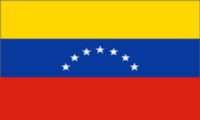
The Venezuela flag was first designed over 200 years ago. The flag consists of a traditional tricolor design complete with a set of stars in the middle and the Venezuela coat of arms in the upper left.

venezuela flag

The flag was originally designed by a man named Francisco de Miranda, a Venezuelan revolutionary. Miranda is most well known for his attempts to liberate Spanish America, and although he was not successful in his efforts he is widely regarded as the forerunner of Simon Bolivar, another well known revolutionary. It is widely noted that Francisco de Miranda created the current design for the Venezuela flag in the year 1806, after a failed attempt to liberate the Venezuelan people. Interestingly enough, de Miranda is said to have inspired the flags of Colombia and Ecuador as well.

The Venezuela flag is primarily a tricolor design of red, blue and yellow. In the flag, the color blue represents courage. The red represents independence from Spain, while the yellow band represents the wealth of the land. There was a collection of 7 stars in the center of the flag; however another star was added by Venezuelan president Hugo Chavez in 2006. The seven stars were originally intended to represent the seven provinces in Venezuela (Barcelona, Barinas, Caracas, Cumana, Margarita, Merida and Trujillo). These provinces originally united against Spain in the Venezuelan War for Independence, which lasted from 1811 until 1823.

The Venezuelan flag has experienced a number of changes during its history. In the early 19th century, the collection of seven stars was added to the blue band of the flag. In the year 1954, the Venezuelan Coat of Arms was added to the flag; however the coat of arms was not added to any civil or maritime flags. Finally, in the year 2006, Venezuelan President Hugo Chavez ordered that an eighth star be placed upon the Venezuelan flag – a decision that has been met with heavy opposition.

Vietnam Flag

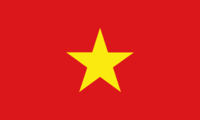
The flag of Vietnam has a much storied history. Although the flag design itself has not changed much over the years, the Vietnam flag has withstood some very tumultuous political and economic events throughout the years of its existence.vietnam flagThe design of the Vietnam flag is a very simple one – a bright yellow star emblazoned upon a bright red background. Although simple, the design of the flag does indeed have a very significant meaning. As can probably be guessed, the red background of the Vietnam flag was based upon the flag of the Communist Party. The yellow star does not have such an obvious meaning, however. Each point of the five pointed yellow star on the Vietnam flag represents a different segment of the Vietnamese people. The star is representative of the unity of peasants, workers, soldiers, traders and intellectuals all working together for the common good of socialism.

The Vietnam flag was not officially recognized as the “national flag” until August 18, 1945 at a meeting held in Northern Vietnam. Not long after, the Vietminh proclaimed Hanoi part of the Democratic Republic of Vietnam towards the end of World War II. A few years after, in the year 1954, the Democratic Republic of Vietnam became the government of North Vietnam, following the conditions of the Geneva Accord between France and Vietnam.

The current Vietnam flag would not fly over the entire country of Vietnam until over 20 years later. Northern and Southern Vietnam remained separate entities until North Vietnam overran Saigon in 1975. The current flag of Vietnam was adopted in 1975, and the entire country of Vietnam became the Socialist Republic of Vietnam shortly thereafter on July 2, 1976. The flag of Vietnam has perhaps endured one of the most tumultuous and difficult histories of any country in the modern world, and the flag has remained remarkably unchanged throughout it all.

Soviet Union Flag

The flag of the former USSR may perhaps be one of the most well-known and infamous flags in the entire world. The design consists of the traditional hammer and sickle emblazoned upon a background of red.  The first design for the Soviet Union flag was created adopted on November 12, 1923. There have been two slight modifications to the flag since that time, and the most recent flag of the Soviet Union flew from 1980 until the collapse of the Soviet Union a few years later.soviet union flagThe colors of the Soviet Union flag have a very particular symbolism and meaning. The background of the flag is a bright red color – representative of the blood that has been shed by workers and farmers. The color red is also very indicative of Communism, which was the central ideology of the former Soviet Union government. The USSR flag contains an image of a yellow hammer and sickle placed in the top left hand corner of the flag. The image of the hammer and sickle is perhaps the most well known symbol of communism anywhere in the world. The hammer in the image is meant to symbolize the nation’s workforce (termed “Proletariats” by Karl Marx), and the sickle is representative of the nation’s agricultural industry, one of the most important industries in the entire Soviet Union. One final image appears above the hammer and sickle on the flag, and that is of a red star – an image indicative of the Communist rule.

The Soviet Union was the first country in the world to ever form any sort of communist government, thus the Soviet system became the basis for many other countries’ political ideologies. There have been many other world flags based upon the flag of the Soviet Union including the flags of the People’s Republic of China, North Vietnam, Yugoslavia, and Angola.

US Virgin Islands Flag

The Virgin Islands were originally discovered and named by Christopher Columbus in the year 1493. The islands were originally named for Saint Ursula and her virgin followers, and they were under the control of at least 5 different European countries over the first 300 years of the islands’ existence (Spain, England, Netherlands, France and Denmark). The Virgin Islands were held under Danish control however, from the year 1672 until they were purchased by the United States on January 17, 1917. The United States took control of the territory on March 31st of that same year, thus the islands were officially renamed the Virgin Islands of the United States.

virgin islands flagThe Virgin Islands of the United States consist of a group of islands located in the Caribbean sea, about 90 miles east of Puerto Rico. The Virgin Islands are made up of many small islands; however the notable ones include the islands of Saint Croix, Saint John, Water Island, and Saint Thomas.
The United States Virgin Islands flag was officially adopted in the year 1921. The design is strikingly simple; it consists of little more than a simplified variant of the Seal of the United States of America placed atop a white background. To the immediate left and right of the seal on the flag sit the letters “V” and “I”, representing of course the name of the islands.

One interesting thing to note about the symbol on the flag is the three arrows being held by the eagle in its left talon. This is of course symbolic of the three major islands that make up the Virgin Islands – Saint Thomas, Saint John, and Saint Croix.

Also, interestingly enough, the original design was drawn by a cartoonist named Percival Wilson Sparks. Once approved, the design for the US Virgin Islands flag was embroidered by the cartoonist’s wife Grace – thus the flag was born.

Colorado Flag

The Colorado flag consists of one of the simplest, yet perhaps most interesting designs of any flag in the Union. The Colorado flag consists of three horizontal stripes of equal width. The middle stripe is white, while the top and bottom stripes are colored blue. On top of the 3 stripes of the Colorado flag sits a red “C” filled with a golden circle.

colorado flag

According to numerous reports, the colors of the Colorado flag represent the following:

  • The blue stripes on the Colorado flag are meant to represent the Colorado skies
  • The golden circle inside of the red “C” is meant to represent the sunshine enjoyed by the state of Colorado
  • The white stripe across the middle of the Colorado flag represents the snowcapped mountains
  • The red of the “C” is meant to represent the earth

The Colorado flag was originally designed by a man named Andrew Carlisle Carson in 1911. On June 5th of that same year, this same Colorado flag was officially adopted by the state’s General Assembly. The official colors of the flag were not, however, decided upon by the General Assembly until 18 years later on February 29, 1929. It was eventually declared that the red and blue of the Colorado flag would be the same exact colors as the American flag. Years later, on March 31, 1964, the legislature further declared that the diameter of the gold disc should be equal to the width of the center white stripe.

One interesting thing to note about the Colorado flag is the fact that it is incorporated into all of Colorado’s state highway signs. Also, in a 2001 survey by the North American Vexillogical Association, the Colorado flag was ranked as the 16th best flag as compared by 72 other state, provincial, and territory flags in North America.

First Flag On The Moon

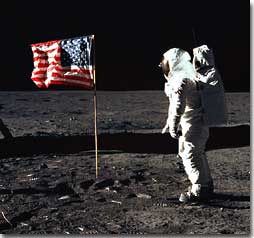
The first flag to be planted on the moon by human hands was an American flag. It was displayed by astronauts Neil Armstrong and Buzz Aldrin on July 21, 1969. Armstrong and Aldrin were members of the crew of the Apollo 11, the first manned spacecraft to land on the surface of the moon. It was Armstrong who first stepped onto the moon’s surface, uttering the now well-known line “That’s one small step for man, one giant leap for mankind.”

American Flag on the moon

Armstrong and Aldrin worked together to plant the pole that displayed the American flag. Photos taken of this first flag on the moon have been the source of some controversy. The flag stands away from the pole, as if being lifted by a brisk breeze. Yet it’s fairly well known that there is no air in the moon’s atmosphere and therefore no way that a breeze could make the flag fly.

A clever trick on the part of Apollo 11 engineers created the illusion of a flag flying on the surface of the moon. They started with an off-the-shelf flag and then added a pocket to the top of the flag through which a collapsible horizontal rod was inserted. This collapsible rod was attached to the flagpole, making the flag stand away from the flagpole at a perpendicular angle. One small glitch occurred when the rod wouldn’t fully extend, making the flag look rippled rather than smooth. This ripple effect actually enhanced the illusion that the flag was waving in the breeze.

The effect was very successful, especially compared to the limp look the flag would have had without its horizontal support bar. The photo of the First Flag on the Moon is now remembered as one of the most significant flag images in the history of the United States. Today there are six U.S. flags on the lunar surface, each planted by a different Apollo mission.