Hawaii Flag

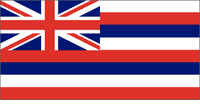
The Hawaii flag is perhaps the most similar of all state flags to the traditional flag of the United States of America. Consisting of no other colors but the traditional red, white and blue, the Hawaii flag on first glance looks like no more than a hybrid British/American flag.
hawaii flag

The Hawaii Flag is very similar in design to the American flag – it consists of a rectangular field in the top left atop a field of stripes all around.  One major difference however is that while the stripes in the American flag are simply an alternating red and white pattern, the stripes of the Hawaii flag are red, white and blue.  Also, in the top left corner of the Hawaii flag sits a design much different from the traditional 50 star design of the American Flag.  Rather than the well known 50 star pattern atop a blue background, the image in the top left corner of the Hawaii flag is an exact  replica of the flag of the United Kingdom.

As previously mentioned, the Hawaii flag contains a field of st ripes surrounding the top left canon of the flag.  Traditionally, the American flag has had 13 stripes fashioned in this same manner; however the Hawaii flag has just eight.  The eight stripes of the Hawaii flag represent the eight major Hawaiian islands; Hawaii, Oahu, Kauai, Kahoolawe, Lanai, Maui, Molokai and Niihau.  There are also various conflicting reports as to the origins of the stripes as some claim that the stripes were influenced by various historical British flags, while still others claim the design was based upon the American flag.

Regardless of the exact origins of the Hawaii flag – origins that will likely forever remain unknown in their entirety – there is little doubt that the Flag of Hawaii, despite the tiny size of the island, has one of the most detailed histories of any state flag in the American Union
Georgia Flag

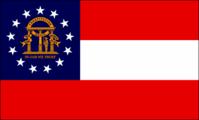
According to most accounts, the Georgia flag is still in its infancy as compared to most other flags in the United States of America.  Officially recognized as the flag of Georgia on May 8th, 2003, the Georgia flag has a design that is incredibly similar to that of the American flag.

georgia flag

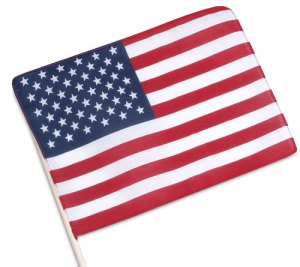
Similar to the American flag, the Georgia flag consists of a design of red and white stripes with a blue field in the  top left corner of the flag.  However, in contrast to the American flag, the Seal of Georgia sits in the blue field of the Flag of Georgia as opposed to the 50 stars of the American Flag.

The Seal of Georgia in the top left of the flag consists of a yellow arch encircled by 13 white s tars.  The arch is meant to symbolize Georgia’s Constitution, and the three pillars supporting the arch represent the three branches of the Georgia government (Executive, Legislative and Judicial).  Also, wrapped around the three pillars in the Seal of the words “Wisdom, Justice, Moderation”, the Georgia state motto.  The entire seal is symbolically guarded by what looks to be a male soldier dressed in the traditional Colonial battle uniform, and directly below the seal sit the words “IN GOD WE TRUST”. Intrestingly enough, however, the actual text “IN GOD WE TRUST” is not a part of the Georgia state seal of the coat of arms, however it does appear on the Georgia flag.

Encircling the entire state seal are 13 white stars, symbolizing Georgia along with the 12 other states that originally formed the Confederate States of America.  One interesting thing to note is that the Georgia flag is often nicknamed the “Georgian Stars and Bars” after the flag from which it was originally derived – the Flag of the Confederate States of America.

Florida Flag

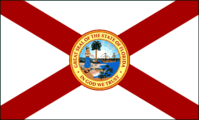
The flag of Florida consists of the seal of Florida emblazoned upon a white  background and a red saltire (diagonal cross). At first glance, the Florida flag seems strikingly simple – however upon further inspection, the intricacies of the flag of the “Sunshine State” start to become apparent.

florida flag

Despite the simplicity of the red cross on top of a white background, the centerpiece of the Florida flag is unusually complex.  Officially coined the “Great Seal of the State of Florida”, the centerpiece in the Florida flag does its best to represent the many facets of Florida life.

First and perhaps most obviously, the seal depicts a Seminole woman standing on the Floridian shoreline spreading Hibisucus flowers.  A steamboat can be seen in the background of the seal, sailing off into the strikingly beautiful Floridian horizon.  Also pictured on the seal of Florida is the state tree – the Sabal Palm.  Encircling the entire scene are the words “GREAT SEAL OF THE STATE OF FLORIDA” and “IN GOD WE TRUST”.

Originally, the design of the Flag of Florida consisted of no more than the seal of Florida atop a white background.  However, this was changed in the late 1890s according to the wishes of General Francis P Fleming, who suggested that a red cross be added to the background so that the flag would not appear to simply represent the white flag of surrender when floating atop the flagpole.

One interesting thing to note about Florida is the fact that at least 16 different flags have flown over Florida at various times during its history.  Currently, there is even a small grassroots movement aimed at redesigning the Florida flag yet again to commemorate Florida’s 500th anniversary.  The future of the Florida flag remains yet to be seen – however one thing is very apparent, and that is that the Florida flag has perhaps one of the richest histories of any flag in the Untied States of America.

Delaware Flag

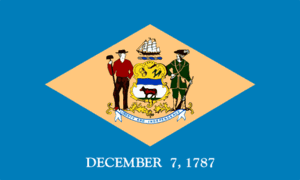
The Delaware flag consists of one of the most peculiar designs of any flag in the United States. In a general sense, the flag simply consists of the Delaware coat of arms placed upon a blue background.  Below the Delaware coat of arms sits the phrase “December 7, 1787” which of course marks the day in which the state of Delaware ratified the United States Constitution – the first state to ever do so.

delaware flag

The flag layout and design sound simple enough; however the peculiarities arise upon further inspection of the Delaware coat of arms in the middle of the flag.  The center of the Delaware coat of arms consists of a shield of horizontal blue, white and green stripes with an ox in the center.  Also on the shield sit an ear of corn along with a sheaf of wheat – symbolic of Delaware’s agricultural industry.  Above the shield in the center of the Delaware flag sits a small ship sailing the Delaware waters.  Below the shield sits the state motto, “Liberty and Independence”, and holding the entire design together are a farmer and soldier placed on each side of the design.  Compared to many other state flags in the American Union, the Delaware flag design is unusually complex.

Just as with almost any other flag in the Union, the colors of the Delaware flag have a very interesting and symbolic meaning.  Officially, the flag consists of a buff-colored diamond on top of a field of colonial blue with the Delaware coat of arms placed squarely inside the center diamond.  The background ( colonial blue) and forground (buff-colored) sections of the Delaware flag have officially been designated “Arno Blue” and “Golden Beige”, respectively.  Interestingly enough, the colors of the Delaware flag were supposedly originally derived from the colors of George Washington’s uniform.

Fiji Flag

The Fiji Flag as it is in present use was adopted on October 10, 1970. Although the state arms have been slightly modified, the flag has remained the same since the colonial period.

Fiji previously has a national flag of blue and white vertical stripes with a red shield in the center depicting a white dove. When the country ceded to British Rule in 1874, Fiji relinquished its independence and was a British colony from 1874 to 1970.

fiji flag

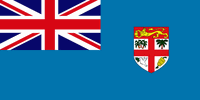
The Fiji flag is a defaced sky-blue “Blue Ensign,” the actual Blue Ensign version of the Fiji flag is the Government’s Ensign. The bright blue background represents the Pacific Ocean, which is an important part in the lives of the islanders, with the fishing trade and tourism industry. The Union Jack embodies the country’s links to Great Britain.
The shield, on the right hand side of the flag, is derived from the country’s official coat of arms. The white shield has a red cross with a red chief. The images on the shield stand for the agriculture so important to Fiji and the historical connection with Great Britain. The top of the shield has a British lion which holds a cocoa pod between its paws. In the upper left portion is a sugar cane, and the upper right has a coconut palm. In the lower left area of the shield is a dove of peace and in the right a bunch of bananas.

The flag is such a wonderful tribute to the lives and industry of the Fiji Islands.

Old Glory

It’s not uncommon to hear the flag of the United States referred to as Old Glory, though the origin of this nickname is not commonly known. The saga of Old Glory involves the history of a particular flag that played a symbolic role in the Civil War. The story begins sometime in the 1820s, when a large flag (10 feet by 17 feet) was presented to a young sea captain named William Driver. According to history, the flag was made by Captain Driver’s mother and a group of young women in Salem, Massachusetts and was designed to be flown from a ship’s mast. The flag featured 24 stars on its blue field, and a small anchor had been sewn near the stars to indicate that it was a ship’s flag.

Old GloryCaptain Driver used the flag on the whaling ship Charles Doggett during an around the world voyage in 1831-32. It was at this time that Driver began referring to the flag as Old Glory. Driver retired from the seafaring life in 1837 and moved to Nashville, Tennessee. Old Glory came with him and was displayed for all patriotic occasions, becoming famous among the citizens of Nashville. By this time the flag was showing quite a bit of wear and had been mended many times.
Additional stars had been added to Old Glory over the years as states joined the Union, so that the total number was 34 by 1861. It was in that year that the Civil War began and Tennessee seceded from the Union. Fearing an action against Old Glory by rebel forces, Driver had the foresight to hide the flag inside the comforter on his bed. Stitched into place, it remained there safely until Union troops reclaimed Nashville the following year. Driver brought out his flag and it was flown from the spire of the Tennessee State Capitol. Old Glory was saluted by the Sixth Ohio Regiment, who adopted the name Old Glory as their motto. This event was reported in many newspapers, bringing national fame to Old Glory.

William Driver died in 1886 at the age of 83. His grave in Nashville is one of only 3 places in the U.S. that has been designated by an Act of Congress to fly a flag perpetually. Old Glory was preserved as a Driver family heirloom until 1922, when it was presented to the Smithsonian Institute. Along with the flag which inspired Francis Scott Key to write The Star Spangled Banner, Old Glory is one of the most important historical flags preserved at the Smithsonian.

Top 500 Internet Retailer Award

Online Stores, Inc. Ranked Among America’s Top 500 Internet Retailers

New Stanton, PA May 12, 2009 – Online Stores, Inc. announced today that they have again been included amongst America’s top 500 internet retailers in the Internet Retailer Top 500 Guide. 2009 will be Online Stores, Inc.’s third year on the prestigious list; the company has received the award annually since 2007.

See the full press release here

The Tricolor French Flag

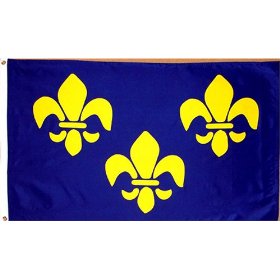
Over the centuries, since long before Charlemagne, France has flown many flags. Typically, when conjuring up an image of the French Flag, we think of the Fleurs-dis-Lis- three gold lilies on a blue shield. However, the ‘drapeau tricolore’ or ‘drapeau bleu-blanc-rouge’ is now the official French flag.

Fleur De Lys
Fleur De Lys

With its vertical blue, white, and red bands, the Tricolor French Flag was adopted in 1790, after the French Revolution of 1789, and then made the official flag by the French National Convention on February 15, 1794. But it has not represented the country without disruption.

Under the Tricolor French Flag, Napoleon I led France through war and battle after battle until the nation dominated parts of North Africa and most of the western world. Then in 1814, the Bourbon’s re-seized power and all symbols of the revolution were replaced with those of the Bourbons. After intrigues and betrayal, the July Revolution of 1830, put King Louis-Philippe on the throne, who resurrected the ‘drapeau tricolore’.

French Flag
The order of the colors has sometimes changed, and explanations for the colors vary. Blue and red are the traditional colors of the arms of Paris, and, ironically, white is color of the Bourbon dynasty. The blue is sometimes referred to as strong blue, or, again ironically, as King’s blue.

Its simple design, with the blue band at the hoist, followed by two more equal-sized bands, one of white, then a red “fly” (the outer band), is said to represent the common people, a reaction to the monarchy and the elaborate royal coats of arms found on pre-revolutionary flags. The revolutionary motto, liberté, égalité, fraternité , or liberty, equality and brotherhood, is closely associated with the Tricolor French Flag.

According to Whitney Smith, flag scholar and founder of the Flag Research Center in Winchester Massachusetts, the Tricolor French Flag “has no specific symbolism attached to the individual colors and shapes in its design” and that all symbolism was attached to it in retrospect. Yet, speculation abounds.

Sometimes the colors are thought to be influenced by those of the American Revolution, and also by Holland, but there are other explanations. With France being traditionally Catholic, blue is said to be the color of Saint Martin, a Gallo-Roman officer who ripped his blue cloak with his sword to give one half of it to a poor cold beggar. Red is the color of Saint Denis, the patron saint of Paris, and white, in this manner of thinking, represents the Virgin Mary.

Prime Minister Jean-Pierre Raffarin (2002-2005) consistently and poetically referred to the colors as “the blue of our history, the white of our hopes, and the red of the blood of our ancestors”. As influenced as it may be by ideas and idealism, the Tricolor is equally influential, with post-colonial and post-revolutionary countries all over world either using either the blue, white, and red, or the Tricolor French Flag‘s banded style to represent freedom from tyranny.

–Carol Frome