
The flag of the Czech Republic was adopted on March 30, 1920, shortly after the formation of the Czech Republic. It is a rectangular flag with a blue isosceles triangle on the left side and two horizontal stripes covering the remaining area. The top stripe is white and the bottom is red. The Czech flag is identical to the flag of former Czechoslovakia.
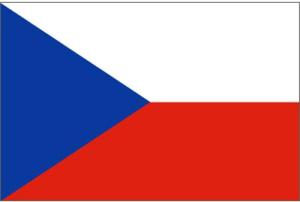 Like many European nations, the colors of the flag of the Czech Republic originated from its coat of arms. The coat of arms of the Czech Republic displays shield from the three regions that make up the nation: Bohemia, Moravia, and Silesia. The Bohemian coat of arms consists of a white lion with two tails on a red background. The Moravian coat of arms features a red and silver eagle on a blue background, and the flag of Silesia features a black eagle on a gold background.
The original flag of Czechoslovakia is based on the Bohemian coat of arms and was identical to the Bohemian flag. The first flag of Czechoslovakia consisted of a white horizontal band on the top and a red band on the bottom. Since this flag was nearly identical to the flag of Poland and very similar to the Austrian flag in its choice of colors, a blue isosceles triangle was added to the left side.
During World War II, the Nazi regime banned the flag of Czechoslovakia. The central region of Czechoslovakia—including parts of Bohemia, Moravia, and Czech Silesia—was named the Protectorate of Bohemia and Moravia by Hitler and considered part of the Third Reich. During this region’s formal existence from 1939-1945, the Protectorate of Bohemia and Moravia flew a rectangular flag with three horizontal stripes of equal width: the top stripe was white, the middle stripe was red, and the bottom stripe was blue.
At the end of World War II, the flag of Czechoslovakia was restored. From 1990 until 1992, during the formation of the Czech and Slovak Republics, the Czechs briefly used the original red and white flag of Bohemia. Eventually, however, the Czech government decided to continue using the Czechoslovakian flag established in 1920.
 The flag of Serbia was adopted on August 16, 2004. It is a rectangular flag with three horizontal stripes of equal width: the top stripe is red, the middle stripe is dark blue, and the bottom stripe is white. Centered vertically, towards the left side of the flag is the lesser coat of arms of Serbia, which features a red background with a white double-headed eagle, Serbian cross between four silver fire steels, two fleurs-de-lys, and a crown at the top. The colors blue, red, and white, represent the pan-Slavic colors and are featured in many countries’ flags near Serbia.
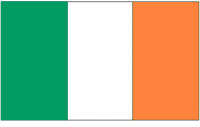 The flag of Ireland was officially adopted in 1919 when Ireland gained its independence from Great Britain. The flag is rectangular with three vertical stripes: a green stripe on the left side, a white stripe in the middle, and an orange stripe on the right.
 The flag of Canada was adopted on February 15, 1965. It is a rectangular flag with two vertical red stripes on the left and right sides. The center section of the flag is white with a red 11-pointed maple leaf in the center. The flag is known in Canada as the “Maple Leaf” or l’Unifolié (“the one-leafed”).
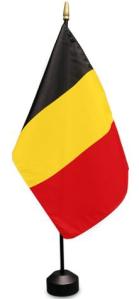 The flag of Belgium was adopted on January 23, 1831. The flag is rectangular with three vertical stripes: a black stripe on the left, a yellow stripe in the center, and a red stripe on the right. The official ratio of the Belgian flag is 13:15 (almost square, but not quite), but due to its unusual proportions, the flag is rarely produced this way and is usually seen in a 2:3 ratio.
 The Flag of Chile was adopted on October 18, 1817, during Chile’s battle for independence from Spain. The flag of Chile is called La Estrella Solitaria, or “The Lone Star.” The flag is divided into two horizontal regions. In the top portion, there is a blue square in the left corner with a white five-pointed star in the center. The remainder of the top half is occupied by a white stripe. The bottom half of the flag consists of a red stripe.
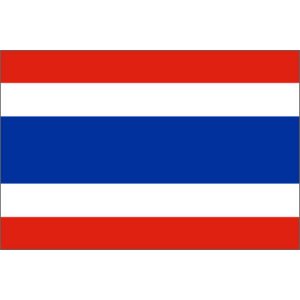 The colors of the flag represent an unofficial motto of Thailand, “nation-religion-king:” red represents the Thai nation, white represents religion, and blue represents the Thai monarchy. Some sources claim that the blue represents support of the Allies of World War I, as many other countries in the alliance had red, white, and blue flags. Thailand adopted a naval flag in 1917 in addition to the national flag, which includes a red circle in the center of the national flag. In the center of the red circle is a white elephant, a symbol of royalty. The Kingdom of Thailand has many other military flags currently in use as well, which include the colors of the Thai flag and relevant military emblems.
 The flag of Bolivia was adopted in 1851. The civil flag consists of a rectangular shape with three horizontal stripes: the top stripe is red, the middle stripe is yellow, and the bottom stripe is green. The state flag consists of the three-striped civil flag with the Bolivian coat of arms in the center.
 Flag Blog