World Cup 2010 – Support Your Team!

The 2010 FIFA World Cup will be getting under way in less time than you think. It’s scheduled to start on June 11, and whether you’re planning to cheer for the good old U.S. of A. or some other country, a good way of showing your support is by wearing a classy, patriotic patch or pin from the United States Flag Store.

Pins and patches from most of the top teams participating in this year’s World Cup are available, including Brazil, Spain, England, Portugal, Mexico and the United States. If you can’t decide who to cheer for, you can always have pins the feature two country flags custom made. You could, for instance, make a pin featuring the U.S. and British flags.

Many different patches are available at the United States Flag Store as well. Throwing your support behind the French this year? Make sure to check out the French patch, which is machine embroidered and very detailed. Best of all, the patch has a vinyl back, meaning it can be either ironed of sown to just about anything, including backpacks, shirts, pants and hats.

French PatchOf course, flags for each of the countries taking part in the 2010 World Cup are also available. There’s no better way to let the entire neighborhood know where you stand than hanging a beautiful 3×5 flag outside your home. Those from Mexico are particularly attractive if you ask me.

If you’re heading out for the evening to watch the games amongst friends, why get yourself some of our hand flags. Available in both 4×6 inch and 12×18 inch sizes, these flags are perfect for waving in the streets or bars of your hometown. They’re also great for anyone that is actually planning on attending the World Cup, as they can be easily waved from the stands.
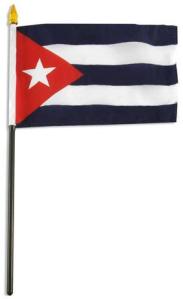
The Flag of Cuba

The flag of Cuba was officially adopted on May 20, 1902, when the United States granted the island, which it had seized control of during the Spanish-American War, its independence. The flag of Cuba’s origins however go back much further than 1902.

The flag of Cuba was designed in 1849 by a poet named Miguel Teurbe Tolón. Tolón’s design included three blue stripes, representing the three parts of the county that were divided from one another during the wars for independence, and two white stripes, which represented the purity of the patriotic cause. The design’s red triangle is meant to stand for the blood that was shed in order to free the nation, while the white star at its center is representative of the island’s independence.

This flag of Cuba was carried into battle by a Venezuelan military leader named Narciso López during his attempt to liberate Cuba. Although López was not victorious, it was indeed the first instance in the flag of Cuba was flown.

According the current government of Cuba (the Castro regime), the meaning behind the flag of Cuba is as follows: the blue strips represent the old divisions of the island; the white stripes represent the strength of the independent ideal; the red triangle symbolizes equality, fraternity and freedom, as well as the blood that was shed during the wars for independence.

Aside from this official flag of Cuba, Fidel Castro’s “26th of July Movement” also created a flag of Cuba which is equally divided into red and black portions, usually in the form of horizontal stripes. The flag often bears inscriptions as well. This flag of Cuba is often flown on public building on the island.

The Flag of Libya

There are 195 countries in the world today, each of which, presumably, has a unique national flag. Of all those flags, however, there is only one which is made up of one color and one color only, with no designs, insignias or other details whatsoever. The Flag of Libya consists of nothing more than a beautiful field of green. No eagles, coat of arms, rising suns or quarter moons. Just the simplicity that is the color green.

The color green is meant to signify the Libyan people’s devotion to Islam, the state religion. Green is also the national color of Libya and is symbolic of the “Green Revolution” of Muammar al-Gaddafi, Libya’s current leader. However, the flag of Libya was not always green. In fact, it once had a leafy palm tree at its center.

The history of the flag of Libya begins in the year 1918, when the short-lived Tripolitanian Republic in Western Libya had its own flag. The flag had a light-blue field and a green palm tree in its center. The palm tree also had a star on top of it, just like a Christmas tree. However, when the Tripolitanian Republic fell in 1923, this version of the flag of Libya was done away with.

Later, in 1951, when Libya gained its independence from Italy, the first flag of modern Libya was adopted. It featured a white crescent and star atop a field of red, black and green. This design was based on the Senussi flag, and is still used to this day abroad by the Libyan opposition movement.

After the 1969 Revolution, the official name of Libya was changed to Al-Jumhuriya al-Arabiya al-Libiya, or the Libyan Arab Republic. This new Republic abolished the previous flag of Libya and replaced it with the Arab Liberation Flag, which was first flown over Egypt after the Revolution of 1952. This particular flag was a tricolor with the colors red, white and black.

In 1972, Libya joined the Federation of Arab Republics and briefly adopted the flag of that organization. It featured a golden hawk holding a scroll with Arabic name of the Federation, Ittihad al-Jumhuriyat al-Arabiya, written upon it.

Finally, in 1977 Libya once again changed its name to Al-Jamahiriya al-Arabiya al-Libiya ash-Sha`biya al-Ishtirakiya, or the Socialist People’s Libyan Arab Jamahiriya. When this change took place, the all-green flag which continues to be flown today in Libya was also adopted.

The Serbian Flag

The Serbian flag, in one form or another, has been around for quite some time. The earliest known description of a Serbian flag dates from the year 1281. It comes from a list of treasures belonging to a Serbian king. The description says, “vexillum unum de zendato rubeo et blavo,” which apparently means, “a flag of fabric red and blue.” There is, however, no indication as to how the colors were patterned.

The earliest known drawing of a Serbian flag goes all the way back to the year 1339. The drawing appears on a map made by a famous Majorcan cartographer, Angelino Dulcert. According to the drawing, at that point in history, the Serbian flag featured a two-headed eagle against a yellow field.

During the time of the First Serbian Uprising, several other flags were made use of. One of these flag, featuring a cross and the colors red, white and blue, may be linked to the Serbian flag used today. Other Serbian flags flown during this time period consisted of such combinations of color as red and yellow, red, white and blue, and red and blue. The army taking part in the uprising also used light yellow flags with various symbols upon them, including a black, two-headed eagle.

Today’s Serbian flag is a tricolor made up of what are known as “Pan-Slavic” colors, which are red, blue and white. The colors are arranged in three horizontal bands of equal width. The modern Serbian State flag also features the coat of arms of Serbia, which consists of a double-headed eagle on red shield. The eagle’s wings and body are silver, while its tongues, beaks, legs and claws are golden.

The current Serbian flag was adopted as part of the new Constitution of Serbia on November 8, 2006. On that date, its usage, along with that of the coat of arms and the national anthem, became constitutionally sanctioned.

The Bosnian Flag – Symbol of Peace

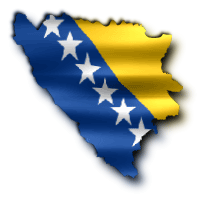
The Bosnian flag is blue with a yellow isosceles triangle. The flag also features seven full stars and two half stars along the hypotenuse of the triangle (I just like using words like isosceles and hypotenuse).

The colors of the Bosnian flag—blue, yellow and white—are usually associated with neutrality and peace throughout the world. In fact, the kings of neutrality and peace, Switzerland and Costa Rica, both feature at least one of these colors on their respective flags. The colors of the Bosnian flag may have also been inspired by those found on the flag of Europe as well as that of the United Nations.

The three points of the Bosnian flag’s isosceles triangle are thought to stand for the three constituent peoples of Bosnia and Herzegovina: the Bosniaks, the Croats, and the Serbs. The triangle is also meant to represent the map of Bosnia, which resembles a heart. Many people even call Bosnia the “Heart-Shaped Nation.”

The stars which run diagonally across the Bosnian flag represent Europe, and are meant to be infinite in number, thus continuing from top to bottom. Many people have speculated as to why the stars are infinite in number, but, much like the mystery surrounding how many licks it takes to reach the center of a Blow Pop, the world may never know—just kidding; I’m sure there’s a good reason behind the stars.

The Bosnian flag was created when the country won its independence from Yugoslavia in 1992. Before choosing the current design, other alternatives were proposed, including one which featured an olive branch. Other designs included the map of Bosnia as well as a lighter shade of blue.

The Flag of Haiti: A Call to Action

By Kristi Ries

Unlike the country it represents, the official flag of Haiti is young, having been adopted in 1987. A tiny island country in the Western Caribbean, Haiti has existed for hundreds of years. Indigenous tribes who were later ‘discovered’ by the great Spanish explorer Christopher Columbus were the island’s first inhabitants. Following this, both Spain and France colonized what is now modern-day Haiti. Eventually, however, the island’s emerging multicultural population fought and won its independence in 1804. A new nation was born.

On the afternoon of January 12, 2010, the small nation’s history and life of its citizens was turned upside down. Haiti was struck by a magnitude-7.0 earthquake, the country’s most severe earthquake in more than two centuries. The epicenter of the quake was just off the Haitian capital Port-au-Prince. Entire communities have been leveled and countless lives have ended prematurely.

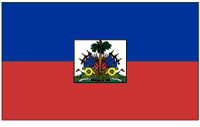
What this nation’s flag symbolizes and the feelings it evokes are what makes it so singularly powerful. It recognizes the country’s European heritage through its vibrant blue and red colors. This new design was based on a torn French Tricolore flag and features Haiti’s Coat of Arms centered in a white square.

For all who see and recognize it today, however, the flag of Haiti serves as a reminder that help is urgently needed and that a major humanitarian crisis is occurring as we go about our daily lives.

Once Americans are away from their television sets, laptops and radios, it is somehow easier to forget the overwhelming devastation to this impoverished Caribbean nation. Yet people all over the world are showing a unified front by displaying the flag of Haiti in office windows, on their cars or outside their homes. Numerous skyscrapers in major cities have been lit in the Haitian colors of blue and red to pay respect to the multitude of lives lost in the recent tragedy.

As the unbelievable destruction and rising death toll become more apparent, many organizations and individuals have come to Haiti’s aid. Displaying the Flag of Haiti is a quiet call to action; one that clearly declares ‘you are not forgotten or forsaken’ to those bereft of their homes, family, or worst of all—hope.

Visit the American Red Cross for information on donating money to Haiti.

Grenada National Flag

Ostensibly simple, the Grenadian National Flag carries rich historical and cultural significance within its fairly plain design. It was officially recognized in 1974 following its conception at the hands of Anthony C. George. The flag commemorates Grenada’s independence from the United Kingdom, which began in February of that year. Its color scheme and design depict the pride in that independence, and represent much that defines Grenada as a nation.

The color scheme of red, gold and green is representative of the country’s African origins. Each color stands as a symbol of something valued in Grenadian society.

Green, for instance, signifies the Grenadian land’s fertility, which brings about its vast agriculture industry and abundant plant life. Agriculture serves as Grenada’s economic driving force.

Red is indicative of the bravery, vivacity and a desire for independence that is found in the heart of each Grenadian citizen. The history of the Grenadian people is one filled with struggle, civil discord and adversity, all of which they were able to persevere, refusing to give up the hope of a unified independent nation.

Gold is the color of wisdom. It also embodies the warmth and kindness of the Grenadian people. Additionally, the gold serves to symbolize the bright sunshine of the Grenadian islands, which adds to its beauty and fertility.

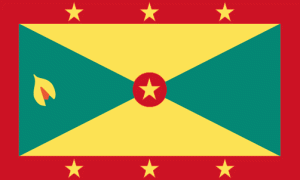
The flag’s symbols hold a great deal of significance, as well. Three yellow stars align along the upper portion of the flag, while three more are found across the bottom. Collectively, they represent the nation’s six parishes; Saint Mark, Saint John, Saint George, Saint Patrick, Saint Andrew, and Saint David. They also represent the ideas and ambitions upon which the nation was founded.

Another single yellow star lies at the center of the flag, surrounded by a red circle. This star signifies the nation’s capital city of Saint George’s. This beautiful city lies on the southwestern portion of the country and sits upon a horseshoe-shaped Caribbean harbor next to a volcano crater. Despite becoming a developing tourism destination in recent years, the city still holds on to much of Grenada’s rich cultural history.

The hoist of the flag displays a clove shaped emblem. This represents a clove of nutmeg, one of the nation’s primary crops. Grenada produces the second largest amount of nutmeg in the world, and is often referred to as the “Isle of Spice.” Grenadians are proud of their reputation for agricultural distinction, and their flag displays this pride.

The Grenadian National Flag is a symbol of the strength and vitality of a people unified under the idea of independence. It flies as a tribute to a rich cultural history and a promising future of continued independence, growth and development.

Flag of Argentina

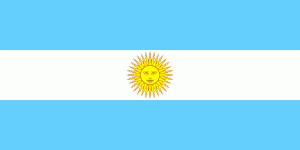
The flag of Argentina is light blue and white and features a golden sun at its center. In Spanish, the sun is known as the Sol de Mayo (Sun of May) and is modeled after the symbol of the Incan Sun God, Inti. Before the national flag, the Sol de Mayo was used on the first Argentine coin in 1813. As for the colors of the flag, there are several theories about reasons behind them. Traditionally it is believed that a man named General Manuel Belgrano created the flag of Argentina with the colors used by the Criollos in the May Revolution of 1810. However, it is apparently more likely that the colors were based on the coat of arms of the House of Bourbon, Spain’s royal family. Other theorists believe the colors represent the sky, clouds and sun.

Flag of Argentina

Belgrano created the flag of Argentina during the Argentine War of Independence. As commanded a battle near Rosario, Argentina, Belgrano noticed that the colors of the Crown’s forces and the independence forces were the same, the yellow and red of Spain. Upon realizing this, Belgrano had the flag of Argentina created. However, Belgrano’s flag was still much different than the one used today. Instead of three horizontal stripes, it had two vertical stripes, one light blue and the other white. Belgrano’s soldiers first swore allegiance to this flag on February 27, 1812, on the Batería Libertad by the Paraná River. On that day, Belgrano is supposed to have said the following:

Soldados de la Patria, en este punto hemos tenido la gloria de vestir la escarapela nacional; en aquél (señalando la batería Independencia) nuestras armas aumentarán sus glorias. Juremos vencer a nuestros enemigos interiores y exteriores y la América del Sud será el templo de la Independencia y de la Libertad. En fe de que así lo juráis decid conmigo: ¡Viva la Patria!” Señor capitán y tropa destinada por la primera vez a la batería Independencia: id, posesionaos de ella y cumplid el juramento que acabáis de hacer.”

Which, according to Wikipedia, can be translated as:

Soldiers of the Fatherland, we have heretofore had the glory of wearing the national cockade; there (pointing to the Independence battery) shall our weapons enlarge their glory. Let us swear to defeat our enemies, internal and external, and South America will become the temple of Independence and Freedom. In testament that you so swear it, say with me: Long life to the Homeland!” (after the oath) “Lord Captain and troops chosen for the first time for the battery Independence: go, take possession of it and fulfill the oath you have just sworn”.

In Buenos Aires, the nation’s capital, the flag of Argentina was flown for the first time on August 23, 1821, atop the Saint Nicolas of Bari Church, where the Obelisco currently sits. The Argentine National Congress adopted it as its symbol on July 9, 1816, after the declaration of impendence. Since that time, the flag of Argentina has been the inspiration for the flags of other nations, such Uruguay and Paraguay.

Chilean Flag

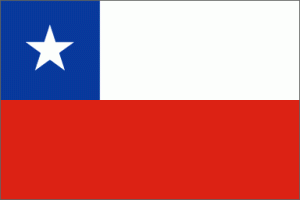
The Chilean flag is often referred to in Spanish as la estrella solitaria (the lone star) because of the fact that it bears a single, five-pointed star. The star represents a guide to honor and progress, while the field of blue that surrounds it is meant to symbolize the Chilean sky and the Pacific Ocean. The white and red portions of the flag represent the magnificent snow-covered Andes and the Chilean blood spilled during the fight for independence.

Chilean Andes

However, as is often the case, Chile’s flag has undergone a few changes over the years. In fact, the first Chilean flag looked nothing like its modern-day counterpart, as it consisted of three horizontal stripes that were blue, white and yellow respectively. This initial Chilean flag was created during the country’s struggle for independence, when the government of José Miguel Carrrera ordered that it be created. The flag was raised for the first time on July 4, 1812, at a banquet celebrating the independence of the United States. Apparently, the American Revolution had greatly influenced Chileans and motivated them in the struggle for independence.

The second Chilean flag was adopted after the triumph of Chacabuco on May 28, 1817. It was called la Bandera de la Transición (the Flag of the Transition). La Bandera de la Transición was very similar the first Chilean flag, simply replacing the yellow horizontal stripe with a red one. Juan Gregorio Las Heras is credited with designing it, but the colors themselves originate in the verses of a poet named Alonso de Ercilla. Blue, white and red were also the colors of the French Revolution, which, like the American Revolution, inspired Chileans. However, la Bandera de la Transición was never actually made official and it simply disappeared after about five months.

Chilean Flag

The disappearance of la Bandera de la Transición cleared the way for Chile’s current flag, la estrella solitaria, to be adopted. The flag itself was conceived by a man named José Ignacio Zenteno and designed by Antonio Arcos, although some Chileans claim that Gregorio de Andía y Varela actually drew it up. The flag was made official on Oct. 18, 1817, but it wasn’t until 1854 that the official proportions of each color were set, while the star’s diameter didn’t become official until 1912. Many people consider the Chilean national flag to be one of the world’s most beautiful; it’s even rumored that the Chilean flag actually won a “Most Beautiful National Flag in the World” contest in Belgium.

Afghanistan Flag

The flag of Afghanistan underwent more changes during the 20th century than any other flag in the world. By my count, the design of the flag was change some twenty times in that time period. Since 2000 it has been modified three more times. The first of these flags, flown under the rule Abdur Rahman Khan, was completely black. Today’s Afghanistan flag, on the other hand, consists of three stripes and the emblem of Afghanistan.

Afghanistan Flag

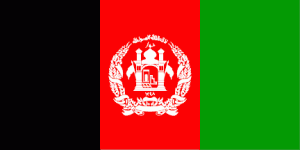
The Afghanistan flag’s colors – black, red and green – are meant to represent different chapters in the nation’s history. Black represents the 19th century, when a series of wars led to British occupation. Red represents the Afghans fight for independence, and green is meant to show that independence has been achieved. These colors were also part of the Afghanistan flag from 1928 to 1978, running either vertically or horizontally. Back then, black represented the previous monochrome version of Afghan flags, which in turn represented the sovereign. It’s believed that the red was taken from the Soviet flag and meant to represent modernity and progress. Green stood for Islam.

The emblem of Afghanistan, which is found at the center of the current design, consists of several things. At the very top of the emblem, one finds the Shahadah. The Shahadah is the Muslim declaration of belief in the oneness of God and the acceptance of Muhammad as his prophet. Depending on whom you ask, in English it more or less reads, “There is no god but God, and Muhammad is the Messenger of God.” Below the Shahadah, there’s an image of a mosque with its mihrab facing Mecca. A mihrab is a niche in the wall of a mosque that indicates the direction of the Kaaba, a cube-shaped building in the city of Mecca, and hence the direction all Muslims should pray. Two flags are also attached to the mosque, which are taken to be Afghanistan flags. Below the mosque is an Arabic inscription stating the name of the nation.