Flag Patches – From America to Armenia

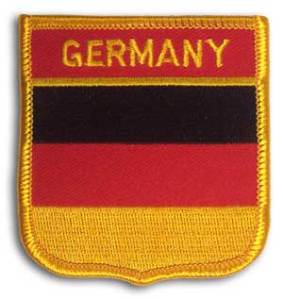
If for some reason you’re unable to fly a flag, flag patches are another great way of throwing your support behind a country. The U.S. Flag Store sells more flag patches than anyone else in the world today. We offer over 70 flag patches from such countries as Bolivia, Vietnam, India, Ireland and, of course, the good old United States of America, so no matter where you’re from, we’ve got the flag patch you’re looking for.

Putting one of our embroidered flag patches on your backpack, computer bag or coat is a great way of letting everyone know where your allegiance lies. And the flag patch doesn’t necessarily have to be from the United States. Did your family come here from the old country years ago? Why not show everyone that you embrace your European roots by using an Italian or Irish flag patch? Maybe it was Germany that your folks came from, or perhaps Poland? Wherever they came from, you’ll find any and all the flag patches you could ever need at the U.S. Flag Store.

As we all know, many of the people living in the U.S. these days are of Mexican decent. Mexico is truly one of the greatest countries on the face of the earth. Its people are kind, generous, and welcoming. Anyone that is lucky enough to say they’re Mexican should do themselves a favor and get a Mexican flag patch. Many people also come from other great places in Latin America such as El Salvador and Honduras. The U.S. Flag also has great flag patches from those countries.

The FIFA World Cup is also just around the corner. Support your team by picking up a few flag patches from the U.S. Flag Store. Flag patches are the perfect way to support your team throughout the entire tournament. I already have a patch on my coat, which is my way of the supporting the U.S. team. You should do the same. Don’t miss out!

Flag of Spain

The flag of Spain was officially accepted as part of the Spanish Constitution in 1978, however its origins date back to the Spanish naval flag of 1783. The flag consists of three horizontal stripes: two thin red stripes on the top and bottom of the flag, and one thick yellow stripe that is twice the width of the red stripes.  Slightly to the left on in the yellow stripe is Spain’s coat of arms.

Unlike flags of many other countries, Spain’s flag has remained largely the same since its first uses in the late 18th century.  The one exception to this is during the Second Republic of Spain (1931-1939), when an indigo stripe, symbolizing a new non-monarchic Republic and also the Castile kingdom, stood in place of the bottom red stripe.

The Spanish coat of arms is complex and actually comprised of six other coats of arms.  The top left section of the shield, a gold castle in a red background, symbolizes the kingdom of Castile.  In the 9th through 12 centuries, Castile was an autonomous medieval kingdom.  It unified in 1230 with León.

The red lion in the upper right corner symbolizes León.  León was founded by the Romans in the first century BC and was a military camp in the early first century.  Although the city struggled with Muslim invaders, it remained a Catholic city and officially became a Kingdom in 910.

The red and yellow stripes in the lower left corner symbolize the kingdom of Aragon, a medieval kingdom in the northeast region of Spain, near the French border.

The gold chains in the lower right corner symbolize the kingdom of Navarre, also in the northern region of Spain.  During the Roman Empire, the Vascones occupied this region, maintaining their language and traditions despite the Roman rule.  In 1513, Castile conquered the southern part of Navarre.  Although the northern part of the kingdom remained independent for several decades, it voluntarily joined with France in 1589 and actually became part of the French Kingdom in 1620.

The pomegranate flower comes from the kingdom of Granada.  Granada lies at the base of the Sierra Nevada mountains and at the merging point of the Beiro, Darro, and Genil Rivers.  Due to its strategic location, Granada is the oldest of the cities represented on the Spanish flag, and was part of the ancient Ibeo-Celtic, Phoenician, and Carthagenian settlements, and later part of the Greek and Roman empires.

Finally, the fleur-de-lis, in the center of the shield, represents the House of Bourbon.  Bourbon rulers controlled Navarre beginning in 1555.  The House of Bourbon, however, dates back to the early 13th century and Bourbon kings, including Henry IV, Louis XIII-XVIII, and Charles X ruled France and Navarre until the French Revolution in 1792.

The Pillars of Hercules are on either side of the coat of arms and the phrase “plus ultra,” meaning “further beyond,” appears on a banner wrapping around the pillars.  “Further beyond” refers to exploring the Americas and former Spanish territories.  The coat of arms also includes the Imperial Crown, used by King Charles I of Spain, and the Royal Crown on the right.

Flag of Iceland

The first Icelandic flag has its roots in the mid-14th century when Iceland’s coat of arms included a silver stockfish with a gold crown. Iceland had no real need for a flag until 1809, when a British sea captain from Denmark, Jörgen Jörgensen usurped Iceland and declared himself king.  In doing this, he announced Iceland’s first flag, a blue banner with three stockfish in the upper left corner.  Jörgensen was arrested shortly after doing this, but it wasn’t until 1870 that an Icelandic artist, Sigurdur Gudmundsson, created a new flag with still the same blue background, but this time with a silver falcon in the center.

The earliest version of the Icelandic flag as we know it today was created by Icelandic poet Einar Benediktsson in 1897.  In a newspaper article, he claimed that the falcon flag needed to be replaced because it didn’t follow international traditions.  His version of the flag featured a darker blue background with a large white cross. The King of Iceland at the time didn’t approve of this flag, however, claiming it was too similar to the Greek flag. The blue and white flag continued to be used unofficially until June 12, 1913, when Einar  Petursson was arrested after rowing a boat and flying a small blue and white Icelandic flag around the Reykjavik harbor. Icelanders were outraged by the incident and began flying the blue and white flags everwhere.

This incident prompted a meeting to create an Icelandic flag that would be officially adopted.  Although the parliament wanted the blue flag with the white cross, Danish authorities that were ruling Iceland at the time, would not allow this due to its similarities to the Green flag.  The committee decided on an official flag containing a blue background with a red cross bordered in white on June 19, 1915.  The King of Iceland officially accepted the flag on November 30, 1918, just one day before Iceland became a separate kingdom from Denmark.

The flag of Iceland as we know it today was adopted on June 17, 1944 when Iceland became a republic.  It is the same as the early 20th-century flag, only the shade of blue is slightly darker.  Iceland has strict rules about when and how its flag can be flown, including that the flag is not to be flown before 7:00AM and should be flown until after sunset but not beyond midnight. The flag is always fully drawn on the President of Iceland’s birthday, New Year’s Day, Easter, the first day of Summer, May 1, Pentecost, Sailor’s Day, June 17, December 1, and Christmas.

Flag of Mexico

Unlike many other flags around the world, Mexico’s national flag is one that has not changed significantly since its first version in 1821. The design of the first Mexican flag was greatly influenced by the flags Mexicans were using during the War of Independence from Spain.  Many of these rebel flags included the eagle on a cactus and the official flag colors: green, white, and red.

Agustín de Iturbide officially decreed Mexico’s first national flag in November 1821, following Mexico’s independence from Spain, although the the flag was not officially used until July 1822.  The flag included the vertical tricolor of green, white, and red, and the national coat of arms, the crowned eagle, in the center.

When Mexico became a federal republic in 1823, the government altered the flag slightly.  Instead of a crowned eagle, the eagle was depicted with a serpent in its right talon.  The flag also included the oak and laurel branches that are still included in the Mexican flag today.

The Federal Republic of Mexico gave way in 1865 to the Second Mexican Empire, and once again, the flag changed.  Still keeping the vertical green, white, and red tricolor pattern, the Emperor Maximilian ordered the ratio of the flag to be changed and for the flag to include four crowned eagles, one in each corner of the flag.  Each eagle stands on a cactus, which is on a rock in a lake, holding a snake in its mouth.

Mexico’s current national flag was approved by President Venustiano Carranza’s decree in 1916, officially adopted on September 16, 1968, and confirmed by law on February 24, 1984.  The current flag still includes the tricolor green, white, and red, but the eagle is no facing to the side instead of to the front.

The Mexican flag is rich in symbolism and history.  The green strip symbolizes the Independnce Movement of the early 19th century.  The white symbolizes the purity of the Catholic religion.  The red symbolizes both the blood of Mexico’s national heroes and recognizes the Spaniards that joined the Mexicans in the fight for independence.  The shield in the center of the white stripe includes an eagle eating a snake, standing on a prickly pear cactus that is on a rock in the middle of a lake.  This coat of arms has its roots in an Aztec legend: the Aztec gods told them to build their city where they found this exact scene.  The Aztecs followed this command and built their first city where Mexico City is today.

The Arizona State Flag

The Arizona State Flag has its roots in the 1910 National Rifle Matches at Camp Perry, Ohio, even before Arizona was officially a state in the Union. Camp Perry’s shooting matches began in 1907, quickly became popular, and still continue today.  Ideas for the Arizona flag first developed when Arizona rifle team members noticed that many of the states competing in the matches displayed flags or emblems representing their state.   The team captain, Arizona National Guard Colonel Charles Wilred Harris, suggested the idea of a flag for use at the National Rifle Matches.

Arizona State Flag

Harris, along with Carl Hayden, Arizona’s first Congressional Representative, set out to designing a flag.  In patriotic spirit, it was of great importance to Harris and Hayden that the Arizona flag design display historical values in both its design and colors.  Nan Hayden, Carl Hayden’s wife, sewed the first flag, and it was used in the National Rifle Match in 1911.

In 1912, Harris, now Adjunct General of Arizona, designed a similar flag for use as a state flag.  The Arizona State Legislature officially adopted Harris’s flag on February 17, 1917, despite Governor Thomas Campbell’s refusal to sign the bill into law.

The Arizona State Flag consists red and yellow rays on the top half, a blue bottom half, and a copper star in the middle.  There are 13 red and yellow rays, symbolizing the 13 original colonies of the United States and Arizona’s 13 original counties.  The red and yellow symbolize both the colors of Arizona’s beautiful sunsets.  Red and yellow are also the colors on the Spanish flag flown by Francisco Vasquez de Coronado and his conquistadors during their search for the Seven Cities of Cibola in 1540.

The blue bottom half of the flag represents the Liberty Blue found on the U.S. flag.  The copper star in the middle of the flag represents Arizona’s copper-mining industry, which produces the largest amount of copper in the nation.

Arizona indeed has a beautiful flag, and reasons for Thomas Campbell’s refusal to accept the flag are unknown.  As if to spite him, however, a 2001 poll by the North American Vexillological Association voted Arizaon’s state flag as the sixth best flag on the continent.

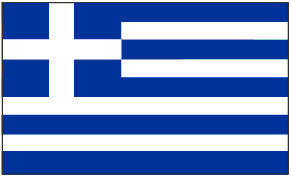
The Flag of Greece

The origins of the Greek flag that we know today can be traced back to the Hellenic Revolution in 1821 during which the Greeks declared their independence from the Ottoman Empire. The First National Assembly at Epidaurus adopted the current design, the “sea” flag, differing from the land flag (a white cross on a blue backdrop) and the merchant marine flag (a blue cross on a white background).

The origins of the Greek flag’s two components, a cross and stripes, are difficult to trace.  Both elements have ancient historical connotations, but there are no records from the National Assembly at Epidaurus explaining the exact reasons for the flag’s key features.

There have been dozens of versions of the Greek flag since the early 19th century, but the cross has always been a central feature.  Many versions of the Greek flag feature only a cross (no stripes), sometimes with a coat of arms or crown at the center of the cross displaying allegiance to a particular leader.  The cross on today’s Greek flag occupies the region in the top left corner, and is a white cross with a blue background, much like a mini-version of the old Greek land flag.  The cross, although Greece is now a democracy, demonstrates the Greek people’s devotion to and respect for the Greek Orthodox Church.  During the Ottoman rule, the Greek Orthodox Church helped the Greeks to retain their language, religion, and ethnic identity and Christianity is still the predominant religion among Greeks.

The Greek flag has nine blue and white stripes and there are two popular beliefs regarding the number nine.  There are nine letters in the Greek word for freedom, eleytheria.  There are also nine syllables in the phrase, “Eleftheria i Thanatos,” which translates as “Liberty or Death,” and was the motto during the Hellenic Revolution against the Ottoman Empire in 1821.   And despite popular beliefs, some simply believe that the design of the Greek emulates other prominent flags, such as the British East India Company’s 17th-century flag or the U.S. flag.

The blue and white colors of the flag symbolize the blue water and white-capped waves of the sea that surround the Greek peninsula.  According to Greek mythology, Aphrodite, the Goddess of Love, emerged from the waves of the Aegean sea.

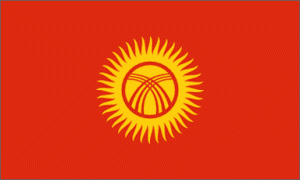
Kyrgyzstan Flag

In light of the recent uprising in Kyrgyzstan, we’ve decided to supply you the public with a bit of information concerning the nation’s flag. Truth be told, the Kyrgyzstan flag is rather attractive, featuring of a glorious red field upon which is placed a brilliant yellow sun with forty uniformly spaced golden rays emanating from it.

The red background of the Kyrgyzstan flag is meant to represent bravery and valor, while the flag’s sun represents peace and wealth. The tunduk, which can be seen at the flag’s center, is a symbol replicated in much of the architecture of Kyrgyzstan and is based on the “crown” of traditional Kyrgyz yurts, or houses. On the Kyrgyzstan flag it’s meant to represent the family home or, by extension, the universe.

As for the forty uniformly spaced golden rays emanating from the brilliant sun, word has it that they represent the forty Kyrgyz tribes that were united against the Mongols by Manas, the epic hero of Kyrgyzstan.

The flag was adopted on March 3, 1992 by the Supreme Council of Kyrgyzstan, after the nation had become the very last Soviet republic to secede. Today Kyrgyzstan is home to an American military base which is key to our efforts in Afghanistan. The recent uprising in Kyrgyzstan has therefore come as some cause for concern, but we’re sure everything will work out just fine in the end.

World Cup 2010 – Support Your Team!

The 2010 FIFA World Cup will be getting under way in less time than you think. It’s scheduled to start on June 11, and whether you’re planning to cheer for the good old U.S. of A. or some other country, a good way of showing your support is by wearing a classy, patriotic patch or pin from the United States Flag Store.

Pins and patches from most of the top teams participating in this year’s World Cup are available, including Brazil, Spain, England, Portugal, Mexico and the United States. If you can’t decide who to cheer for, you can always have pins the feature two country flags custom made. You could, for instance, make a pin featuring the U.S. and British flags.

Many different patches are available at the United States Flag Store as well. Throwing your support behind the French this year? Make sure to check out the French patch, which is machine embroidered and very detailed. Best of all, the patch has a vinyl back, meaning it can be either ironed of sown to just about anything, including backpacks, shirts, pants and hats.

French PatchOf course, flags for each of the countries taking part in the 2010 World Cup are also available. There’s no better way to let the entire neighborhood know where you stand than hanging a beautiful 3×5 flag outside your home. Those from Mexico are particularly attractive if you ask me.
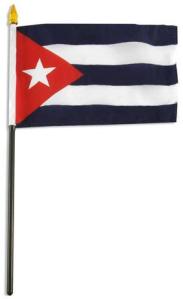
If you’re heading out for the evening to watch the games amongst friends, why get yourself some of our hand flags. Available in both 4×6 inch and 12×18 inch sizes, these flags are perfect for waving in the streets or bars of your hometown. They’re also great for anyone that is actually planning on attending the World Cup, as they can be easily waved from the stands.

The Flag of Cuba

The flag of Cuba was officially adopted on May 20, 1902, when the United States granted the island, which it had seized control of during the Spanish-American War, its independence. The flag of Cuba’s origins however go back much further than 1902.

The flag of Cuba was designed in 1849 by a poet named Miguel Teurbe Tolón. Tolón’s design included three blue stripes, representing the three parts of the county that were divided from one another during the wars for independence, and two white stripes, which represented the purity of the patriotic cause. The design’s red triangle is meant to stand for the blood that was shed in order to free the nation, while the white star at its center is representative of the island’s independence.

This flag of Cuba was carried into battle by a Venezuelan military leader named Narciso López during his attempt to liberate Cuba. Although López was not victorious, it was indeed the first instance in the flag of Cuba was flown.

According the current government of Cuba (the Castro regime), the meaning behind the flag of Cuba is as follows: the blue strips represent the old divisions of the island; the white stripes represent the strength of the independent ideal; the red triangle symbolizes equality, fraternity and freedom, as well as the blood that was shed during the wars for independence.

Aside from this official flag of Cuba, Fidel Castro’s “26th of July Movement” also created a flag of Cuba which is equally divided into red and black portions, usually in the form of horizontal stripes. The flag often bears inscriptions as well. This flag of Cuba is often flown on public building on the island.

The Flag of Libya

There are 195 countries in the world today, each of which, presumably, has a unique national flag. Of all those flags, however, there is only one which is made up of one color and one color only, with no designs, insignias or other details whatsoever. The Flag of Libya consists of nothing more than a beautiful field of green. No eagles, coat of arms, rising suns or quarter moons. Just the simplicity that is the color green.

The color green is meant to signify the Libyan people’s devotion to Islam, the state religion. Green is also the national color of Libya and is symbolic of the “Green Revolution” of Muammar al-Gaddafi, Libya’s current leader. However, the flag of Libya was not always green. In fact, it once had a leafy palm tree at its center.

The history of the flag of Libya begins in the year 1918, when the short-lived Tripolitanian Republic in Western Libya had its own flag. The flag had a light-blue field and a green palm tree in its center. The palm tree also had a star on top of it, just like a Christmas tree. However, when the Tripolitanian Republic fell in 1923, this version of the flag of Libya was done away with.

Later, in 1951, when Libya gained its independence from Italy, the first flag of modern Libya was adopted. It featured a white crescent and star atop a field of red, black and green. This design was based on the Senussi flag, and is still used to this day abroad by the Libyan opposition movement.

After the 1969 Revolution, the official name of Libya was changed to Al-Jumhuriya al-Arabiya al-Libiya, or the Libyan Arab Republic. This new Republic abolished the previous flag of Libya and replaced it with the Arab Liberation Flag, which was first flown over Egypt after the Revolution of 1952. This particular flag was a tricolor with the colors red, white and black.

In 1972, Libya joined the Federation of Arab Republics and briefly adopted the flag of that organization. It featured a golden hawk holding a scroll with Arabic name of the Federation, Ittihad al-Jumhuriyat al-Arabiya, written upon it.

Finally, in 1977 Libya once again changed its name to Al-Jamahiriya al-Arabiya al-Libiya ash-Sha`biya al-Ishtirakiya, or the Socialist People’s Libyan Arab Jamahiriya. When this change took place, the all-green flag which continues to be flown today in Libya was also adopted.