Flag of New Jersey

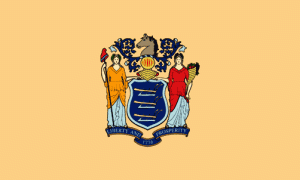
The state flag for New Jersey was officially adopted and described in a joint resolution of the legislature in 1896. The colors for the flag were chosen by General George Washington in 1779, after he was headquartered in New Jersey during the Revolutionary war. These were the military colors used by the New Jersey troops. The 1896 resolution reads as follows:
New Jersey Flag

Joint Resolution to Define the State Flag

  1. BE IT RESOLVED by the Senate and General Assembly of the State of New Jersey: The State flag shall be of buff color, having in the center thereof the arms of the State properly emblazoned thereon.
  2. The State flag shall be the headquarters flag for the Governor as Commander-in-Chief, but shall not supersede distinctive flags which are or may hereafter be prescribed for different arms of military or naval service of this State.
  3. This act shall take effect immediately.

In 1965, a law was passed that defines the specific shades of Jersey blue and buff. If you use the Cable color system developed by The Color Association of the United States, Jersey blue is Cable #70087, and buff is Cable #65015.

The flag itself is buff colored and has the state coat of arms in the center, which is where you find the Jersey blue color. The shield has three plows with a horse’s head above it. The two women on the shield represent the goddesses of Liberty and Prosperity which is the state motto. The ribbon on the bottom reads Liberty and Prosperity and includes the year of independence 1776.


Flag of New Hampshire

The flag of New Hampshire was officially adopted in 1909. Prior to that time period, the state of New Hampshire had a number of regimental flags to represent the state. The flag has been modified only once since its adoption in 1909 when the state’s seal was modified in 1931.

Flag of New Hampshire

The body of the New Hampshire flag is blue. Upon the center of the flag rests the state’s seal with the frigate Raleigh. These are surrounded by laurel leaves and nine stars. The frigate Raleigh is tipped on the flag to appear as though it’s floating on water. The nine stars represent New Hampshire as the ninth state to enter the union.

New Hampshire Statutes state, “The state flag shall be of the following color and design: The body or field shall be blue and shall bear upon its center in suitable proportion and colors a representation of the state seal. The seal shall be surrounded by a wreath of laurel leaves with nine stars interspersed. When used for military purposes the flag shall conform to the regulations of the United States.”

In a 2001 survey of members of the North American Vexillological Association, the New Hampshire state flag design was ranked as one of the ten worst flags within the United States, Canadian provinces, or select nations. In 2003, at least one elected official has suggested replacing the state seal in the center of the flag; however, no official action has ever been taken on that proposal.

Nevada State Flag

by Sherri Smith

Nevada has been associated with, more or less, four “official” flags with the current design having been made the official in 1991. The current design is very similar to the design adopted in 1929; however, it fixes some errors that were not caught until 60 years later.

Nevada State Flag

During the 1929 session of the Nevada State Legislature, a bill was introduced that repealed the 1915 flag and officially adopted the “Schellbach” design. This bill went through the state senate; however, it was held up in the Assembly because the flag did not include the state name. The Senate and the Assembly could not agree on the placement of the name and a conference committee was designed and a compromise was worked out.

On March 26, 1929, the bill adopting the “Schellbach” flag was signed by then Governor Balzar. However, the bill that was signed by the Governor was not the version that contained the amendment agreed upon by the Senate and the Assembly. This error was discovered by legislative researcher Dana Bennett in 1989 and was confirmed by the State Archives and Records Administrator Guy Rocha.

Senator William Raggio introduced the bill in 1991 to correct the problem. After the Senate and Assembly hearings on the subject, the legislature voted to correct all of the shortcomings of the 1929 flag legislation.

Nevada Revised Statutes state: “The official flag of the State of Nevada is hereby created. The body of the flag must be of solid cobalt blue. On the field in the upper left quarter thereof must be two sprays of sagebrush with the stems crossed at the bottom to form a half wreath. Within the sprays must be a five-pointed silver star with one point up. The word “Nevada” must also be inscribed below the star and above the sprays, in a semicircular pattern with the letters spaced apart in equal increments, in the same style of letters as the words “Battle Born.” Above the wreath, and touching the tips thereof, must be a scroll bearing the words “Battle Born.” The scroll and the word “Nevada” must be golden-yellow. The lettering on the scroll must be black-colored sans serif gothic capital letters.”

Jolly Roger Flag

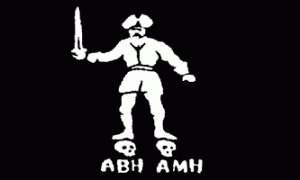
Still very popular in today’s culture is the Jolly Roger, the name of which was given to any of the various flags flown to identify a ship’s crew as pirates. The most common flag that identified a ship’s crew as pirates is the skull and crossbones: a skull above two long bones set in an x-mark arrangement on a black field. The name “Jolly Roger” has been thought to have come from joli rouge (pretty red), an ironic French description of the bloody banner flown by early privateers. These flags were intended to strike mortal terror in the hearts of the pirate’s intended victims.

Jolly Roger Flag

This design was reportedly used by the pirate captains Edward England, John Taylor, Sam Bellamy, and John Martel. Despite the current popularity, most pirates in the 17-18th centuries used plain black flags. Pirates did not use the black flag or Jolly Roger flag at all times. Instead they stocked a variety of flags and would fly false colors until they had their prey within firing distance. When they had their victim within range, it was then that the Jolly Roger flag would be raised, often concurrently with a warning shot.

Another Jolly Roger Flag

An interesting tidbit is that in World War II, it was common practice for the submarines of the Royal Navy and Royal Australian Navy to fly the Jolly Roger on completion of a victorious combat operation as a display of boasting and slyness instead of mayhem. Additionally, since the decline of piracy (although pirates in today’s world still exist), various military units have used the Jolly Roger as a victory flag and a show of fierceness and stoutness.

Flagpoles for Hurricane Season

Hurricane season means different things to different people. For some of us, hurricane season is simply that time of year when the weather man’s radar screen is full of bright colors swirling across places like Cuba and the Florida Keys. Sadly, for others, hurricane season is much more than swirling colors on a map; it’s a time when extra precautions must be taken to insure the safety of our families and possessions.

Hurricane

If you’re someone that lives in an area that’s prone to being hit by hurricanes, one such precaution that you might want to consider taking is that of buying a flagpole strong enough to resist the high winds that such a storm can produce. Standard flagpoles can bend and even snap in such conditions, leaving anything within striking distance at risk.

Our Hurricane Series Flagpoles are the perfect option. Due to their increased wall thickness and butt diameter, they can withstand up 255 MPH when unflagged and 150+ when flagged. Standard accessories include a cast aluminum cleat with mounting screws and a galvanized steel foundation sleeve. They’re also available with either an internal or external halyard.

Hurricane Series Flagpole

A durable flag is also essential to anyone living in an area with high wind conditions. Our sewn polyester flags are the toughest on the market today. Their open-weave design reduces fabric stress and is more resistant to high winds. However, due to the fact that they’re made of a heavier fabric, they require more wind to fly than would a flag made of, say, nylon. They also require more effort to take down and put up. We offer a six month warranty on these flags.

Christopher Gadsden – Creator of the Gadsden Flag

Christopher Gadsden lived a long a storied life. He was, among other things, deeply involved in the American Revolution. However, Gadsden may be best known for having designed the Gadsden Flag.

Christopher Gadsden

Gadsden was born in Charleston, South Carolina on February 16, 1724. His father, Thomas Gadsden, sent him to be educated at a school near Bristol, England. Upon returning the States in 1740, Gadsden became an apprentice in a Philadelphia court house, and when his parents died one year later in 1741, he inherited a sizable fortune.

Starting in 1745, Gadsden spent time serving as a purser on a British warship, and by 1747 he had saved enough money to buy back the land that his father, a chronic gambler, had lost more than a decade earlier.

Gadsden soon became a prominent merchant in Charleston, and a wharf that he built there still bears his name to this day. However, despite being busy with his mercantile ventures, Gadsden found time in 1759 to captain a militia company during an expedition against the Cherokees.

In 1757, he was elected to the Common House of Assembly, and in 1765 the Assembly made him one of its delegates to the Stamp Act Congress in New York City. During the Congress, Gadsden’s addresses caught the attention of Samuel Adams and the two began a long friendship; Gadsden eventually came to be known as the “Samuel Adams of the South”.

Upon returning to South Carolina, Gadsden became a member of a secret organization of American patriots known as the Sons of Liberty, and by 1774 he’d been elected as a delegate to the First Continental Congress.

One year later, in 1775, Gadsden was serving as a member of the Second Continental Congress when it created the United States Navy to stop British ships from reaching the Colonies. The Congress also ordered that a group of Marines be got together to accompany the new Navy on its first mission, and the first men enlisted happened to carry yellow drums with the image of a rattlesnake poised to attack and the motto “Don’t Tread on Me” painted upon them.

Gadsden Flag

Whether Gadsden was inspired by the drums or had designed them himself is to this day unclear. However, what is clear is that the commander of the Navy, Esek Hopkins, received a flag from Gadsden bearing the same imagery as the soldiers’ drums before disembarking on the first mission. The South Carolina congressional journals also record that Gadsden presented a copy of the same flag to the state legislature in Charleston.

Later in life, Gadsden held a number of positions in South Carolina’s state government, including Lieutenant Governor, and became a prisoner of war before dying of an accidental fall in 1805. He is buried in St. Phillip’s Churchyard in Charleston, South Carolina.

Flag of Thailand

by Sherri Smith

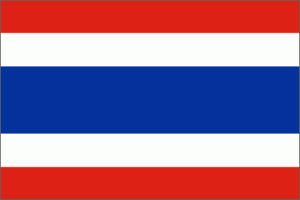
The first Thailand flag was created during the reign of King Rama II. This flag was chosen with the lucky symbol of a white elephant. The present Thailand flag, the Trai Rong or three colors was designed by King Rama VI. It was first used around 1920. The flag has five horizontal stripes in the colors red, white, blue, white and red, with the middle stripe being twice as wide as the other four. Red stands for nation, white represents religion, and the blue signifies the king. Nation-religion-king is an unofficial motto of Thailand.

Thailand Flag

The current flag was adopted on September 28, 1917 according to a royal decree in that year; however, didn’t become widely used until around the 1920s.

The Naval Ensign is similar to the National Flag except that is has a red circle in the middle of the flag and the circle reaches as far as the red stripes on the flag; both top and bottom. Within the circle stands a white elephant, in full regalia, facing the flagpole. This ensign was adopted in 1917 as well.

When the flag of Thailand is flown, it is often flanked by the two Royal flags of the King and Queen on each side. The Royal flags are flown slightly below the flag of Thailand. Thailand’s flag most closely resembles the flag of Costa Rica, which was adopted 11 years prior to Thailand’s. The difference is that the blue and red colors have been inverted.

Flag of Switzerland

by Sherri Smith

The flag of Switzerland is a red square with a white cross in the center of the flag. It was adopted from the flag of the Swiss canton of Schwyz (one of the first three Swiss cantons.) The flag was officially adopted as the flag of Switzerland on December 12, 1889; however, the design dates back to about 1480, which is long before Switzerland was even formed.

Flag of Switzerland

The flag of Switzerland stands for freedom, honor, and fidelity. An interesting thing to note is that the Swiss National Flag and the flag of the Vatican are the only square national flags. Additionally, for centuries, the Swiss people identified themselves with their cantons (regions). During the industrial age of the 19th and 20th centuries, there was huge migration inside Switzerland and many Swiss citizens could no longer identify with a specific canton, thus the national flag became more visible.

Another interesting fact is that when the International Committee of the Red Cross was founded to be a neutral institution to take care of the military or civil persons injured in war on the initiative of Henri Dunant and a Swiss general Dufour in 1864. Dufour proposed the reversal of the flag as an emblem. So the Red Cross flag is an inverted version of the flag of Switzerland.

The official use of the flag is to be displayed on federal, cantonal, and municipal buildings; however, there is no uniform pattern or regulation to its use. In private use, the flag is often shown as a display of patriotism and flown together with the cantonal and municipal flags.

Displaying the American Flag

by Kathy McCarthy

Whenever anyone displays an American Flag there is a certain protocol that should be respected. Follow these 8 helpful tips to make sure that your American Flag is properly displayed.

  1. The flag should only be flown when the weather is clear, unless the flag and its hardware are designed to withstand the elements.
  2. The flag should never be altered in any way. Never affix any letter, number or symbol to an American Flag.
  3. The flag should never be used as a wrapping or covering.
  4. The flag should not be used for any decoration in general, nor should it be used for any advertising purpose. It should also never be used as part of a costume or athletic uniform except when worn as a flag patch such as those found on uniforms of service personnel and members of patriotic organizations.
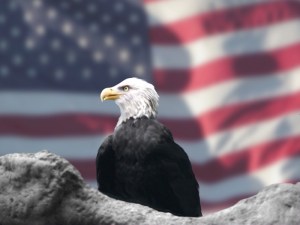
  5. Eagle and American Flag

  6. The flag should be always be lighted. It can be displayed in sunlight, but if it is to be displayed at night it must be lit with an appropriate flagpole light.
  7. The flag should never be displayed, lowered or dipped except when mourning a death or being used as a distress signal.
  8. The flag should never touch the ground. When lowering the flag it should be received by an attendant, properly folded and stored.
  9. The flag should be kept in good repair, and when a flag is so worn that it cannot be repaired, it should be destroyed with dignity by burning it.

By following these 8 suggestions, you can proudly fly your American Flag and honor those who bravely fought for the freedom that you enjoy today!

My Country, My Flag

by Kathy McCarthy

Whether you own a house or live in an apartment, you can always be proud of being an American by flying the American Flag. Whether you buy just the flag or a kit with all of the hardware and a pole, it’s pretty easy to fly your own flag. I know, because I just hung my first flag yesterday.

American Flag

I just moved into my first house. It’s a townhouse actually, but it’s all me. Last year I lived with a roommate, so I’m not really counting that place as my own. I grew up with my family  in a small community just outside of Sacramento, California. Though we lived in a neighborhood, our property was several acres. So every morning my Dad would carry the American Flag out to the front gate and place it on its hanger, and every evening my Mom would bring it in.

I never thought much of this little ritual until I moved out of my family’s house and no longer had a flag. I never realized that every day as I drove in an out of our driveway the flag reminded me of who I am and why I’m grateful to be an American.

I know that I have not sampled a lot of things that life has to offer just yet, but I do know enough to be grateful for all of the freedoms that I enjoy in my country. For example, I have not had to go to war, but many have, and I know that it’s to protect my rights, and me. When I see the flag it reminds me, and I am grateful.

Now I have hung my own flag in front of my house for all to see. I carry it out to hang it up in the morning, and I bring it in at nightfall. As I come and go throughout the day, I see it, and it reminds me that I am proud and grateful to be an American.