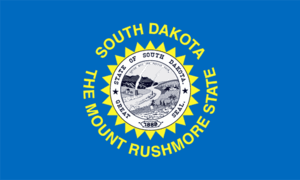
Flag of South Dakota


The flag of the state of South Dakota was adopted on November 9, 1992. The flag is rectangular with a bright blue background. The seal of the state of South Dakota appears in the center of the flag surrounded by gold triangles that represent the sun’s rays. The text, “SOUTH DAKOTA” and “THE MOUNT RUSHMORE STATE” appear around the seal, in all capital letters.

The seal of the state of South Dakota was designed in 1885. The seal features hills, a mine, a river and a boat, a farmer, and cattle, a scene representative of South Dakota’s economy, industry, landscape, and natural resources. Above the scene is that state’s motto: “Under God the People Rule.” The text “STATE OF SOUTH DAKOTA” and “GREAT SEAL” appear around the seal. The date “1889” appears at the bottom of the seal, the year South Dakota became an official state in the Union.

The original flag of South Dakota was somewhat different than the state’s current flag. The original flag, which was designed in 1909, featured the same bright blue background but contained different images on the banner’s front and back. The front of the flag featured a large yellow sun with the text “SOUTH DAKOTA” and “THE SUNSHINE STATE.” The back of the flag contained the seal of the state of South Dakota and the same text. Printing a flag with different front and back designs was expensive; however, and the cost of the flag prohibited many homes and businesses from displaying the flag.

In 1963, the South Dakota State Legislature passed a bill to change the state flag to display the state seal on both sides. In 1992, the flag underwent its final modification. Although the state adopted the nickname, “The Sunshine State,” to reflect the many sunny days that occur every year in South Dakota, the state officially adopted “The Mount Rushmore State,” as its official nickname. Subsequently, in the same year, the text on the flag was changed from “THE SUNSHINE STATE” to “THE MOUNT RUSHMORE STATE.”
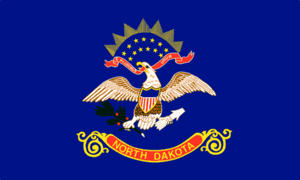
Flag of North Dakota


The flag of the state of North Dakota was adopted on March 3, 1911. The flag is rectangular with a dark blue background. The flag features a bald eagle with a red, white, and blue shield. In its feet, the eagle holds an olive branch and a bundle of arrows. A gold sunburst and thirteen gold stars appear above the eagle. The eagle holds a ribbon in its mouth; on the ribbon is the text, “One nation made up of many states.” A red and gold scroll appears below the eagle with the text “North Dakota.”

Rather than containing images symbolic of state, land, and people of North Dakota, the flag of North Dakota contains images important to the United States as a whole. The image of the bald eagle with the olive branch, bundle of arrows, and shield, for example, closely resembles the United States Coat of Arms, Great Seal of the United States, and the Seal of the President of the United States.

The bald eagle symbolizes freedom and the founding fathers often compared the United States to the characteristics of this powerful bird. The shield lies on the eagle’s breast without any support, representing the thought that the United States must rely on its own virtues. The thirteen stripes on the shield—as well as the thirteen gold stars above the eagle—represent the original thirteen colonies of the United States. The olive branch symbolizes the power of peace, while the arrows symbolize the power of war.

The red, white, and blue colors in the shield contain the same symbolic meanings as the colors of the American flag. The white symbolizes innocence and purity; the red represents valor and strength, and the blue represents justice and perseverance.

The flag of the state of North Dakota is nearly identical to the flag the North Dakota infantry carried during both the Spanish American War and the Phillipine-American War. In 1953, a bill was introduced in the North Carolina Legislative Assembly to change the flag on the basis that it too closely resembles the United States Coat of Arms and other national seals; however the bill was promptly defeated in the same year.

Flag of the State of Maine


The current flag of the state of Maine was adopted on February 23, 1909. The flag is rectangular with a blue background. The state flag of Maine features Maine’s coat of arms in the center, two men on either side of the shield, a star above the shield, and the text “MAINE” below the shield.

The coat of arms of the state of Maine, which appears in the center of the flag, reflects Maine’s beautiful northeastern United States scenery: a large pine tree is featured in the center of the shield with a moose resting below near a river. A farmer holding a sickle and a sailor holding an anchor appear on either side of the shield. These two men represent the importance of the agriculture and sea industries for the state’s economic livelihood.

The star that appears radiantly above the shield is the North Star. The text, “DIRIGO,” appears below the North Star. Dirigo, which is Latin for “I direct,” is the state of Maine’s official motto. The text, “MAINE,” appears below the shield on a light blue banner.

Maine’s current flag is somewhat different from the state’s first flag, which was developed in 1901. The original flag was rectangular with a buff or tan-colored background. The flag featured a block image of a green pine tree in the center. The North Star appeared as a blue star in the top left corner of the flag.

Maine and Massachusetts are the only two states in the Union to fly a separate ensign, or flag at sea. Maine’s official ensign is a rectangular flag with a white background. A block image of a green pine tree appears in the center with a blue anchor behind it. The text, “DIRIGO,” appears in blue capital letters above the tree and anchor; and the text, “MAINE,” appears below the tree and anchor in the same font.

Flag of the State of Delaware


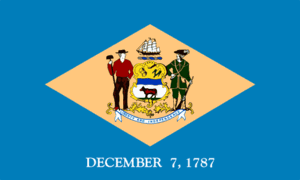
The flag of the state of Delaware was adopted on July 24, 1913. The flag is rectangular with a colonial blue background. The center of the flag features a buff-colored diamond and the Delaware coat of arms appears inside the diamond. The date December 7, 1787 appears on the bottom of the flag below the coat of arms. This date refers to the day on which the state of Delaware was the first state to ratify the United States constitution. This bold action made Delaware the first official state in the Union, and because of this, Delaware holds first position at national events like presidential inaugurations.

The other elements of Delaware’s state flag have important meaning for the state and recall the Revolutionary era. The blue and buff colors on the state flag of Delaware, for example, symbolize the colors of George Washington’s uniform.

The elements of the coat of arms also represent important people and industries of the state of Delaware during the Revolutionary era. The center of the coat of arms features a shield with horizontal red, blue, and white stripes. An ear of corn and sheaf of wheat appear in the red stripe, symbolizing the importance of agriculture in Delaware’s economy. The blue stripe is plain, representing the Delaware River, and the river’s importance to Delaware’s transportation and economy. An ox appears in the white stripe and reflects the importance of animals in Delaware’s economy. A ship appears above the shield, symbolizing the importance of shipbuilding and trade to Delaware’s economic livelihood.

Two men appear on either side of the coat of arms: a farmer with a hoe and a militiaman with a musket. These two men reinforce the importance of farming in Delaware and also emphasize the importance of the militia—an army made up of civilians—in gaining independence during the Revolution. Under the shield and the men are the words “Liberty and Independence,” Delaware’s state motto.

Flag of the State of Kentucky


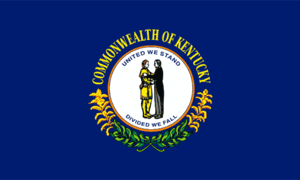
The flag of the state of Kentucky was officially authorized on March 26, 1918. The 1918 flag act, which was adopted by the Kentucky General Assembly, mandated that the Kentucky state flag have a dark blue background. The flag must include the seal of the Commonwealth of Kentucky in the center, and the seal must be encircled by the goldenrod, Kentucky’s state flower. The original dimensions of the flag were not specified.

The original Kentucky state flag was not created until 1920, when a ceremony at Camp Zachary required its use. After this ceremony, a committee was formed to improve the design of the flag, but unfortunately, the committee’s work never reached the governor.

In 1927, Jouett Cannon, the Secretary of the Kentucky Historical Society, commissioned a Frankfort art teacher, Jesse Cox, to design an official Kentucky state flag. The flag Cox designed is very similar to the current Kentucky state flag.

The Kentucky state flag’s design was officially codified in 1961–1962, when Kentucky Adjunct General, Major Taylor L. Davidson researched historical designs of previous Kentucky state flags and commissioned artist Harold Collins to produce three designs of the Kentucky state flag. After Kentucky Governor Bert Combs approved one of the designs, the Kentucky Legislature passed a more detailed bill in 1962 to codify the design of the state flag and eliminate uncertainties.

The Kentucky state flag we see today adheres to the original flag act and includes the dark blue background, seal of the Commonwealth of Kentucky, and goldenrod flowers. The seal of the Commonwealth of Kentucky depicts two friends, a frontiersman and a statesman embracing. According to popular belief, the frontiersman is Daniel Boone, who explored much of Kentucky, and the statesman is Henry Clay, Kentucky’s most famous politician; the official explanation of the seal, however, claims that the figures represent all frontiersmen and statesmen. The words “UNITED WE STAND, DIVIDED WE FALL,” encircle the men in the seal and refer to lyrics from the popular American Revolution tune, “The Liberty Song.” In addition to the goldenrod flowers, the words “COMMONWEALTH OF KENTUCKY” also encircle the seal.

Flag of Florida


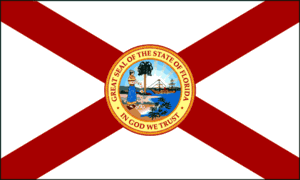
The flag of the state of Florida was adopted by popular referendum on September 24, 1900. The flag is rectangular with a white background and a red diagonal cross. The seal of the state of Florida appears in the center of the flag, at the intersection of the red stripes.

The red diagonal cross is reminiscent of the Cross of Burgundy flag that the Spanish navy used in the sixteenth and seventeenth centuries, during which the empire colonized Florida. The seal of the state of Florida depicts a Native American Seminole woman spreading hibiscus flowers in the foreground. Florida’s state tree, the Sabal palm, appears behind the woman. A steamboat appears in the background as the suns rays break into the sky. A gold border encloses the seal. The text, “Great Seal of the State of Florida,” and “In God We Trust,” appear in red capital letters insider the border.

During the Civil War, when Florida seceded from the Union, the Florida Legislature passed a law authorizing Florida’s governor to design Florida’s first official state flag. Florida’s first flag was included a blue vertical field on the left side with Florida’s state seal (different from the current state seal) inside the blue field. The other region of the flag included two red horizontal stripes, one on the top of the flag and one on the bottom, with a white stripe in the center.

Between 1868 and 1900, Florida used a flag that featured the state’s seal on a white background. Just before the turn of the century, however, Florida’s Governor Francis P. Fleming suggested adding the red diagonal cross to Florida’s state flag. By adding color to the flag, the banner could not be mistaken as a flag of retreat, and the red stripes added significance as well. This decision was approved by popular referendum in 1900. In 1985, the graphics of the Florida state seal were improved slightly, and the flag changed subsequently as well.

Flag of Virginia

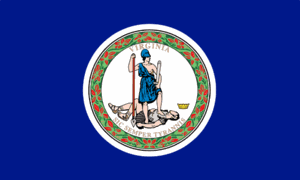
The Flag of the Commonwealth of Virginia was adopted on January 31, 1861 at the beginning of the United States Civil War. The flag is rectangular with a blue background. In the center of the flag is the seal of Virginia enclosed in a white circle. Virginia’s seal was designed by George Mason, known as the “Father of the Bill of Rights” and George Wythe, whose signature appears on the United States Declaration of Independence.

The seal depicted on the flag of Virginia features a woman, personifying Virtus, or virtue in ancient Roman times. Virtus is a symbol of peace, and she stands with her sword in its sheath resting her weight on a long spear, indicating a victorious battle. Her bare foot rests on Tyrannis, or tyranny, represented by a man in a purple robe and sandals with a fallen crown. The scene symbolizes the Virginia’s—and the United States’—defeat of the British government during the American Revolution. The broken chain in Tyranny’s left hand further emphasizes Great Britain’s defeat by the American Colonies. Virginia is the only state besides New York to include a crown in its flag.

The word “Virginia” appears on top of the seal, and the Latin phrase, Sic semper tyrannis, appears at the bottom. The motto literally means “Thus Always to Tyrants,” and describes the scene depicted on the seal. The phrase’s origins, like the image, date back to Roman times whe Marcus Junius Brutus assassinated the tyrant Julius Caesar. The phrase has been used to ill effect as well during notable U.S. assassinations. John Wilkes Booth shouted, Sic semper tyrannis, when he assassinated Abraham Lincoln at Ford’s Theatre on April 14, 1865. Timothy McVeigh wore a T-shirt with the phrase and a picture of President Lincoln when he was arrested after the Oklahom City bombing in April 1995. In Virginia, however, saying Sic semper tyrannis, is a common joke dating back to the Civil War and means “get your foot off my neck.”

The Arizona State Flag

The Arizona State Flag has its roots in the 1910 National Rifle Matches at Camp Perry, Ohio, even before Arizona was officially a state in the Union. Camp Perry’s shooting matches began in 1907, quickly became popular, and still continue today.  Ideas for the Arizona flag first developed when Arizona rifle team members noticed that many of the states competing in the matches displayed flags or emblems representing their state.   The team captain, Arizona National Guard Colonel Charles Wilred Harris, suggested the idea of a flag for use at the National Rifle Matches.

Arizona State Flag

Harris, along with Carl Hayden, Arizona’s first Congressional Representative, set out to designing a flag.  In patriotic spirit, it was of great importance to Harris and Hayden that the Arizona flag design display historical values in both its design and colors.  Nan Hayden, Carl Hayden’s wife, sewed the first flag, and it was used in the National Rifle Match in 1911.

In 1912, Harris, now Adjunct General of Arizona, designed a similar flag for use as a state flag.  The Arizona State Legislature officially adopted Harris’s flag on February 17, 1917, despite Governor Thomas Campbell’s refusal to sign the bill into law.

The Arizona State Flag consists red and yellow rays on the top half, a blue bottom half, and a copper star in the middle.  There are 13 red and yellow rays, symbolizing the 13 original colonies of the United States and Arizona’s 13 original counties.  The red and yellow symbolize both the colors of Arizona’s beautiful sunsets.  Red and yellow are also the colors on the Spanish flag flown by Francisco Vasquez de Coronado and his conquistadors during their search for the Seven Cities of Cibola in 1540.

The blue bottom half of the flag represents the Liberty Blue found on the U.S. flag.  The copper star in the middle of the flag represents Arizona’s copper-mining industry, which produces the largest amount of copper in the nation.

Arizona indeed has a beautiful flag, and reasons for Thomas Campbell’s refusal to accept the flag are unknown.  As if to spite him, however, a 2001 poll by the North American Vexillological Association voted Arizaon’s state flag as the sixth best flag on the continent.

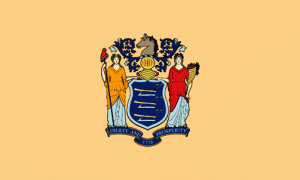
Flag of New Jersey

The state flag for New Jersey was officially adopted and described in a joint resolution of the legislature in 1896. The colors for the flag were chosen by General George Washington in 1779, after he was headquartered in New Jersey during the Revolutionary war. These were the military colors used by the New Jersey troops. The 1896 resolution reads as follows:

New Jersey Flag

Joint Resolution to Define the State Flag

  1. BE IT RESOLVED by the Senate and General Assembly of the State of New Jersey: The State flag shall be of buff color, having in the center thereof the arms of the State properly emblazoned thereon.
  2. The State flag shall be the headquarters flag for the Governor as Commander-in-Chief, but shall not supersede distinctive flags which are or may hereafter be prescribed for different arms of military or naval service of this State.
  3. This act shall take effect immediately.

In 1965, a law was passed that defines the specific shades of Jersey blue and buff. If you use the Cable color system developed by The Color Association of the United States, Jersey blue is Cable #70087, and buff is Cable #65015.

The flag itself is buff colored and has the state coat of arms in the center, which is where you find the Jersey blue color. The shield has three plows with a horse’s head above it. The two women on the shield represent the goddesses of Liberty and Prosperity which is the state motto. The ribbon on the bottom reads Liberty and Prosperity and includes the year of independence 1776.