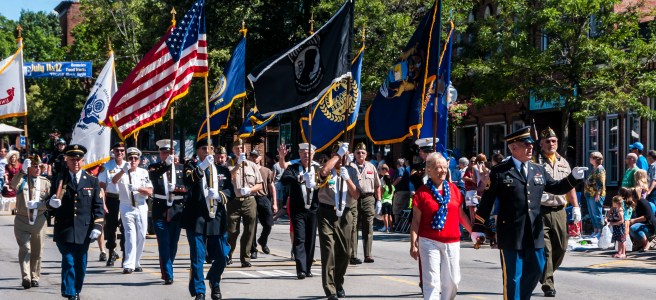
On Memorial Day we honor the men and women who have died while serving in the U.S. military. This day is observed by visiting cemeteries or memorials, holding family gatherings, and participating in parades. Originally known as Decoration Day, it originated in the years following the Civil War and became an official federal holiday in 1971.
By the time the American Civil War had ended in the spring of 1865, more lives had been claimed than in any other conflict is U.S. history. This required the establishment of the country’s first national cemeteries. By the late 1860s, various towns and cities had begun holding springtime tributes to these countless fallen soldiers by decorating their graves with flowers and reciting prayers.
While it is unclear where this tradition had originated, what with numerous different communities independently initiating the memorial gatherings, Waterloo, New York was declared the official birthplace of Memorial Day by the federal government in 1966. Waterloo – which first celebrated the day on May 5, 1866 – was chosen because it hosted an annual, community-wide event, during which businesses closed and residents decorated the graves of soldiers with flowers and flags.
On May 5, 1868, General John A. Logan, leader of an organization for Northern Civil War veterans, called for a nationwide day of remembrance later that month. General Logan chose May 30th and called it Decoration Day. The date was chosen because it wasn’t the anniversary of any particular Civil War battle.
On the first Decoration Day, General James Garfield made a speech at Arlington National Cemetery, where 5,000 participants decorated the graves of 20,000 Union and Confederate soldiers buried there. Many Northern states held similar commemorative events and by 1890, each one had made Decoration Day an official state holiday. Southern states continued to honor their dead on separate days until after World War I.
Memorial Day, as Decoration Day gradually became to be known, originally honored only those lost while fighting in the Civil War. However during World War I, the United States found itself embroiled in another major conflict. The holiday grew to commemorate all American military personnel who died in any war.
For decades, Memorial Day continued to be observed on May 30th, the date General Logan had selected for the first Decoration Day. But in 1968, Congress passed the Uniform Monday Holiday Act, which established Memorial Day as the last Monday in May, in order to create a three-day weekend for federal employees. This change, that went into effect in 1971, also declared Memorial Day as a federal holiday.
United States Flag Store is here to answer all your questions. Feel free to give us a toll free call at 1-877-734-2458 or email us at support@onlinestores.com.
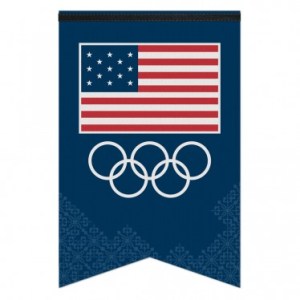 Every Olympic games holds an Opening Ceremony, featuring spectacular performances, music, culture, and more. In the midst of the Opening Ceremony is the Parade of Nations, which usually take place in a stadium, arena, or another type of venue in the host nation. The Parade of Nations is where the participating countries parade into the venue, carrying their flag, along with their national team. The teams usually range from one person to several hundred. Each team has a flagbearer, and the flagbearer is picked due to various reasons. Sometimes the flagbearer may be the sole team
 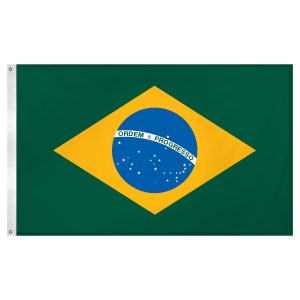 member, a medal hopeful, a medal winner from the previous games, or an official from the nation’s team. Larger nations like the United States elect their flagbearer
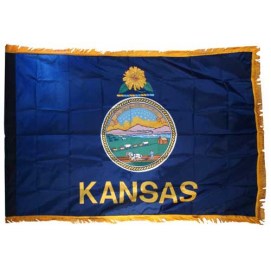 Kansas’ state flag was adopted on May 21, 1927. It had been flown at Fort Riley for the first time to honor the troops and the Kansas National Guard. The flag is a navy blue and has the state seal emblazoned in the middle. This seal depicts the rising sun in the East while life, of covered wagons, livestock, and farming, go on in the left hand corner and below. In the sky are 34 stars, each symbolizing a state at the time the seal was created during Kansas’ entry into the Union. Above the stars is a gold ribbon, reading Ad Astra Per Aspera, the state’s motto, meaning “to the stars through difficulties”. Underneath the state seal is the word “Kansas” in yellow and atop the seal is a sunflower sitting on a twisted blue and gold bar. This bar is said to symbolize the Louisiana Purchase in which the land Kansas was in was also acquired from. The sunflower is also Kansas’ state flower.
 Since the 70’s, the United States has seen a shift in being the leading society of producers, to a society of doers and thinkers. While America has gravitated towards technology and research over manufacturing, China has stepped in to be the major producers and exporters of goods.
 Flag Blog