
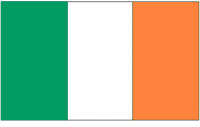
 The flag of Ireland was officially adopted in 1919 when Ireland gained its independence from Great Britain. The flag is rectangular with three vertical stripes: a green stripe on the left side, a white stripe in the middle, and an orange stripe on the right.
The colors and design of the Irish flag have clear symbolism and historical context. The green stripe on the flag represents the Gaelic tradition, the majority of Ireland’s population and the group of revolutionaries that fought for Ireland’s independence. The orange stripe stands for William of Orange—the king of England and Ireland—and his supporters. These supporters were overwhelmingly Protestant, loyal to the British government, and often found conflict with the Gaelic Irish majority. The white in the center represents a truce, and more importantly, peace, between the two major Irish traditions.
The origin of the Irish flag dates back to the rivalry between the Gaelic and Orange Irish traditions. The Gaelic Irish began using a green flag with a harp on it in the mid seventeenth century, and shortly after, the color green—and the harp—became widely associated with the Gaelic people. The Protestants, who organized the Orange Order, founded their kingdom in 1795, and the two traditions fought each other in the Irish Rebellion of 1798. In the mid-nineteenth century, many Irish nationalists began to spread the idea of making peace between these two traditions in order to have an independent Irish nation.
The use of green, white, and orange colors together was first exhibited during the French Revolution, when Irish supporters wore cockades, rosettes, and badges featuring this tricolor to celebrate. In 1848, a group of French women gave the first version of the Irish flag to Thomas Francis Meagher, a Young Ireland leader, and he displayed the flag from publicly for the first time during a public address celebrating the French Revolution. Although the tricolor flag was often displayed alongside the French tricolor during this period, the green Gaelic flag was most often used until the Easter Rising, which began the Irish revolution in 1916.

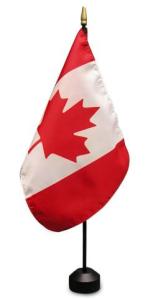 The flag of Canada was adopted on February 15, 1965. It is a rectangular flag with two vertical red stripes on the left and right sides. The center section of the flag is white with a red 11-pointed maple leaf in the center. The flag is known in Canada as the “Maple Leaf” or l’Unifolié (“the one-leafed”).
 The flag of Bolivia was adopted in 1851. The civil flag consists of a rectangular shape with three horizontal stripes: the top stripe is red, the middle stripe is yellow, and the bottom stripe is green. The state flag consists of the three-striped civil flag with the Bolivian coat of arms in the center.
 embroidered by machine to enable for exact replication of the tiny details found on many country’s flags. All world flag patches have a vinyl backing, allowing them to be stitched or ironed on to clothing. Shield-shaped patches approximately are 3” x 2.5” and rectangular patches are 3.5” by 2.25”. Most patches are available at a low price of $2.49 each, but discounts are available for purchasing quantities of ten or more. Order your favorite patches today!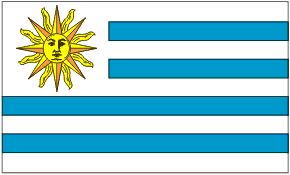
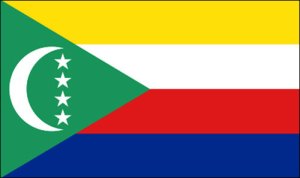

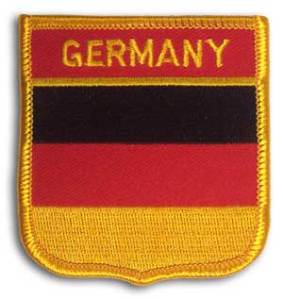 If for some reason you’re unable to fly a flag, flag patches are another great way of throwing your support behind a country. The U.S. Flag Store sells more flag patches than anyone else in the world today. We offer over 70 flag patches from such countries as Bolivia, Vietnam, India, Ireland and, of course, the good old
  Flag Blog