Flag of Serbia

The flag of Serbia was adopted on August 16, 2004. It is a rectangular flag with three horizontal stripes of equal width: the top stripe is red, the middle stripe is dark blue, and the bottom stripe is white. Centered vertically, towards the left side of the flag is the lesser coat of arms of Serbia, which features a red background with a white double-headed eagle, Serbian cross between four silver fire steels, two fleurs-de-lys, and a crown at the top.  The colors blue, red, and white, represent the pan-Slavic colors and are featured in many countries’ flags near Serbia.

The origins of the Serbian flag date to 1281.  This flag was flown under the rule of Stephen Vladislav I of Serbia and consisted of two horizontal stripes: the top stripe was red and the bottom was blue. A map from 1339 depicts of a different flag, however. This flag, flown under the rule of Stephen Uros IV Dusan of Serbia, features a red double-headed eagle on a golden background, similar to the Serbian coat of arms.

In the early nineteenth century, many flags were used in Serbia, some using the double-headed eagle in various colors and others using the pan-Slavic colors.  In 1835, however, the Sretenje Constitution standardized the Serbian flag, mandating that the official flag would contain three horizontal stripes of red, blue, and white.  Critics of the flag and the constitution thought the flag was too similar to Russia’s flag and the flag of the French Revolution, but the tricolor base remained.

The red, white, and blue stripes have been the foundation of the flag, but several variations have been used during the last two centuries.  From 1892 until 1918, during the Kingdom of Serbia, the royal coat of arms was included in the center of the flag.  After World War II, during the Socialist Republic of Serbia, the flag contained a red star in the center.  Following the fall of the communist regime, Serbia’s flag was a plain tricolor until 2004, when the lesser coat of arms was included.

Fall Banner Flags

Fall is here to stay (at least for a little while), and what better way to show your seasonal spirit than by displaying a fall banner flag from the United States Flag Store?! All banners are made of durable, high quality 200 Denier nylon.  Images and lettering are either artfully appliquéd or embroidered. You might see some of these beautiful fall flags at your local store for up to $30, but at the U.S. Flag Store, you’ll save big, paying as little as $16.95 for these beautiful flags.

For a classic fall look, the United States Flag Store offers several fall banner flags featuring leaves, pumpkins and flowers in beautiful shades of red, orange, and brown. The Season’s Harvest Pumpkin Flag, for example features an exquisite array of fall vegetables—including pumpkins, corn, grapes, and squash—as well as flowers and leaves.  The flag measures 28” x 40” so your neighbors and passersby will be sure to notice.

If your looking for a whimsical flag, take a look at the Scarecrow Banner Flag.  The scarecrow on this flag is more realistic than even the most sophisticated animated images.  With a pumpkin in hand, fall sunflowers in the background, and an adorable stitched grin on his face, this scarecrow is sure to melt your heart and put you in fall spirit! This flag is made from 100% pretreated polyester, so you won’t even need to worry about taking your scarecrow in when it rains!

For schoolteachers, or just anyone in the back-to-school spirit, the United States Flag Store offers two fantastic School and Teacher Flags. Both flags feature a beautiful array of back-to-school supplies—crayons, pencils, apples, books, rules, and chalk script—and include a pole hem and attachment tabs.  At a low price of $16.95, you’ll save $9 off the list price and have a beautifully decorated lawn or garden.

American Flag Pins – Lapel Pins

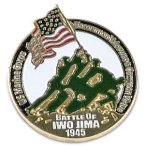
Iwo Jima Pin

American flag pins are a great way to support the U.S. without overdoing it. Don’t get me wrong: American flag t-shirts are awesome, but sometimes they can be a bit much. American flag pins, on the other hand, are rarely seen as inappropriate. You can wear them to school, church, work, or just around the house. With American flag pins, you’ll always be on the classy side of life.

Here at the United States Flag Store, we offer a wide selection of American flag pins, including one commemorating the Battle of Iwo Jima. We also offer service pins, military pins, and those featuring the support-our-troops yellow ribbon.

If you happen to be from Texas, Canada or the U.K., we also offer American flag pins featuring the U.S. flag coupled with your nation of state’s flag. There’s even a pin displaying the U.S. flag and the Christian flag side by side, making it easy for folks every where to express their love-of-country and faith at the same time.

American flag pins: they’re the way to go when supporting your country is one of your top priorities, no matter where you happen to be.

Gadsden Flag T-Shirts

The United States Flag Store has a fantastic selection of Gadsden Flag T-Shirts. The Gadsden flag is an American historical flag.  It has a yellow background with a coiled rattlesnake.  Underneath the rattlesnake reads the phrase: “Don’t tread on me.”  The American general Christopher Gadsden designed this flag. The Gadsden flag was used for by the United States Navy, and it has most recently been adopted by the Tea Party Movement.
The Original Don’t Tread On Me T-Shirt features an authentic image of the Gadsden flag on a bright yellow t-shirt.  These shirts are printed in-house on high-quality, value-priced, 100% heavy-duty Fruit of the Loom cotton. Shirts are available in sizes small through triple extra large, and at only $14.95, they are truly a great value and make great gifts!

If you’re looking for something more formal, United States Flag Store also offers a classy Gadsden Flag Polo Shirt.  The image is featured in the upper left-hand corner.  These great shirts are only $19.99 and available in sizes small through double extra large.

If you’re looking for something more animated, take a look at the United States Flag Store’s Gadsden t-shirts in diamond and fire designs.  These t-shirts feature a profile image of the rattlesnake, ready to bite.  An American flag and Declaration of Independence appear in the background of these snazzy shirts, and you can choose from diamond or fire text for the slogan. These great shirts are available in sizes small through triple extra large, and discounts are available for ordering two or more!

The scrolls version of the Gadsden t-shirt is particularly flashy because it features the open-mouthed rattlesnake facing out, allowing both beady eyes and long, sharp fangs to be completely visible. Like the diamond and fire t-shirts, the American flag and Declaration of Independence are featured in the background.  The famous slogan appears on two scrolls, one above and one below the rattlesnake image.

Be sure to check out more great varieties of the Gadsden flag t-shirt at United States Flag Store’s website.  Printed on the highest quality, heavy-duty cotton, these shirts are truly a great value and fantastic way to voice your political views!

Flag of Rwanda

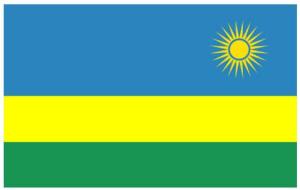
The flag of Rwanda was adopted on October 25, 2001. The flag is rectangular with three horizontal stripes.  The top stripe is a bright but light blue and is twice as wide as the two other stripes.  Below the blue stripe is a yellow stripe, and a green stripe lines the bottom of the flag. A yellow, twenty-four rayed sun is featured in the top right corner of the flag, in the blue field.  Alphonse Kirimbenecyo, a Rwandan artist, designed his country’s current flag.

The flag’s colors and the sun have symbolic meaning for the people of Rwanda.  The large blue stripe represents happiness and peace in Rwanda.  The yellow stripe symbolizes Rwanda’s mineral resources, which contribute to the country’s economy.  The green stripe stands for Rwanda’s natural resources and also for the Rwandan people’s hopes for prosperity.  The yellow sun in the upper right corner stands for unity among the Rwandan people and also transparency and enlightenment.

Rawanda used a different flag from 1961—just prior to Rwanda gaining independence from Belgium—until the time of the current flag’s adoption.  The older version of the flag was a vertical tricolor with an “R” in the middle.  The “R” distinguishes Rwanda’s flag from Guinea’s national flag, which is a vertical tricolor with the same colors.  The color choice for the older version of the flag represents the traditional African tricolor of red, yellow and green. In the older Rwandan flag, the red stripe is on the left side; the yellow stripe is in the middle and contains the large black “R” for Rwanda; and the green stripe is on the left side.  Traditionally, the red represents the strength of the Rwandan people; the green represents peace; and the yellow stands for the Rwandan people’s hope for future development. Although this African tricolor flag was used for many years, the flag’s association with the Rwandan Genocide of 1994 during which over 800,000 people were murdered prompted creation of a new flag.

Flag of Ireland

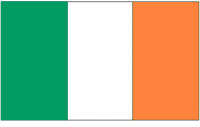
The flag of Ireland was officially adopted in 1919 when Ireland gained its independence from Great Britain. The flag is rectangular with three vertical stripes: a green stripe on the left side, a white stripe in the middle, and an orange stripe on the right.
The colors and design of the Irish flag have clear symbolism and historical context. The green stripe on the flag represents the Gaelic tradition, the majority of Ireland’s population and the group of revolutionaries that fought for Ireland’s independence.  The orange stripe stands for William of Orange—the king of England and Ireland—and his supporters.  These supporters were overwhelmingly Protestant, loyal to the British government, and often found conflict with the Gaelic Irish majority.  The white in the center represents a truce, and more importantly, peace, between the two major Irish traditions.

The origin of the Irish flag dates back to the rivalry between the Gaelic and Orange Irish traditions.  The Gaelic Irish began using a green flag with a harp on it in the mid seventeenth century, and shortly after, the color green—and the harp—became widely associated with the Gaelic people.  The Protestants, who organized the Orange Order, founded their kingdom in 1795, and the two traditions fought each other in the Irish Rebellion of 1798.  In the mid-nineteenth century, many Irish nationalists began to spread the idea of making peace between these two traditions in order to have an independent Irish nation.

The use of green, white, and orange colors together was first exhibited during the French Revolution, when Irish supporters wore cockades, rosettes, and badges featuring this tricolor to celebrate.  In 1848, a group of French women gave the first version of the Irish flag to Thomas Francis Meagher, a Young Ireland leader, and he displayed the flag from publicly for the first time during a public address celebrating the French Revolution. Although the tricolor flag was often displayed alongside the French tricolor during this period, the green Gaelic flag was most often used until the Easter Rising, which began the Irish revolution in 1916.

Flag of Russia

The flag of Russia was originally adopted in 1896. The flag was in use until the October Revolution of 1917, banned from use during the Communist era, and then readopted on December 11, 1993.  The Russian flag is a rectangular flag with three horizontal stripes of equal size: a white stripe on the top, a blue stripe in the middle, and a red stripe on the bottom.

Historians argue over the historical origins of the Russian flag, but two tales of the flag’s beginnings remain the most prevalent.  According to one legend, a Dutch sailor was sailing a Russian ship and was unsure what flag to sail on the boat.  He asked the Boyar Duma, a council that advised Russia’s princes and tsars in the seventeenth century, what his ships flag should look like.  This issue had never arisen before, and the Boyar Duma asked the sailor for his opinion. The Netherlands had already adopted its flag—a horizontal tricolor with a red stripe on the top, white in the middle, and blue on the bottom—and the sailor brought red, white, and blue fabric on to the ship. He designed another tricolor, similar to the flag of the Netherlands, but with a different arrangement of the stripes.

The second tale claims that Tsar Peter the Great visited Archangel, a city in northeastern Russia, several times in 1693 and 1964 to study European shipbuilding.  The tsar ordered a Dutch-built ship in 1693, and when it was finished, it had a Dutch flag flying from the back. In need of a Russian naval flag, the tsar changed the arrangement of the stripes on the Dutch flag to create a Russian banner.

Both tales of the flag’s origin support the Dutch flag’s influence on the Russian flag. Red, white, and blue colors can also be found on the Grand Duchy of Moscow’s coat of arms, which depicts St. George wearing white armor with a blue cape, riding a white horse, and holding a blue shield in front of a red background.

As with the origins of the Russian flag, there are several interpretations of the meaning of the colors of the Russian flag. One theory holds that the colors of the Russian flag represent the Russian monarchical social system in which the white represents God, the blue represents the Tsar, and the red represents the peasants.  Another interpretation argues that the colors represent the three main geographical regions of Russia: the white represents Belarus or White Russia, the blue represents the Ukraine or Little Russia, and the red represents Great Russia.  Finally a third interpretation argues that the white stands for hope for the future, the blue stands for the present, and the red stands for the bloodshed in Russia’s past.

Flag of Canada

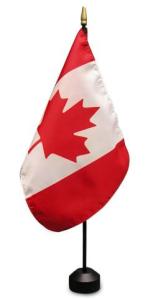
The flag of Canada was adopted on February 15, 1965. It is a rectangular flag with two vertical red stripes on the left and right sides.  The center section of the flag is white with a red 11-pointed maple leaf in the center.  The flag is known in Canada as the “Maple Leaf” or l’Unifolié (“the one-leafed”).
The story of the Canadian flag’s development is a colorful one and dates back to the Age of Exploration.  Both the British and the French settled in Canada in the sixteenth and seventeenth centuries.  When John Cabot arrived in Newfoundland in 1497, he flew the St. George’s Cross, a white flag with a red cross that was is used in England.  When Jacques Cartier arrived in Gaspé in 1534, he flew a red flag with a white cross, the reverse image of the St. George’s Cross that, at the time, was France’s national flag.

When the British settled in Nova Scotia in 1621, the Royal Union Flag, the current United Kingdom flag that contains St. George’s, St. Andrew’s, and St. Patrick’s crosses, was introduced into Canadian colonies.  Once New France came under British control in the mid-eighteenth century, the Union Flag served as the official Canadian flag until the current flag’s adoption in 1965.

This did not stop Canadians from advocating for a distinctively Canadian flag, however.  Many versions of a national banner were proposed before the Canadian flag’s official adoption.  The first flag proposed was called the “Flag of the Governor General of Canada” and contained a red background, the Union Flag in the upper left corner, and a shield in the center that combined the coats of arms of Canada’s four provinces: Ontario, Quebec, Nova Scotia, and New Brunswick.  As new provinces were added in the nineteenth century, their arms were added to this shield.  The British approved this flag, now called the “Canadian Red Ensign,” for use at sea, but not as the official Canadian flag.  In 1920, the Canadian coat of arms replaced the combined coat of arms on this flag.

During World War II, some efforts were made to design a new Canadian flag; however, debate regarding the presence of the Union Flag on the Canadian flag halted these efforts.  The real flag debate began in the 1960s with the help of future Canadian Prime Minister Lester B. Pearson.  He proposed a flag similar to the current flag, but with blue vertical stripes and three red maple leaves in the center.  Despite strong opposition more conservative Canadians, Pearson formed a committee to design a new flag, and the House of Commons, the Senate, and Queen Elizabeth II all approved the current Canadian flag design by 1965.

Flag of Belgium

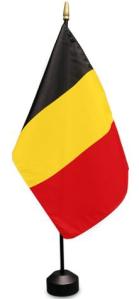
The flag of Belgium was adopted on January 23, 1831. The flag is rectangular with three vertical stripes: a black stripe on the left, a yellow stripe in the center, and a red stripe on the right. The official ratio of the Belgian flag is 13:15 (almost square, but not quite), but due to its unusual proportions, the flag is rarely produced this way and is usually seen in a 2:3 ratio.

The colors of the Belgian flag are based on the colors of Duchy of Brabant’s coat of arms, which features a black shield and a yellow lion with red claws and a red tongue.  The Duchy of Brabant was located in the historic “Low Countries,” and is now known as three present-day Belgian provinces: Flemish Brabant, Walloon Brabant, and Antwerp.  The colors of the Belgian flag are the same as those in the German flag and the vertical tricolor design of the flag is most similar to that of France.

Several flags preceded the current Belgian flag.  When Belgium was part of Lotharingia in the ninth century, the territory flew a rectangular flag with two horizontal red stripes, one across the top and one across the bottom, and a white area in the center.  When the area came under Spanish rule in the 1500s, a yellow stripe was added to the flag. During this time period, Belgium’s official colors became red, white, and yellow.

When Belgium was under Austria’s rule in the eighteenth century, the Emperor required Belgium to fly the Austrian flag, which was red and white.  Belgians were opposed to this, however, and citizens began wearing red, black, and yellow cockades, knots of colored ribbons to display national pride.

The Belgian Revolution began in August 1830 when a French flag was waved at the Brussels City Hall.  Shortly after this incident, some Belgian revolutionaries created a horizontal-striped red, yellow, and black flag at a fabric store.  By January of 1831, the stripes were changed to vertical and the flag was made official.

Flag of Chile

The Flag of Chile was adopted on October 18, 1817, during Chile’s battle for independence from Spain. The flag of Chile is called La Estrella Solitaria, or “The Lone Star.”  The flag is divided into two horizontal regions.  In the top portion, there is a blue square in the left corner with a white five-pointed star in the center. The remainder of the top half is occupied by a white stripe.  The bottom half of the flag consists of a red stripe.

The flag of Chile is simple in design; however, the colors and the star have symbolic meaning.  The red bottom half of the flag represents the bloodshed of Chilean revolutionaries during the quest for independence.  In the top half, the white portion represents the snow on top of the Andes Mountains and the blue represents both the sky and the Pacific Ocean.  The white star stands alone in the upper left corner as a guiding symbol towards progress and honor.

Chile flew several other flags before adopting its current version.  Chile’s first flag, used as early as the sixteenth century, featured a blue background with a white eight-pointed star.  This flag was most likely used by the Mapuche warriors, a group of indigenous Chileans, during the Arauco War.

In 1812, at the beginning of the Chilean War of Independence, the provincial Chilean government adopted its first flag, the Patria Vieja (“Old Fatherland”).  This flag consisted of three horizontal stripes, one each in blue, white, and yellow.  These colors represent the sky, the snow on the Andes Mountains, and Chile’s vast golden wheat fields.  Occasionally, this version of the flag appeared with the Cross of Santiago in the upper left corner and the Chilean shield in the center.  In 1817, during Chile’s transition towards being an independent nation, the country flew a flag that also contained three horizontal stripes, but a red stripe replaced the older yellow stripe.

Finally, in 1817, the Chilean government adopted the current version of their flag, which was designed by José Ignacio Zenteno del Pozo y Silva, a Chilean soldier that fought in the Chilean War for Independence.