Flag of Thailand

The flag of the Kingdom of Thailand was adopted on September 28, 1917. The flag is rectangular with five horizontal stripes: the top and bottom stripes are red, the second stripes from the top and bottom of the flag are white, and the center stripe is blue.  The center blue stripe is twice as wide as the others. King Vajiravudh (Rama VI), who ruled Thailand from 1910 until 1925, designed the flag.
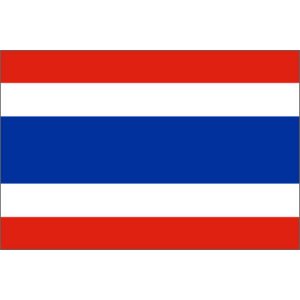
The colors of the flag represent an unofficial motto of Thailand, “nation-religion-king:” red represents the Thai nation, white represents religion, and blue represents the Thai monarchy. Some sources claim that the blue represents support of the Allies of World War I, as many other countries in the alliance had red, white, and blue flags. Thailand adopted a naval flag in 1917 in addition to the national flag, which includes a red circle in the center of the national flag.  In the center of the red circle is a white elephant, a symbol of royalty.  The Kingdom of Thailand has many other military flags currently in use as well, which include the colors of the Thai flag and relevant military emblems.

The flag of Thailand dates back to the seventeenth century and were most likely plain red rectangular banners.  During the Chakri Dynasty in the late eighteenth century, a white chakra—a disk-like weapon used by the god Vishnu and symbol of the Chakri Dynasty—was added to the flag.  During the next dynasty, a white elephant was added inside the chakra to symbolize the royal monarchy.  The chakra disappeared from the flag around 1855 with Rama IV dynasty, but the white elephant, decorated in varying amounts of regalia, remained in the center of the red flag until 1917.  For a short time in 1917, Thailand used a red and white striped flag, but by the fall of that year, the flag included the blue stripe.

Flag of Bolivia

The flag of Bolivia was adopted in 1851. The civil flag consists of a rectangular shape with three horizontal stripes: the top stripe is red, the middle stripe is yellow, and the bottom stripe is green.  The state flag consists of the three-striped civil flag with the Bolivian coat of arms in the center.
Bolivia’s coat of arms features a central cartouche, an oblong-shaped scene, containing an alpaca, plains and mountains, a rising sun, and a tree and a wheat plant.  This scene represents Bolivia’s diverse landscape and its natural resources.  Behind and to either side of the cartouche are three Bolivian flags, two muskets, and laurel branches.  An Andean condor rests on top of the cartouche.  The laurel branches represent peace and the condor represents the Bolivian people’s willingness to defend their nation.  A close look at this coat of arms reveals a Phrygian hood on top of the left musket and an axe on top of the right musket.  These are traditional symbols of liberty and freedom.

The colors of the Bolivian flag have several meanings.  According to some sources, the red stands for the bloodshed during Bolivia’s quest for independence, the yellow stands for Bolivia’s natural resources, and the green stands for Bolivia’s fertile land.

Bolivia also includes the Wiphala flags among its national symbols. These flags represent the Incans that are indigenous to Bolivia. The Wiphala is a square checkered flag with yellow, orange, red, purple, blue, green, and white patchwork squares in several different diagonal patterns. The designs are seven squares across and seven squares down and their specific patterns represent individual suyus, or Incan regions.  The colors also have significance: red stands for the earth and for man, orange for society and culture, yellow for energy, white for time, green for nature, blue for the heavens, and purple for government and self-determination.

Temporary Tattoos

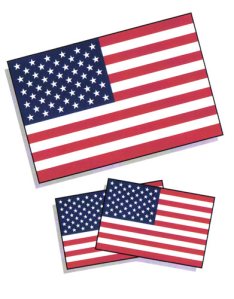
Temporary tattoos are a great and fun way to show your pride without the cost and permanence of getting the real thing!  The U.S. Flag Store has a great selection of temporary tattoos that are non-toxic, safe, and fun to wear.  These tattoos are easy to apply, last for several days—even with showering and swimming—and are easily removed.  Most tattoo packages include 1 large version and two smaller versions of the design.

Whether it’s for the Fourth of July, Memorial Day or even Labor Day, the U.S. Flag Store’s American Flag Temporary Tattoos are a great way to show your patriotic spirit. These detailed tattoos, including all thirteen stripes and all fifty stars.  The U.S. Flag Store also sells Confederate Flag temporary tattoos, Betsy Ross Flag temporary tattoos, and an assortment of twenty four Patriotic temporary tattoos.  At a great price of $2.99, order a few packages for your family and friends and enjoy putting them on together!

If you have a loved one serving in the armed forces, the U.S. Flag Store offers a great selection of military temporary tattoos that you can easily apply to support your soldier. The U.S. Flag Store sells Army, Marine, Navy Seals, Coast Guard, Air Force, National Guard and POW MIA temporary tattoos.  On the Flag Store website, you’ll find that the U.S. Army and Air Force patches have two different designs, one with the official seal and one with a simple logo.

The skull and crossbones icon might be the first image that comes to mind when you think about traditional tattoos, and the U.S. Flag Store will not disappoint: check out the Jolly Roger Flag Temporary Tattoo.  With a black background, a grinning skill, and detailed crossbones, this tattoo is the perfect way to show your inner pirate!

World Flag Patches

Wear your pride on your sleeve—or on your book bag—with the U.S. Flag Store’s beautiful World Flag Patches! The U.S. Flag Store carries a huge selection of the world’s most popular country patches. All patches are made of the highest quality materials, intricately designed, and are available in shield and rectangular shapes.  These patches are embroidered by machine to enable for exact replication of the tiny details found on many country’s flags.  All world flag patches have a vinyl backing, allowing them to be stitched or ironed on to clothing.  Shield-shaped patches approximately are 3” x 2.5” and rectangular patches are 3.5” by 2.25”.  Most patches are available at a low price of $2.49 each, but discounts are available for purchasing quantities of ten or more.  Order your favorite patches today!
Among the best selling World Flag Patches is the American Flag Patch Standard.  Intricately embroidered with all thirteen stripes and fifty stars, the patch also includes a gold trim border.  Discounts are available for purchasing five or more American Flag patches, so order some for your friends and family today!

Other rectangular patches, particularly those that have include the country’s seal, are very intricately embroidered.  The beautifully detailed seals on Austria’s country patch, or Mexico’s patch, are great examples of the high-quality patches available from the U.S. Flag Store.

Although the shield-shaped patches are not necessarily flag shaped, they display the country’s name at the top of the patch with the flag below it.  The United Kingdom patch or the Canadian patch, for example, are particularly elegant.

The world flag patches shown on the U.S. Flag Store web page represent the countries that the Flag Store carries in its inventory; however, many other countries and all of the U.S. state patches are available through special order at low prices.  For details, contact the U.S Flag Store by calling 1-877-734-2458 or emailing sales@onlinestores.com.

Flag of Cuba

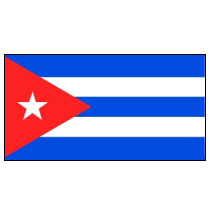
The flag of Cuba was officially adopted on May 20, 1902, although it had been in use for over fifty years before this date. The flag is rectangular with alternating blue and white horizontal stripes (three blue and two white).  On the left side is a red triangle with a white star in the center.

Six Cuban revolutionaries—Narciso López, Miguel Teurbe Tolón, José Aniceto Iznaga Borrell, José Maria Sánchez Iznaga, Cirilo Villaverde, and Juan Manuel Macías—designed the flag in 1848 during the country’s battle for independence from Spain. Tradition holds that while these revolutionaries held their meetings, Narciso Lopez’s wife embroidered the first Cuban flag, and that the ideas for the flag were those of Miguel Tuerbe Tolón, who was also a poet.  López, who led the revolutionaries, carried the Cuban flag for the first time at the Battle of Cárdenas in 1850 and the Battle of Playitas in 1851.

The flag’s design holds symbolic meaning.  At the time of Cuba’s independence, the country was divided into three parts: Central Cuba, Occidental Cuba, and Oriental Cuba. These regions of the country are represented by the three blue stripes on the flag.  The two white stripes in between the blue stripes represent the strength and purity of the independence movement.  The red, as in many national flags, represents the bloodshed of the Cuban revolutionaries during the independence era.  Today the red also stands for equality, brotherhood, and liberty.  The white star symbolizes an independent and free Cuba.

In 1869, after Cuba gained independence from Spain, the Cuban flag became the national flag of the Republic of Cuba until the Spanish-American War in 1899.  From 1899 until 1902, Cuba was required to fly the United States flag, as the country was under siege by the U.S.  When Cuba gained independence from American control in 1902, the Cuban government officially adopted the current flag.

Flag of Mississippi

The Flag of Mississippi was officially adopted in 1894 following the state’s appointment of a committee to design an appropriate state flag. The flag features a square version of the Confederate Battle Flag in the upper left corner, a red background that includes a blue southern cross and thirteen white stars inside the cross.  The rest of the flag consists of three large horizontal stripes, one each in blue, white, and red.  Mississippi is the only state in the Union that still incorporates the Confederate flag into their state flag.

The meaning of the colors and stars on the Mississippi state flag are not difficult to interpret.  The thirteen stars in the Confederate flag symbolize the thirteen original colonies of the United States.  The red, white, and blue colors are also in accordance with the official colors of the United States.  The use of the Confederate flag in the Mississippi state flag is controversial, however.  Those who support the Confederate flag argue that it is a symbol of southern heritage that is distinctively unique from the Northern traditions.  To others, due to its use in the Civil War, by Neo-Nazis, and the Ku Klux Klan, the Confederate flag is viewed as racist and anti-Union.  For these reasons, most Southern states, schools, and universities that at one time included the Confederate flag in their own state flags or that flew the Confederate flag no longer follow this tradition.

In 1993, the National Association for the Advancement of Colored People (NAACP) filed a lawsuit against the state of Mississippi regarding the Confederate flag’s inclusion in the state’s flag.  After reviewing the case, the Mississippi Supreme Court overruled the NAACP, and in 2000, Mississippi Governor Ronnie Musgrove made the current state flag official.  Although controversy continued to brew over the flag’s use, in 2001, Mississippi residents voted to keep the Confederate flag on their state flag.

Flag of Louisiana

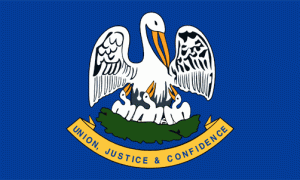
The flag of the State of Louisiana was originally adopted in 1912 and revised in 2006. This rectangular flag features a blue background with a “pelican in her piety” in the center: a mother pelican feeding three baby pelicans in their nest.  The mother pelican has three small drops of blood on her chest and is using the blood to feed her children.  This symbol is also used on the Louisiana state seal.  The state motto is included on a white ribbon below the pelican of piety and reads: “Union, Justice, and Confidence.”

The drops of blood on the pelican of piety on the Louisiana state flag might seem disturbing, and it is not surprising that their inclusion on the flag was inconsistent throughout the nineteenth and twentieth centuries.  It wasn’t until an eighth grade student at Vanderbilt Catholic High School in Houma, Louisiana brought the issue to the attention of the Louisiana State Legislature that it became a requirement that all versions of the Louisiana seal and flag include the three drops of blood on the pelican’s breast.

The pelican of piety has been a Christian symbol of charity since the Middle Ages.  Medieval Europeans thought that pelicans were particularly caring for their babies. Because of the way the pelican presses its bill into its chest when feeding, it was thought that a pelican mother would injure herself to feed her young her own blood in the absence of available food.  Other legends about pelicans hold that the pelican mother kills its young, only to resurrect the babies with her own blood, symbolic of the Passion of the Christ. Both versions of the pelican mother support self-sacrifice and generosity in the Christian faith.  In addition to its use on the Louisiana state flag and seal, the pelican image is featured in Great Britain on the emblems of the Corpus Christi College in both Cambridge and Oxford.

Yachting Flags

Yachting is a great recreational activity, especially during the beautiful summer months.  It’s important to send the right message while on your ship, however; and the U.S. Flag store wants to help you keep everyone informed with their fantastic Yachting Signal Flags.  All message flags are made of durable nylon, have a polyester heading and sturdy brass grommets, and are packaged in a clam shell box.

The Absent Flag is a solid blue rectangle and signals to others that the owner of the yacht is not on the ship.  This prevents others from approaching the yacht looking for the owner to receive them.

Let your guests know it’s dinnertime with a yachting Dinner Flag.  Just like the dinner bell at home, this solid white rectangular flag signals that dinner is being served.  Come and get it while it’s hot!

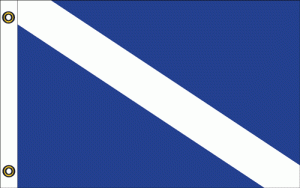
The Guest Flag is a blue rectangular flag with a white diagonal stripe.  This flag is used to indicate that the owner is not aboard, but rather a guest of the owner is sailing the yacht.  If the owner is aboard with a guest, this flag is not flown.

The Skin Diver Flag is an important safety flag for yachters.  It signals to other boats that scuba divers or snorkelers may be swimming in the area.  When this flag is flown, most states require that other boats stay between one hundred and three hundred feet from the boat.  The skin diver flag comes in two sizes: 12” by 18” and 20” by 30”.

If you’re serious about yachting, the U.S. flag store sells sizes two and three of the International Code of Signals Flags.  These sets both come with forty durable nylon flags with double stitched seams, nylon rope, distance lines, and durable plastic toggles.  The flag set includes the 26 alphabet flags, eleven pennants, one 6” by 12”, and the first, second, and third repeater flags in a durable nylon storage case.

Military Patches

If you’ve already bought a U.S. Flag Store Military Flag to honor your loved one in the Service but are looking for another way to show your support, then check out the U.S. Flag Store’s Military and POW Patches. For as little as $1.99, you can show your support for your loved one serving by stitching or ironing one of these patches onto your coat or bag.  All Military and POW patches are beautifully embroidered and have a vinyl backing.

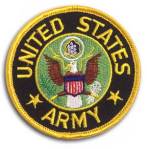
If you’re looking for classic logos, the U.S. Flag Store sells traditional circular and rectangular U.S. Military Patches.  You’ll have your choice of a patch with the Air Force, Army, Coast Guard, Marine Corps, or Navy logo.  Each embroidered circular patch is three inches in diameter, has a vinyl backing for durability, and beautiful gold trim.  These great patches are just $1.99—33% off the list price.  Discounts are available for buying five or more patches, so order some patches for your friends and family as well!

The rectangular military patches are of the highest quality and very detailed in their design.  These 3½” x 2¼” patches are machine embroidered, enabling exact duplication of the finest details of the military logos.  Choose from the Air Force, Marine Corps, Army, Coast Guard, or Navy emblems.  The Army and Coast Guard patches also include the year each service branch began, 1775 and 1790, respectively.  These patches are just $2.49 each and can be sewn or ironed onto clothing.

The POW/MIA Patch is black and white and includes a silhouette of a man’s head in front of a watchtower and barbed wire fence.  The text “POW/MIA” and the motto, “You Are Not Forgotten,” are also included on the patch.  The embroidered POW patch is 3” by 2¼” and has a vinyl backing.  At just $1.99 each and with discounts available for buying five or more, this POW patch is a great way to muster your family and friends’ support for you during this most stressful time.

These military patches are truly a great, affordable way for you and your family and friends to show your support for your loved one in the U.S. Armed Services.  So start wearing your pride on your sleeve and order your patches today!

Flag of Poland

The flag of Poland was adopted on August 1, 1919. It is a simple flag consisting of a rectangle divided into two horizontal fields, a white field on the top and a red field on the bottom.

Red and white have been important colors in Poland since its first royal arms banner in the Middle Ages.  This banner represented the Kingdom of Poland under the rule of King Ladislaus the Elbow-High and was a red cloth with a white eagle in the center.  This banner was not only used in battle but also as a symbol of the Polish royalty.

Later, in the sixteenth century, during the Polish-Lithuanian Commonwealth, the two countries combined their symbols.  Fortunately, both countries used coats of arms that consisted of white figures with red backgrounds: Poland’s coat of arms featured a white eagle and Lithuania’s was a white knight on horseback.  During this time, the Polish-Lithuanian Commonwealth also flew a red-and-white striped banner that included two, three, or four horizontal stripes.

Beginning in the eighteenth century, with the reign of August II, soldiers wore colored ribbons or knots, called cockades, to signify their nation’s color. Polish soldiers wore white knots, but by the second half of the 1700s, soldiers began wearing red and white ribbons to honor their country.  Finally, as a result of an uprising against the Russians in November 1830, the Sejm, or Polish house of government declared red and white as the national colors of Poland.

The flag of Poland is always flown on government buildings, including the House of Parliament and the Presidential Palace.  The flag is flown on other public buildings for the first three days of May: May 1 is May Day (formerly Labor Day), May 2 is Poland’s Flag Day, and May 3 is Constitution Day.  The flag is also flown on November 11 to honor Poland’s Independence Day.