Flag of Bahrain

The flag of Bahrain has made appearances in the news frequently this year as demonstrators wear and wave the flag in protest. Although protests in Bahrain have been occurring for the last ten years, demonstrations have become more frequent and forceful in the last few months.

Bahrain is one of many countries in the Middle East and North Africa that has been overcome by protests. In Bahrain, protestors are rallying in regard to the systematic discrimination of the Shia majority by the ruling Sunni minority. Despite a policy enacted in 2002 that introduced a number of reforms, including parliamentary elections, Shias still face tough inequalities, including limited access to government jobs. To make matters worse, the ruling Khalifa family has thwarted the parliament’s power and Bahrain voting districts are gerrymandered to keep Shia groups in the minority.

If you’re following the protests in Bahrain, you may have seen demonstrators wearing or waving the flag of Bahrain. The flag of Bahrain is a rectangular banner. The left side of the flag is white and the right side is red. Instead of a straight line dividing the red and white sections of the flag, however, the flag of Bahrain includes five white triangles, making a serrated divide between the two fields.

Like many Middle Eastern, North African, and Persian Gulf countries, the colors of Bahrain’s flag pay homage to Islam, the country’s main religion. The five white triangles represent the five pillars of Islam:

1.    Shahada: monotheism and accepting Mohammed as God’s messenger
2.    Salat: a set of five Islamic prayers
3.    Sawm: three types of fasting
4.    Zakat: alms, or charitable giving
5.    Hajj: a pilgrimage to the holy city of Mecca

The original flag of Bahrain was a solid red banner. In 1820, when Bahrain and the United Kingdom signed a peace treaty, Bahrain added a white stripe to the flag. This flag was used until 1932 when Bahrain added a serrated line to its flag to make its flag unique from its other Persian Gulf neighbors. In 1972, the flag’s serrated line was reduced from 28 to eight points, and in 2002, the current five-point flag was adopted and remains in use through the Bahrain protests.

Sources:
“Bahraini protesters demand end of Khalifa regime,” Tehran Times, February 26, 2011. http://www.tehrantimes.com/index_View.asp?code=236380.
Roula Khalaf, “Q&A: Bahrain Protests,” Financial Times, March 15, 2011. http://www.ft.com/cms/s/0/547d0a42-4f1a-11e0-9c25-00144feab49a.html#axzz1Gt6ATOYK.

Flag of California

The flag of the state of California was adopted on April 30, 1911.  It is a rectangular flag with a white background.  The flag is known as the “Bear Flag” because it features a bear on a patch of grass in the center of the flag.  Above the bear image, in the upper left corner is a red lone star.  Below the bear reads “California Republic” and a red horizontal stripe lines the bottom edge of the flag.

The Bear Flag’s origins date back to 1846, when California was part of Mexico and known as Alta California.  Tensions were building between Mexicans and Americans in Alta California as Americans settlers began moving in masses to the region.  Americans residing in California became increasingly concerned that Mexican government officials would act against them.

Tensions came to a peak in 1846 when U.S. explorer John C. Fremont and a group of about sixty men snuck into Mexico and built a fort on Gavilan Peak in March 1846. Fremont eventually retreated, leaving California for a few months, during which the United States declared war on Mexico.

Fremont returned to California in June 1846, and on June 10, he and a small group of Americans living in the San Francisco Bay area captured Mexican Lieutenant Francisco Arce and his horses. The American insurgents then traveled to Sonoma, gathering several more Americans to participate on their way, seized control of the area, and took several Mexican men as prisoners.  During this time, the American insurgents created the “Bear Flag” as a banner for their operation and began calling themselves the “Bear Flaggers.” The Bear Flag revolt ended on July 9, 1846 when a U.S. flag was raised in Sonoma. California officially became part of the United States in 1850.

The original version of the bear flag was slightly different than the current flag.  The white background and red stripe along the bottom of the flag were present in the original version.  The red lone star in the upper left corner is significantly larger on the original flag.  The bear is orange in the original version and is placed in the upper region of the flag without a patch of grass underneath.  “California Republic” appears higher on the flag in the original version.

The Bear Flag continued to be used by native Californians, particularly by the Native Sons and Native Daughters of the Golden West (NSGW and NDGW, respectively). As a result of their advocacy for the Bear Flag to be adopted as California’s first State Flag, the flag became official in 1911.

Libya’s Protest Flag

Since January, demonstrators have been protesting the Libyan government leaders and their policies. Protests are related to a variety of important issues, including housing, unemployment, human rights, and governmental corruption. Demonstrations began in January when protesters broke into and occupied a government housing project that was experience delays in development.

Protests escalated in mid-February after Libyan human rights activist Fathi Terbil was arrested. As demonstrations broke out, the Libyan government began taking violent measures, including firing guns from helicopters into crowds of anti-government protesters. On February 21, after stealing weapons from Libyan security buildings, protesters marched to the courthouse, lowered the current Libyan flag and raised the old flag of the Kingdom of Libya.

Protests have continued through February and the flag of the Kingdom of Libya has become an important symbol of these demonstrations. On February 24, for example, protesters seized control of Tobruk and celebrated by waving the old Libyan flag.

The situation in Libya continues to change by the hour. World leaders are encouraging Libya’s leader Moammar Gadhafi to abdicate his power as the opposition organizes an interim government. The United States is offering assistance to the Libyan opposition and the United Nations is imposing sanctions on the country’s government, warning that there will be consequences for Gadhafi.

The flag that protesters have been using during these recent demonstrations is the flag of the Kingdom of Libya. The flag was adopted in 1951, when Libya gained independence from Italy. It was used until 1969, when a military coup lead by Libya’s current ruler Muammar Gadhafi, overthrew the Libyan monarchy and declared the country the Libyan Arab Republic.

The flag is rectangular with three stripes. A red stripe lines the top of the flag and a green stripe lines the bottom. The black stripe in the center of the flag is twice as wide as the green and red stripes. In the center of the flag is the white crescent and star that is used on the flags of many Islamic nations around the world. The black background and white crescent has its roots in the flag of the Senussi dynasty, of which Libya’s king during the 1950s and 60s was a part. The red stripe represents Fezzan, the southwestern region of Libya and also symbolizes the bloodshed by the Libyan people during the quest for independence. The green stripe pays homage to the green flag of the Libyan province Tripolitania and symbolizes prosperity.

Sources:
“Recap of developments in the Middle East, North Africa,” Inquirer Politics, February 27, 2011. http://politics.inquirer.net/politics/view/20110228-322614/Recap-of-developments-in-Middle-East-North-Africa.
“Unrest in the Middle East and Africa—country by country,” CNN, February 27, 2011. http://edition.cnn.com/2011/WORLD/meast/02/27/mideast.africa.unrest/.

Flag of Laos

The flag of Laos was adopted on December 2, 1975, when the country became a People’s Republic. The flag is rectangular with three horizontal stripes. The top and bottom stripes are red and half the height of the center stripes, which is blue. In the center of the flag is a white circle.

Laos’s flag is one of only a few Communist flags that does not include the five-pointed star often associated with communist regimes. The colors on Laos’s flag have symbolic meaning. The red stripes symbolize the blood shed by the people of Laos during their quest for freedom, and the blue stripe stands for wealth and prosperity. The white circle has three symbolic meanings: it represents a full moon over the Mekong River, the unity of Laos’s multiethnic population under the communist government, and the country’s hopeful future.

The original flag of Laos was quite different from the country’s current flag. During the Royal Kingdom of Laos (1952-1975), the flag of Laos featured a three-headed elephant in front of a red background. Since ancient times, Laos has been called the “Land of a Million Elephants,” and the white elephant is a common symbol for many Southeast Asian countries. The three-headed white elephant on Laos’s flag is the Hindu god Erawan, which can have up to thirty three heads. The three-headed version on Laos’s old flag represents the country’s three former kingdoms: Vientaine, Luangprabang, and Champasak. The elephant sits atop a five-tiered pedestal, which symbolizes the country’s laws. Above the elephant is an umbrella with nine layers, representing a royal Buddhist symbol.

From 1953 until 1975, the Royal Kingdom of Laos was at war with the Pathet Lao, a communist political movement in Laos. When the Pathet Lao assumed control of Laos in 1975, forcing Laos’s king to resign his power, the communist regime adopted Laos’s current flag.

Utah’s State Flag Correction

The state of Utah may experience an historic moment this March if the Utah State Legislature approves a correction to the state’s flag. Along with celebrating the centennial anniversary of the adoption of the Utah State flag, the placement of the year “1847” on Utah’s state flag will be moved from under—and almost behind—the shield to a new placement at the bottom of the shield. The color of the shield will change from blue to the originally intended white.

The correction to the Utah state flag restores the flag to its original 1903 design. The flag’s errors began in 1922 when a hand-stitched state flag inexplicably changed the color of the shield from white to blue and placed the year 1847 below the shield instead of at the bottom of it. Since the commission of that flag, the makers of the Utah state flag have continued to manufacture the flag in error.

Ron Fox, an amateur historian, brought the error to the Utah State Legislature’s attention recently when he found a Utah state flag from 1903 at the Utah State Historical Society. After Fox raised the issue to Utah State Representative Julie Fisher, Fisher led the passage of a resolution in the State Legislature. If the State Legislature approves of the resolution, Utah Governor Gary Herbert will sign the legislation on March 9, 2011. Herbert will also designate March 9 as Utah’s official Flag Day and commemorate the one hundredth anniversary of the adoption of the Utah state flag.

The proposed corrections to the new flag will result in a Utah banner that features Utah’s state seal on a blue background. The state seal features a white shield a bald eagle on top of it, draped American flags on either side of it, and the year 1896 below. A beehive with lilies appears inside the shield. The word “INDUSTRY” appears above the beehive and the word “UTAH” as well as the date 1947 appears below it. Utah is the “beehive state” and the beehive on the flag symbolizes industry. The lilies symbolize peace and the bald eagle represents the protection of peace. The American flags stand for patriotism to the United States of America. The year 1847 marks the year the Mormons entered the Salt Lake Valley, and the year 1896 is the year Utah officially became the 45th state in the Union.

Sources:
“Utah State Flag and Seal,” Utah.gov. http://pioneer.utah.gov/research/utah_symbols/flag.html.
“Utah State Symbols,” Utah.com. http://www.utah.com/visitor/state_facts/symbols.htm.
Logan Daniels, “Bill would correct error on Utah state flag,” KSL.com, December 27, 2010. http://www.ksl.com/index.php?nid=148&sid=13791697.
Dennis Romboy, “Resolution aims to correct decades-old error in Utah state flag,” Deseret News, January 27, 2011. http://www.deseretnews.com/article/705365214/Resolution-aims-to-correct-decades-old-error-in-Utah-state-flag.html.

California’s “Bear Flag” Centennial

February 3, 2011 marked the centennial anniversary of the California state flag. One hundred years ago last week, California’s governor Hiram Johnson signed an act that made California’s “Bear Flag”—which had been in use since 1846—the official state flag.

Celebrations marking the California flag centennial were minor, if not nonexistent. An article in the Sacramento Bee provided pieces of an interview with Bill Trinkle, a Sacramento attorney and flag historian. Trinkle founded the Bear Flag Museum, a nonprofit online museum and library, dedicated to educating adults and children about California’s state flag.

In honor of the California flag’s centennial, Trinkle wrote a blog entry, celebrating the occasion. The blog entry included photographs of Governor Hiram Johnson, a historic flag, and a copy of the Senate Bill. The entry also included a whimsical picture of the California state flag that adorned the fierce grizzly bear with a party hat and a horn. Because the Bear Flag Museum exists solely on the web and does not have a physical location, Trinkle did not plan any celebratory events, but instead hoped that his fellow Californians would visit the Bear Flag Museum online and learn about the California state flag.

Trinkle said that he and his wife would toast the flag with a bottle of Bear Flag Wine, a creatively blended and reasonably priced line of California blended wines.

California’s State Flag, also known as the “Bear Flag,” has an interesting history. Designed by William Todd (Mary Todd Lincoln’s cousin), the Bear Flag was first flown when U.S. Explorer John C. Fremont and a group of insurgents who captured Sonoma from Mexico. The first flag was most likely hand drawn on a piece of cotton cloth. The original stripe on the flag was a strip of red flannel, most likely from a petticoat or pair of long underwear. The word California was spelled incorrectly on the flag’s original version, and was corrected in later editions. The grizzly bear was very common in California in the mid-nineteenth century and was respected for its ferocity, even in the presence of danger.

Read more about the Bear Flag’s history on the United States Flag Store blog.

Sources:
Dixie Reid, “100 years ago this week, bear flag became California’s official banner,” The Sacramento Bee, January 31, 2011. http://www.sacbee.com/2011/01/31/3363999/100-years-ago-this-week-bear-flag.html.
Bill Trinkle, “Happy 100th Anniversary to the California State Flag,” Bear Flag Museum Blog, February 3, 2011. http://bearflagmuseum.blogspot.com/2011/02/happy-100th-anniversary-to-california.html.

Dr. Martin Luther King, Jr. Flags

Dr. Martin Luther King, Jr. Day is coming up next Monday, January 17. If you’re going to a parade or ceremony, or want to commemorate this incredible man with an outdoor flag, then take a look at the United States Flag Store’s beautiful Dr. Martin Luther King, Jr. flags. Supplies are limited, so place your order today!

The Dr. Martin Luther King, Jr. Flag is available two sizes and orientations: one option is a 3 feet by 5 feet horizontal flag and the other is a 28 inch by 40 inch vertically oriented decorative banner flag. Both flags are made of high quality nylon and are suitable for indoor or outdoor use, making it a perfect banner to wave at a home, school, or business, or in a parade, march, or rally.

These beautifully vibrant flags feature the hopeful face of Dr. Martin Luther King, Jr. on the right side of the flag. A waving American flag is featured in the in the background of the flag towards the left side. The text at the top of the banner reads: Martin Luther King, Jr. in capital letters. The phrase “Yesterday’s Dream, Tomorrow’s Reality” runs across the bottom of the flag.

Dr. Martin Luther King, Jr. was born on January 15, 1929 and was a prominent leader in the African American Civil Rights Movement. Through nonviolent protesting, speeches, and rallies, Dr. King helped advance the civil rights for African Americans in the United States and around the world. Dr. King’s notable accomplishments include leading the Montgomery Bus Boycott in 1955, founding the Southern Christian Leadership Conference in 1957, and delivering his most famous “I Have a Dream” speech during the 1963 March on Washington. In 1964, he became the youngest recipient of the Nobel Peace Prize. Dr. King was assassinated on April 4, 1968 in Memphis, Tennessee, where he was speaking in support of better working conditions for African American sanitation workers. Dr. Martin Luther King, Jr. Day was mandated by former President Ronald Reagan in 1983 and first observed in 1986.

Click here to watch Dr. Martin Luther King, Jr.’s “I Have a Dream” speech.

Valley Forge Flags

Looking for a Valley Forge Flag? The United States Flag Store is the largest vendor of Valley Forge flags and accessories. At the U.S. Flag Store’s website, you’ll find the widest variety and most complete selection of Valley Forge flags.
The Valley Forge Flag Company began as a burlap sac company in 1882. During World War I, the company became a surplus and began making American flags. Due to increasing demand for the company’s expertly sewn products, the Valley Forge Flag Company opened a small sewing factory in Spring City, PA in 1932. Since its inception, the Valley Forge Flag Company remains a family-owned business that manufactures U.S. flags with exclusively American-made materials. The Valley Forge Flag Company is also a founding member of the Flag Manufacturers Association of American, an organization committed to educating the public and flag sellers about the importance of 100% American-made flags.

The Valley Forge American Flags have been flown during many significant American wars and events. During World War II, a Valley Forge flag was raised on Mount Suribachi in Iwo Jima, after the U.S. military liberated more than 20,000 prisoners at Buchenwald (flown at half mast), and after liberating several French cities on D-Day. On July 20, 1969, Buzz Aldrin placed a Valley Forge American flag on the moon. Valley Forge Flags also used during all of the American wars since World War II, at military funerals, and in several Hollywood films.

The United States Flag Store provides a great way for you to own these very special flags at unbeatable prices. The Valley Forge nylon American flags are beautifully sewn and have embroidered stars. They can be flown outside, are designed to resist fading and fraying and have reinforced fly ends.

The Valley Forge Best cotton flags are made of heavyweight 2×2 ply mercerized cotton, combining rich, vibrant, long-lasting colors with durable quality. The best fabric for outdoor use, the cotton flags have four rows of stitching for ultimate durability in a cotton flag.

Valley Forge also manufactures a line of Koralex II American flags. Koralex II is a polyester fabric that is designed to look like coarse cotton. Koralex is designed for outdoor use and resists fading and fraying more effectively than nylon flags.

These are just three of the most basic Valley Forge American flags sold at the United States Flag Store’s website. Be sure to visit the site for Valley Forge flagpoles, residential kits, pleated fans, and heritage series flags at the best prices on the web!

Flag of the Canary Islands

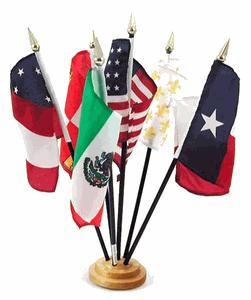
The flag of the Autonomous Community of the Canary Islands was officially adopted on August 16, 1982. The flag is rectangular with three vertical stripes. One left side is a white stripes, a blue stripes is in the center, and a yellow stripes is on the right side. In the center of the flag is the coat of arms of the Canary Islands.

The flag was designed in the 1960s during the Canary Islands Independence Movement, or the Movement for the Independence and Self-determination of the Canaries Archipelago. The movement largely used violence to attempt to achieve independence for the Canary Islands from the Spanish government by force.
Carmen Sarmiento and her two sons, Arturo and Jesus, all activists in the Canary Islands Independence Movement, designed the flag of the Canary Islands on September 7, 1961. The family made approximately 3000 flags on paper ribbons and distributed them the following day at the “fiesta of the Virgin Mary of Pino.”

The flag of the Canary Islands combines the colors of two of the archipelago’s provinces. The province of Santa Cruz de Tenerife (making up the western part of the Canary Islands) flew a blue and white flag; and the province of Las Palmas (making up the eastern part of the Canary Islands flew blue and yellow flag. According to some traditions, the white color represents the water that comes off of the mountains, the yellow represents the yellow canary songbird, and the blue represents the celestial blue sky.

The coat of arms of the Canary Islands consists of a blue shield with seven islands inside. Two dogs, in Latin called Insularia Canaria, support the flag, and are thought to depict a large breed of fierce dogs from which the Canary Islands archipelago gets its name. A red crown sits on top of the shield and the word “Oceano” waves on a ribbon over the top.

Texas Gift Ideas

Need a gift for your favorite Texan? Look no further than the United States Flag Store’s website for the best Texas gifts at the best prices!

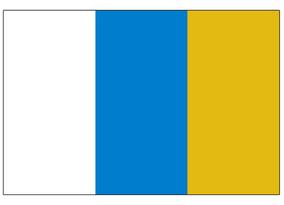
The Six Flags Over Texas gift set is the ultimate Texas flag gift. The gift set includes the six banners that have flown over what is now Texas, including the flags of France, Spain, Mexico, the Confederate States, the United States (28-star version), and, of course, Texas. All flags are 4×6 inches and printed on a polyester-cotton blend. A wooden base is included with the flag set, allowing for display on a desk or table. At a low price of just $7.95 and with a presentation box to boot, this is a great gift for a Texan serving in the military.

The Fibre Metal Texas Hard Hat combines Texas pride with supreme safety. Fibre Metal uses a full graphic process to produce a beautifully vibrant Texas flag that won’t chip, fade, or peel on a SEI-certified thermoplastic hard hat. Besides depicting the Texas flag, the phrase, “Don’t mess with Texas,” appears on the front of the hat.  For business-owners, these hard hats make great safety awards or a special groundbreaking ceremony hats. Order ten or more of these hats to receive an unbelievably low price of $26.99 each!

If you’re just looking for a simple gift, check out the United States Flag Store’s fantastic selection of Texas Stick Flags and Car Flags. The Texas Stick Flags are of the highest quality possible—sewn around the edges for ultimate durability—and are available for as low as $0.80 per flag. The Texas car flag is made of durable, knitted polyester and is double sided to resist wear and tear. At a low price of $7.95 each, order one for yourself and a friend!

For your beach beauty, the United States Flag Store has the ultimate Texas gift: a Texas flag bathing suit! Divided down the center with a blue stripe and white star one side and red and white on the other, this bathing suit is sure to grab the attention of other proud Texans at the pool or beach!