
The flag of Russia was originally adopted in 1896. The flag was in use until the October Revolution of 1917, banned from use during the Communist era, and then readopted on December 11, 1993. The Russian flag is a rectangular flag with three horizontal stripes of equal size: a white stripe on the top, a blue stripe in the middle, and a red stripe on the bottom.

Historians argue over the historical origins of the Russian flag, but two tales of the flag’s beginnings remain the most prevalent. According to one legend, a Dutch sailor was sailing a Russian ship and was unsure what flag to sail on the boat. He asked the Boyar Duma, a council that advised Russia’s princes and tsars in the seventeenth century, what his ships flag should look like. This issue had never arisen before, and the Boyar Duma asked the sailor for his opinion. The Netherlands had already adopted its flag—a horizontal tricolor with a red stripe on the top, white in the middle, and blue on the bottom—and the sailor brought red, white, and blue fabric on to the ship. He designed another tricolor, similar to the flag of the Netherlands, but with a different arrangement of the stripes.
The second tale claims that Tsar Peter the Great visited Archangel, a city in northeastern Russia, several times in 1693 and 1964 to study European shipbuilding. The tsar ordered a Dutch-built ship in 1693, and when it was finished, it had a Dutch flag flying from the back. In need of a Russian naval flag, the tsar changed the arrangement of the stripes on the Dutch flag to create a Russian banner.
Both tales of the flag’s origin support the Dutch flag’s influence on the Russian flag. Red, white, and blue colors can also be found on the Grand Duchy of Moscow’s coat of arms, which depicts St. George wearing white armor with a blue cape, riding a white horse, and holding a blue shield in front of a red background.
As with the origins of the Russian flag, there are several interpretations of the meaning of the colors of the Russian flag. One theory holds that the colors of the Russian flag represent the Russian monarchical social system in which the white represents God, the blue represents the Tsar, and the red represents the peasants. Another interpretation argues that the colors represent the three main geographical regions of Russia: the white represents Belarus or White Russia, the blue represents the Ukraine or Little Russia, and the red represents Great Russia. Finally a third interpretation argues that the white stands for hope for the future, the blue stands for the present, and the red stands for the bloodshed in Russia’s past.
 The flag of Canada was adopted on February 15, 1965. It is a rectangular flag with two vertical red stripes on the left and right sides. The center section of the flag is white with a red 11-pointed maple leaf in the center. The flag is known in Canada as the “Maple Leaf” or l’Unifolié (“the one-leafed”).
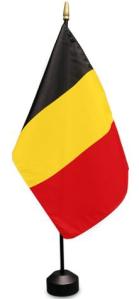 The flag of Belgium was adopted on January 23, 1831. The flag is rectangular with three vertical stripes: a black stripe on the left, a yellow stripe in the center, and a red stripe on the right. The official ratio of the Belgian flag is 13:15 (almost square, but not quite), but due to its unusual proportions, the flag is rarely produced this way and is usually seen in a 2:3 ratio.
 The Flag of Chile was adopted on October 18, 1817, during Chile’s battle for independence from Spain. The flag of Chile is called La Estrella Solitaria, or “The Lone Star.” The flag is divided into two horizontal regions. In the top portion, there is a blue square in the left corner with a white five-pointed star in the center. The remainder of the top half is occupied by a white stripe. The bottom half of the flag consists of a red stripe.
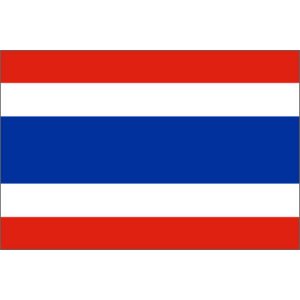 The colors of the flag represent an unofficial motto of Thailand, “nation-religion-king:” red represents the Thai nation, white represents religion, and blue represents the Thai monarchy. Some sources claim that the blue represents support of the Allies of World War I, as many other countries in the alliance had red, white, and blue flags. Thailand adopted a naval flag in 1917 in addition to the national flag, which includes a red circle in the center of the national flag. In the center of the red circle is a white elephant, a symbol of royalty. The Kingdom of Thailand has many other military flags currently in use as well, which include the colors of the Thai flag and relevant military emblems.
 The flag of Bolivia was adopted in 1851. The civil flag consists of a rectangular shape with three horizontal stripes: the top stripe is red, the middle stripe is yellow, and the bottom stripe is green. The state flag consists of the three-striped civil flag with the Bolivian coat of arms in the center.
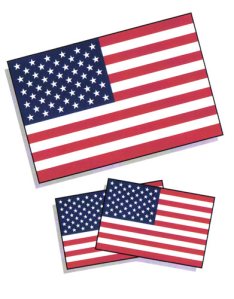 Temporary tattoos are a great and fun way to show your pride without the cost and permanence of getting the real thing! The U.S. Flag Store has a great selection of temporary tattoos that are non-toxic, safe, and fun to wear. These tattoos are easy to apply, last for several days—even with showering and swimming—and are easily removed. Most tattoo packages include 1 large version and two smaller versions of the design.
 embroidered by machine to enable for exact replication of the tiny details found on many country’s flags. All world flag patches have a vinyl backing, allowing them to be stitched or ironed on to clothing. Shield-shaped patches approximately are 3” x 2.5” and rectangular patches are 3.5” by 2.25”. Most patches are available at a low price of $2.49 each, but discounts are available for purchasing quantities of ten or more. Order your favorite patches today!
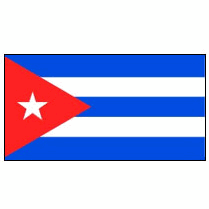 Six Cuban revolutionaries—
 Flag Blog