The Flag of Haiti: A Call to Action

By Kristi Ries

Unlike the country it represents, the official flag of Haiti is young, having been adopted in 1987. A tiny island country in the Western Caribbean, Haiti has existed for hundreds of years. Indigenous tribes who were later ‘discovered’ by the great Spanish explorer Christopher Columbus were the island’s first inhabitants. Following this, both Spain and France colonized what is now modern-day Haiti. Eventually, however, the island’s emerging multicultural population fought and won its independence in 1804. A new nation was born.
On the afternoon of January 12, 2010, the small nation’s history and life of its citizens was turned upside down. Haiti was struck by a magnitude-7.0 earthquake, the country’s most severe earthquake in more than two centuries. The epicenter of the quake was just off the Haitian capital Port-au-Prince. Entire communities have been leveled and countless lives have ended prematurely.

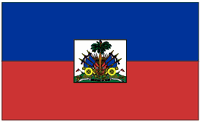
What this nation’s flag symbolizes and the feelings it evokes are what makes it so singularly powerful. It recognizes the country’s European heritage through its vibrant blue and red colors. This new design was based on a torn French Tricolore flag and features Haiti’s Coat of Arms centered in a white square.

For all who see and recognize it today, however, the flag of Haiti serves as a reminder that help is urgently needed and that a major humanitarian crisis is occurring as we go about our daily lives.

Once Americans are away from their television sets, laptops and radios, it is somehow easier to forget the overwhelming devastation to this impoverished Caribbean nation. Yet people all over the world are showing a unified front by displaying the flag of Haiti in office windows, on their cars or outside their homes. Numerous skyscrapers in major cities have been lit in the Haitian colors of blue and red to pay respect to the multitude of lives lost in the recent tragedy.

As the unbelievable destruction and rising death toll become more apparent, many organizations and individuals have come to Haiti’s aid. Displaying the Flag of Haiti is a quiet call to action; one that clearly declares ‘you are not forgotten or forsaken’ to those bereft of their homes, family, or worst of all—hope.

Visit the American Red Cross for information on donating money to Haiti.
Lapel Pins – Show Your Pride

By Kristi Ries

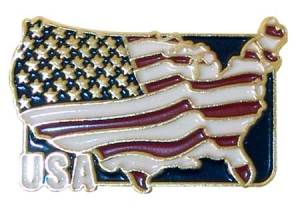
Does the lapel of your sport coat or blazer look a little bare these days? Have nothing to add to your school backpack or messenger bag? Maybe you could add a little decoration—and at that, one that has meaning as well—by adding a lapel pin or two. Lapel pins have become not just a subtle fashion statement, but also a fashion staple. From news anchors to sports analysts to business executives, many are showing their patriotism by wearing a US. Flag lapel pin.

You can showcase your political leanings (a donkey for Democrats, of course, and an elephant for Republicans), or pay homage to the 44th president of the United States, Barack Obama, with a commemorative pin memorializing his historical 2008 campaign and resulting win. Christians can show proud support of their religion when wearing the Christian lapel pin, which consists of a white flag with a cross symbol. Show your faith by wearing one to your next church service, outreach function, or school.
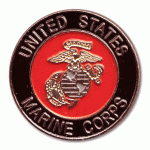
For military veterans and their families, there exists a bevy of pins, including all five areas of the armed forces: U.S. Army, U.S. Marine Corps, U.S. Air Force, U.S. Navy and U.S. Coast Guard. Troops’ family members can proudly display a Service Unity Lapel Pin, which features the U.S. Flag in the form of a ribbon and the emblematic navy blue star signifying a loved one in active service. Why not show support of your loved one who fights for our country’s freedom?
Lapel pins also serve as a sign of unity. Flag pins (as well as nearly any red, white and blue items) became extremely popular following the terrorist attacks of 911. As a loyal and proud American, your flag pin shows your allegiance to this nation and all of the values for which it stands—including liberty and justice for all.

Send a powerful message about your beliefs while adding a decorative enhancement to your wardrobe through these durable symbols of pride!

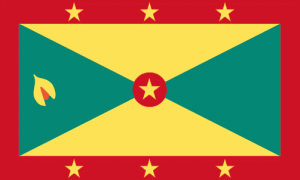
Grenada National Flag

Ostensibly simple, the Grenadian National Flag carries rich historical and cultural significance within its fairly plain design. It was officially recognized in 1974 following its conception at the hands of Anthony C. George. The flag commemorates Grenada’s independence from the United Kingdom, which began in February of that year. Its color scheme and design depict the pride in that independence, and represent much that defines Grenada as a nation.

The color scheme of red, gold and green is representative of the country’s African origins. Each color stands as a symbol of something valued in Grenadian society.

Green, for instance, signifies the Grenadian land’s fertility, which brings about its vast agriculture industry and abundant plant life. Agriculture serves as Grenada’s economic driving force.

Red is indicative of the bravery, vivacity and a desire for independence that is found in the heart of each Grenadian citizen. The history of the Grenadian people is one filled with struggle, civil discord and adversity, all of which they were able to persevere, refusing to give up the hope of a unified independent nation.

Gold is the color of wisdom. It also embodies the warmth and kindness of the Grenadian people. Additionally, the gold serves to symbolize the bright sunshine of the Grenadian islands, which adds to its beauty and fertility.

The flag’s symbols hold a great deal of significance, as well. Three yellow stars align along the upper portion of the flag, while three more are found across the bottom. Collectively, they represent the nation’s six parishes; Saint Mark, Saint John, Saint George, Saint Patrick, Saint Andrew, and Saint David. They also represent the ideas and ambitions upon which the nation was founded.

Another single yellow star lies at the center of the flag, surrounded by a red circle. This star signifies the nation’s capital city of Saint George’s. This beautiful city lies on the southwestern portion of the country and sits upon a horseshoe-shaped Caribbean harbor next to a volcano crater. Despite becoming a developing tourism destination in recent years, the city still holds on to much of Grenada’s rich cultural history.

The hoist of the flag displays a clove shaped emblem. This represents a clove of nutmeg, one of the nation’s primary crops. Grenada produces the second largest amount of nutmeg in the world, and is often referred to as the “Isle of Spice.” Grenadians are proud of their reputation for agricultural distinction, and their flag displays this pride.

The Grenadian National Flag is a symbol of the strength and vitality of a people unified under the idea of independence. It flies as a tribute to a rich cultural history and a promising future of continued independence, growth and development.

Winter Decorative Flags show Holiday Spirit

By Kristi Ries

It’s that time of year again: evergreen wreaths hang on doorways, homemade cookies are baking and fireplaces are aglow all across America. There’s a chill with a scent of chimney smoke in the air, and freshly cut evergreens can be found atop minivans everywhere.

In the throes of winter, the darkest and bleakest months of the year, countless Americans venture out to adorn their lawns and houses in a festive display for the season. Neighbors crane their necks to see intricate light patterns and tall nutcracker cut-outs; elaborate decorations offer an excellent excuse for long holiday joyrides after dark to see lights, reindeer, sleighs and bright candles on a winter’s eve.

Such decorations have become a personal expression of pride in one’s home and in celebration of various religious holidays. Colorful lights and nativity displays, menorahs in windows and garland on doorways are just another way to welcome friends and loved ones to your home during this especially chilly time of year.

As people struggle to untangle last year’s Christmas lights, they might also consider another type of decoration this winter: holiday flags. You can hang a 3D Santa banner flag to honor the wonder of Old Saint Nick; a red poinsettia flower and the words “Seasons Greetings” invite all to share in the joys of the season. You can herald in the Christmas holiday with a trumpeting angel, or display banners of a Christmas tree, a jolly snowman or the Three Wise Men. Hannukah begins this Friday, December 11 at sundown, and several elegant Hannukah flags showcase a Dreidel, the Star of David and a menorah to celebrate the eight-day Festival of Light.

Easy to hang and available in a range of designs, these jubilant flags make a great statement outside your home. They’re also a great gift for your friends and family.

Once these joyous occasions have come to a close, there are still more colorful ways to brighten up the season. Snowflake flags are great all-purpose winter greetings for your snow-covered yard, and New Year’s flags are the perfect way to show you’re ready to ring in 2010! Consider adding one to the beauty and warmth of your home today.

Storm Flags Serve as Warning Signs

By Kristi Ries

Hurricane season in the Atlantic Ocean officially begins on June 1 of each year, and lasts for nearly six tumultuous months before it comes to a close. On average, over 100 tropical storms form over the Atlantic.

Due to this high rate of activity, mariners have historically depended on warning flags displayed at their harbors and Coast Guard Stations to warn of approaching ocean storm systems.
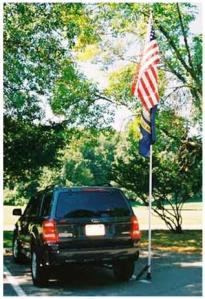
In 2007, the U.S. Coast Guard re-established a Coastal Warning Display (Storm Flag) program at selected Coast Guard boat stations throughout the U.S to warn the public of approaching storm conditions. Coast Guard stations had participated in the National Weather Service’s official Coastal Warning Display program for over 100 years, along with yacht clubs and marinas, until it was discontinued in 1989. Today, experienced boaters can easily identify the meaning of such nautical flags, whose geometric shapes and colors represent the severity of impending weather conditions.

The flags serve to warn mariners of small craft advisories, gale warnings, storm warnings and hurricane warnings. And these flags are being used more often than ever. Scientists claim that rising air and water temperatures worldwide are creating more frequent and severe hurricanes.

A hurricane is a tropical storm with winds that have reached a constant speed of at least 74 miles per hour. The eye of such a storm is vast, usually measuring 20-30 miles wide, and can envelope more than 400 miles. Dangers of a hurricane include torrential rains, high winds and storm surges that leave major destruction in their wake. At sea, hurricanes can last for 2 weeks or more and can run a path across the entire length of the United States’ Eastern Seaboard before dissipating.

In addition to hurricane flags, there are also international maritime signal flags—one for each letter of the alphabet—that mariners can use to spell out messages or can be combined to form a code word. Boating enthusiasts and Atlantic coastline dwellers can breathe a sigh of relief this year, as the 2009 hurricane season ended uneventfully on November 30 with just three storms reaching destructive hurricane status instead of the average six.

Tailgating

By Kristi Ries

Tailgating has become a time-honored tradition in the United States. For decades, sports and music fans across the country have gathered around their trucks, minivans, SUVs and RVs in parking lots outside of stadiums and concert venues. College football fans have created cities out of both empty pastures and asphalt, with makeshift barbeques and pick-up Frisbee games the order of the day.

The term ‘tailgating’ arose from the term for a truck bed’s door, or tailgate, which served as a meeting point and surface area for food and beverages. Nowadays these ‘gatherings’ can include hundreds of thousands of people, producing a veritable sea of vehicles that has become increasingly difficult to navigate. (Try to meet up with friends at a Penn State game in Happy Valley and you’ll be grateful for the 20th century invention of the cell phone.) Yet even the most clearly articulated directions yield confusion, as “third RV on the left, 12 aisles down” can become convoluted. Because of this, avid fans have discovered a new way to differentiate themselves from the masses through the use of tailgating flags.
Brightly colored and typically adorned with a team logo, tailgating flags appear in a number of places. They can be placed on car windows, hung as banners from RV awnings—or, for the extremely ardent fan—flown on tailgating flagpole sets. Not only do these serve as a high-flying beacon for family and friends, but they’re also as a symbol of personal pride and commitment to a team. Telescoping pole sets tower over surrounding trucks and SUVs at 16 feet high. Using these poles, dedicated fans can fly two flags at once to showcase a university and professional team, state flag or armed forces flag, for example.

All things considered, no better way exists to show that you’re the biggest fan than to display it proudly with a several tailgating flags!

American Flag Care and Disposal

by Kristi Ries

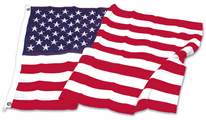
People buy new American flags for various reasons: to honor a loved one, to show patriotism, in observance of a national holiday or to replace an older flag that has grown worn by years of use. Yet many Americans may not be aware of existing “flag protocol” – that is, how to properly dispose of a flag.

Because of its inherent symbolism, the U.S. flag carries special meaning and should be treated accordingly. Flags should never be defaced or be allowed to become tattered, faded or dirty. Once this occurs, the time has come to retire the flag in a respectful manner. The U.S. Flag Code states, “The flag, when it is in such condition that it is no longer a fitting emblem for display, should be destroyed in a dignified way, preferably by burning”.

Many organizations, such as veterans associations, the Boy Scouts and Girl Scouts of America, and other patriotic organizations are equipped to perform flag retirement ceremonies. Turning over your discarded flag to one of these groups ensures a fitting final tribute to your symbol of patriotism.
A few tips on flag selection and maintenance:

Many consumers seek out all-weather flags that are specifically created to withstand prolonged exposure to sunlight, wind and rain. This is recommended for those who wish to fly the flag outdoors, as in some areas pollution as well as inclement weather conditions will affect the fabric. If you live in an area of extreme weather (high winds) or plan to fly the flag daily, pay attention to the material used to construct the flag. These flags will often be more expensive than those created for indoor purposes or more infrequent display outside.

To help make your flag last longer in good condition, consider rotating flags every six months. This will cut down on any exposure to the elements and will guarantee that you always have a replacement flag on hand if one should become too damaged to display.

Flag of Argentina

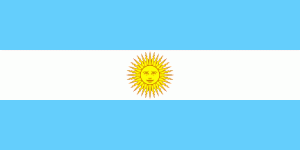
The flag of Argentina is light blue and white and features a golden sun at its center. In Spanish, the sun is known as the Sol de Mayo (Sun of May) and is modeled after the symbol of the Incan Sun God, Inti. Before the national flag, the Sol de Mayo was used on the first Argentine coin in 1813. As for the colors of the flag, there are several theories about reasons behind them. Traditionally it is believed that a man named General Manuel Belgrano created the flag of Argentina with the colors used by the Criollos in the May Revolution of 1810. However, it is apparently more likely that the colors were based on the coat of arms of the House of Bourbon, Spain’s royal family. Other theorists believe the colors represent the sky, clouds and sun.

Flag of Argentina

Belgrano created the flag of Argentina during the Argentine War of Independence. As commanded a battle near Rosario, Argentina, Belgrano noticed that the colors of the Crown’s forces and the independence forces were the same, the yellow and red of Spain. Upon realizing this, Belgrano had the flag of Argentina created. However, Belgrano’s flag was still much different than the one used today. Instead of three horizontal stripes, it had two vertical stripes, one light blue and the other white. Belgrano’s soldiers first swore allegiance to this flag on February 27, 1812, on the Batería Libertad by the Paraná River. On that day, Belgrano is supposed to have said the following:

Soldados de la Patria, en este punto hemos tenido la gloria de vestir la escarapela nacional; en aquél (señalando la batería Independencia) nuestras armas aumentarán sus glorias. Juremos vencer a nuestros enemigos interiores y exteriores y la América del Sud será el templo de la Independencia y de la Libertad. En fe de que así lo juráis decid conmigo: ¡Viva la Patria!” Señor capitán y tropa destinada por la primera vez a la batería Independencia: id, posesionaos de ella y cumplid el juramento que acabáis de hacer.”

Which, according to Wikipedia, can be translated as:

Soldiers of the Fatherland, we have heretofore had the glory of wearing the national cockade; there (pointing to the Independence battery) shall our weapons enlarge their glory. Let us swear to defeat our enemies, internal and external, and South America will become the temple of Independence and Freedom. In testament that you so swear it, say with me: Long life to the Homeland!” (after the oath) “Lord Captain and troops chosen for the first time for the battery Independence: go, take possession of it and fulfill the oath you have just sworn”.

In Buenos Aires, the nation’s capital, the flag of Argentina was flown for the first time on August 23, 1821, atop the Saint Nicolas of Bari Church, where the Obelisco currently sits. The Argentine National Congress adopted it as its symbol on July 9, 1816, after the declaration of impendence. Since that time, the flag of Argentina has been the inspiration for the flags of other nations, such Uruguay and Paraguay.

The Bear Flag – California’s State Flag

The Bear Flag, California’s state flag, was adopted by the California State Legislature in 1911. It is white with a red stripe along the bottom and a red star in its upper left-hand corner. There’s also a California grizzly bear – a species now extinct – at the flag’s center. The bear depicted on the flag is modeled after the last wild Californian grizzly bear to be held in captivity. Named Monarch, the bear was held at Woodwards Gardens in San Francisco. After its death, it was preserved at the Academy of Sciences at Golden Gate Park.

Monarch the Bear

The original Bear Flag was flown during the 1846 Bear Flag Revolt. It was designed by a man named William L. Todd – nephew of Abraham Lincoln’s wife, Mary Todd – using blackberry juice. Todd placed the star on the flag in recognition of the California Lone Star Flag, while the bear was meant to signify strength and unyielding resistance. The flag was raised for the first time in Sonoma, California. Supposedly, when it was hoisted, native Californians were heard saying “Coche,” the common name for a pig. Apparently, Todd had not drawn a very convincing Californian grizzly bear.

The Bear Flag

The colors of which the Bear Flag consists are white, old glory red, maple sugar, seal and Irish green. The color seal is used to shade the dark grizzly bear, the tufts of dirt in the plot of grass, the border of the plot and the words “California Republic.” Old glory red is used for the star, the tongue of the bear and the red stripe at the bottom of the flag. Irish green is used for the grass upon which the grizzly bear stands, and white is used for the bear’s claws.

Chilean Flag

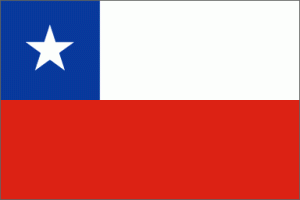
The Chilean flag is often referred to in Spanish as la estrella solitaria (the lone star) because of the fact that it bears a single, five-pointed star. The star represents a guide to honor and progress, while the field of blue that surrounds it is meant to symbolize the Chilean sky and the Pacific Ocean. The white and red portions of the flag represent the magnificent snow-covered Andes and the Chilean blood spilled during the fight for independence.

Chilean Andes

However, as is often the case, Chile’s flag has undergone a few changes over the years. In fact, the first Chilean flag looked nothing like its modern-day counterpart, as it consisted of three horizontal stripes that were blue, white and yellow respectively. This initial Chilean flag was created during the country’s struggle for independence, when the government of José Miguel Carrrera ordered that it be created. The flag was raised for the first time on July 4, 1812, at a banquet celebrating the independence of the United States. Apparently, the American Revolution had greatly influenced Chileans and motivated them in the struggle for independence.

The second Chilean flag was adopted after the triumph of Chacabuco on May 28, 1817. It was called la Bandera de la Transición (the Flag of the Transition). La Bandera de la Transición was very similar the first Chilean flag, simply replacing the yellow horizontal stripe with a red one. Juan Gregorio Las Heras is credited with designing it, but the colors themselves originate in the verses of a poet named Alonso de Ercilla. Blue, white and red were also the colors of the French Revolution, which, like the American Revolution, inspired Chileans. However, la Bandera de la Transición was never actually made official and it simply disappeared after about five months.

Chilean Flag

The disappearance of la Bandera de la Transición cleared the way for Chile’s current flag, la estrella solitaria, to be adopted. The flag itself was conceived by a man named José Ignacio Zenteno and designed by Antonio Arcos, although some Chileans claim that Gregorio de Andía y Varela actually drew it up. The flag was made official on Oct. 18, 1817, but it wasn’t until 1854 that the official proportions of each color were set, while the star’s diameter didn’t become official until 1912. Many people consider the Chilean national flag to be one of the world’s most beautiful; it’s even rumored that the Chilean flag actually won a “Most Beautiful National Flag in the World” contest in Belgium.