Afghanistan Flag

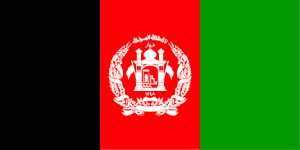
The flag of Afghanistan underwent more changes during the 20th century than any other flag in the world. By my count, the design of the flag was change some twenty times in that time period. Since 2000 it has been modified three more times. The first of these flags, flown under the rule Abdur Rahman Khan, was completely black. Today’s Afghanistan flag, on the other hand, consists of three stripes and the emblem of Afghanistan.
Afghanistan Flag

The Afghanistan flag’s colors – black, red and green – are meant to represent different chapters in the nation’s history. Black represents the 19th century, when a series of wars led to British occupation. Red represents the Afghans fight for independence, and green is meant to show that independence has been achieved. These colors were also part of the Afghanistan flag from 1928 to 1978, running either vertically or horizontally. Back then, black represented the previous monochrome version of Afghan flags, which in turn represented the sovereign. It’s believed that the red was taken from the Soviet flag and meant to represent modernity and progress. Green stood for Islam.

The emblem of Afghanistan, which is found at the center of the current design, consists of several things. At the very top of the emblem, one finds the Shahadah. The Shahadah is the Muslim declaration of belief in the oneness of God and the acceptance of Muhammad as his prophet. Depending on whom you ask, in English it more or less reads, “There is no god but God, and Muhammad is the Messenger of God.” Below the Shahadah, there’s an image of a mosque with its mihrab facing Mecca. A mihrab is a niche in the wall of a mosque that indicates the direction of the Kaaba, a cube-shaped building in the city of Mecca, and hence the direction all Muslims should pray. Two flags are also attached to the mosque, which are taken to be Afghanistan flags. Below the mosque is an Arabic inscription stating the name of the nation.

MLB Flags

The World Series is set to begin tonight with the New York Yankees squaring off against the Philadelphia Phillies in what promises to be one of the greatest Fall Classics in recent memory. The Phils are reigning world champs, their lineup is solid, and they’ve got the ace of their pitching staff, Cliff Lee, going in Game 1. In the other dugout, the Yankee lineup is equally as strong, if not more so, especially since Alex Rodriguez has started earning his pay checks by actually hitting in the post season.

Phillies Flag

With the exceptions of 1904 and 1994, the World Series has been played every year since 1903. The Yanks have won twenty-six championships in that time, while the Phils have won just two. The name “World Series” is derived from the term “World’s Championship Series,” which was used until the early 1900s. The Series is normally decided by a best-of-seven playoff, but in 1903, 1919, 1920 and 1921 the winner was determined by a best-of-nine playoff. At the end of it all, when it’s all said and done, the winners are awarded the Commissioner’s Trophy as well as World Series rings. The winning team also gets a larger portion of the gate receipt than the loser.

Yankees Flag

Whether you plan on cheering for the Yankees of Phillies this year, there’s no better way of doing so than with a beautiful MLB flag. 3’ x 5’ Yankees and Phillies flags made from 100 percent printed polyester are available at the United States Flag Store. These flags would look great inside or outside your home and make great gifts for any true baseball fan. A New York Yankees embroidered yard and wall pennant is also available. Pick yours up today, and don’t forget to watch the game tonight!

Flag of Washington, D.C.

The Flag of the District of Columbia has three red stars above two red bars with a white background. George Washington’s family coat of arms inspired the flag for Washington, D.C.. The Coat of Arms features the same three red stars above two red bars and the shield is white.

Flag of Washington, D.C.

For heraldic reasons, the stars should be called mullets. Washington D.C. was without an official flag and they flew several unofficial flags, such as the flag of the D.C. National Guard. Congress established a commission in 1938 to choose an official and original design. There was a public competition and the submission of Charles A.R. Dunn was chosen. He had first proposed his design in 1921; however, with blue stars or “mullets.”

The flag of Washington, D.C. was first flown on October 23, 1938; however, it did not have widespread usage for another 20 or so years. In 2002, the council for D.C. considered a proposal to change the flag in protest of the District’s lack of voting rights in Congress. The new design would have added the language: “Taxation Without Representation.” Additionally, it would have added the letters “D.C.” to the center star on the flag. The proposal did pass in council; however, it was never signed by then mayor Anthony A. Williams.

In a 2004 poll, the design of the Flag of Washington D.C. was voted the best design among United States city flags by members of the North American Vexillological Association. Previously in 2001, the flag had placed eighth.

Gadsden Flag: Its Place in Today’s Society

Since the horrific attacks of September 11, 2001, the Gadsden flag has been flown throughout the United States by a great number of people.

Gadsden Flag

Customs officials at US ports as well as military personnel in every part of the country hoist the Gadsden flag on a daily basis. In fact, it’s now flown on all active naval ships, and the snake from the flag’s imagery now appears on the US Army Drill Sergeant Identification Badge.

US soccer fans have also begun using the Gadsden flag to support the nation’s team. Nike even uses the image of a snake wrapped around a soccer ball for its patriotic “Don’t Tread on Me” campaign, which supports the US men’s national team.

The Free State Project presented the town manager of Killington, Vermont, with a Gadsden flag after Killington decided to pursue secession from the state. The Free State Project also customized the Gadsden flag by switching out the rattlesnake for a porcupine, which is the organization’s official mascot.

The Gadsden flag is also flown for historical reasons in places like Charleston, South Carolina, where the flag’s designer, Christopher Gadsden, first presented the flag.

Band’s such as Metallica, who put the Gadsden flag’s snake of the cover of their “Black Album”, and 311 have used the flag as inspiration. The Gadsden flag can also be seen in the film, “The Patriot”.

Most recently, the Gadsden flag has been used during the 2009 Tea Party protests.

Flag of New York

The flag of New York was adopted in 1778 and consists of a blue background, with the Great Seal of the State of New York in the center.

Flag of New York

State law from 1778 dictates exactly how the flag and Great Seal are supposed to be designed. The state motto is on the flag, “Excelsior,” meaning “Ever Upward.” The figures on each side of the seal represent Liberty and Justice.

The Laws of New York State

“STATE LAWS – Article 6 – ARMS AND GREAT SEAL OF STATE § 70. Description of the arms of the state and the state flag. The device of arms of this state, as adopted March sixteenth, seventeen hundred and seventy-eight, is hereby declared to be correctly described as follows:

Charge. Azure, in a landscape, the sun in fess, rising in splendor or, behind a range of three mountains, the middle one the highest; in base a ship and sloop under sail, passing and about to meet on a river, bordered below by a grassy shore fringed with shrubs, all proper.

Crest. On a wreath azure and or, an American eagle proper, rising to the dexter from a two-thirds of a globe terrestrial, showing the north Atlantic ocean with outlines of its shores.

Supporters. On a quasi compartment formed by the extension of the scroll.

Dexter. The figure of Liberty proper, her hair disheveled and decorated with pearls, vested azure, sandaled gules, about the waist a cincture or, fringed gules, a mantle of the last depending from the shoulders behind to the feet, in the dexter hand a staff ensigned with a Phrygian cap or, the sinister arm embowed, the hand supporting the shield at the dexter chief point, a royal crown by her sinister foot dejected.

Sinister. The figure of Justice proper, her hair disheveled and decorated with pearls, vested or, about the waist a cincture azure, fringed gules, sandaled and mantled as Liberty, bound about the eyes with a fillet proper, in the dexter hand a straight sword hilted or, erect, resting on the sinister chief point of the shield, the sinister arm embowed, holding before her her scales proper.

Motto. On a scroll below the shield argent, in sable, Excelsior.

State flag. The state flag is hereby declared to be blue, charged with the arms of the state in the colors as described in the blazon of this section.”

Flag of North Carolina

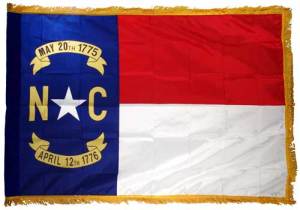
The flag of North Carolina was adopted by the state legislature in March of 1885 to replace the previous flag adopted in June of 1861. The flag of 1861 was adopted because of the state’s secession from the Union on May 20, 1861. The current flag, bears the dates of the Mecklenburg Declaration of Independence, May 20, 1775, and the Halifax Resolves, April 12, 1776, both documents are said to place North Carolina at the forefront of the American independence movement. Both of these dates also appear on the Great Seal of North Carolina.

Flag of North Carolina

The flag design of North Carolina consists of a blue union which has a white star in the center and the letter N in the gilt of the left side and the letter C in the gilt of the right side of the star. The fly portion of the flag consists of two equally proportioned bars; the upper bar is red and the lower bar is white.

Above the star in the center of the union there is a gilt scroll in a semi-circular form inscribed in black letters with May 20th, 1775, and below the star a similar scroll is present containing black letters inscribing April 12th, 1776.

North Carolina flag etiquette requires the flag to be flown on public buildings and institutions as well as at county courthouses in every courtroom.  The flag is to be brought down in cases of inclement weather and it can be flown at half-mast upon the death of any State officer or any prominent citizen.

Flag of New Jersey

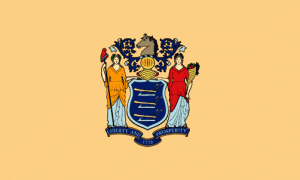
The state flag for New Jersey was officially adopted and described in a joint resolution of the legislature in 1896. The colors for the flag were chosen by General George Washington in 1779, after he was headquartered in New Jersey during the Revolutionary war. These were the military colors used by the New Jersey troops. The 1896 resolution reads as follows:

New Jersey Flag

Joint Resolution to Define the State Flag

  1. BE IT RESOLVED by the Senate and General Assembly of the State of New Jersey: The State flag shall be of buff color, having in the center thereof the arms of the State properly emblazoned thereon.
  2. The State flag shall be the headquarters flag for the Governor as Commander-in-Chief, but shall not supersede distinctive flags which are or may hereafter be prescribed for different arms of military or naval service of this State.
  3. This act shall take effect immediately.

In 1965, a law was passed that defines the specific shades of Jersey blue and buff. If you use the Cable color system developed by The Color Association of the United States, Jersey blue is Cable #70087, and buff is Cable #65015.

The flag itself is buff colored and has the state coat of arms in the center, which is where you find the Jersey blue color. The shield has three plows with a horse’s head above it. The two women on the shield represent the goddesses of Liberty and Prosperity which is the state motto. The ribbon on the bottom reads Liberty and Prosperity and includes the year of independence 1776.

Flag of New Hampshire

The flag of New Hampshire was officially adopted in 1909. Prior to that time period, the state of New Hampshire had a number of regimental flags to represent the state. The flag has been modified only once since its adoption in 1909 when the state’s seal was modified in 1931.

Flag of New Hampshire

The body of the New Hampshire flag is blue. Upon the center of the flag rests the state’s seal with the frigate Raleigh. These are surrounded by laurel leaves and nine stars. The frigate Raleigh is tipped on the flag to appear as though it’s floating on water. The nine stars represent New Hampshire as the ninth state to enter the union.

New Hampshire Statutes state, “The state flag shall be of the following color and design: The body or field shall be blue and shall bear upon its center in suitable proportion and colors a representation of the state seal. The seal shall be surrounded by a wreath of laurel leaves with nine stars interspersed. When used for military purposes the flag shall conform to the regulations of the United States.”

In a 2001 survey of members of the North American Vexillological Association, the New Hampshire state flag design was ranked as one of the ten worst flags within the United States, Canadian provinces, or select nations. In 2003, at least one elected official has suggested replacing the state seal in the center of the flag; however, no official action has ever been taken on that proposal.

Nevada State Flag

by Sherri Smith

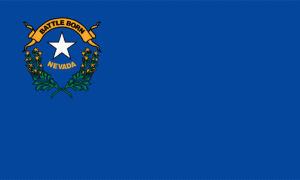
Nevada has been associated with, more or less, four “official” flags with the current design having been made the official in 1991. The current design is very similar to the design adopted in 1929; however, it fixes some errors that were not caught until 60 years later.

Nevada State Flag

During the 1929 session of the Nevada State Legislature, a bill was introduced that repealed the 1915 flag and officially adopted the “Schellbach” design. This bill went through the state senate; however, it was held up in the Assembly because the flag did not include the state name. The Senate and the Assembly could not agree on the placement of the name and a conference committee was designed and a compromise was worked out.

On March 26, 1929, the bill adopting the “Schellbach” flag was signed by then Governor Balzar. However, the bill that was signed by the Governor was not the version that contained the amendment agreed upon by the Senate and the Assembly. This error was discovered by legislative researcher Dana Bennett in 1989 and was confirmed by the State Archives and Records Administrator Guy Rocha.

Senator William Raggio introduced the bill in 1991 to correct the problem. After the Senate and Assembly hearings on the subject, the legislature voted to correct all of the shortcomings of the 1929 flag legislation.

Nevada Revised Statutes state: “The official flag of the State of Nevada is hereby created. The body of the flag must be of solid cobalt blue. On the field in the upper left quarter thereof must be two sprays of sagebrush with the stems crossed at the bottom to form a half wreath. Within the sprays must be a five-pointed silver star with one point up. The word “Nevada” must also be inscribed below the star and above the sprays, in a semicircular pattern with the letters spaced apart in equal increments, in the same style of letters as the words “Battle Born.” Above the wreath, and touching the tips thereof, must be a scroll bearing the words “Battle Born.” The scroll and the word “Nevada” must be golden-yellow. The lettering on the scroll must be black-colored sans serif gothic capital letters.”

Jolly Roger Flag

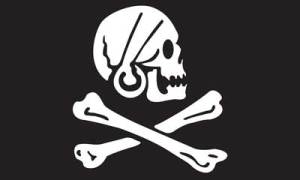
Still very popular in today’s culture is the Jolly Roger, the name of which was given to any of the various flags flown to identify a ship’s crew as pirates. The most common flag that identified a ship’s crew as pirates is the skull and crossbones: a skull above two long bones set in an x-mark arrangement on a black field. The name “Jolly Roger” has been thought to have come from joli rouge (pretty red), an ironic French description of the bloody banner flown by early privateers. These flags were intended to strike mortal terror in the hearts of the pirate’s intended victims.

Jolly Roger Flag

This design was reportedly used by the pirate captains Edward England, John Taylor, Sam Bellamy, and John Martel. Despite the current popularity, most pirates in the 17-18th centuries used plain black flags. Pirates did not use the black flag or Jolly Roger flag at all times. Instead they stocked a variety of flags and would fly false colors until they had their prey within firing distance. When they had their victim within range, it was then that the Jolly Roger flag would be raised, often concurrently with a warning shot.

Another Jolly Roger Flag

An interesting tidbit is that in World War II, it was common practice for the submarines of the Royal Navy and Royal Australian Navy to fly the Jolly Roger on completion of a victorious combat operation as a display of boasting and slyness instead of mayhem. Additionally, since the decline of piracy (although pirates in today’s world still exist), various military units have used the Jolly Roger as a victory flag and a show of fierceness and stoutness.