
 I took a walk today in the cemetery near my home. A portion of the cemetery is dedicated to those who served in the American Armed Forces. What caught my attention was the fluttering of hundreds of flags. Each seemed to stand as a silent thank you for the service of each man and woman.
A flag is more than just a piece of cloth. It is a symbol of so much more. It stands for a country, a government, and a set of ideas. The American flag symbolizes laws laid out in the Constitution, freedoms given in the Bill of Rights, and the risk taken by the Declaration of Independence.
Contrary to popular belief, the colors of the American flag did not have any symbolic meaning when it was first adopted; however the colors of the flag-like portion of the Great Seal do have meaning. Charles Thompson, Secretary of the Continental Congress, stated, “White signifies purity and innocence, Red, hardiness & valor, and Blue . . . signifies vigilance, perseverance & justice.” It was quite fitting these colors should fly over the graves of those had given their all.
 The stars of the flag, however, do have symbolism. The resolution adopted on June 14, 1777, reads, “Resolved, that the flag of the United States be thirteen stripes, alternate red and white; that the union be thirteen stars, white in a blue field representing a new constellation.” As the many stars formed one design, the many states formed one country.
 I continued walking past the flags and I noticed a few of them had fallen over. If they had just been an old rag or even one of the flower displays left on some of the graves, I would have ignored them. But they were flags, lying on the ground. They were a symbol of my country, of my freedom to walk in the sunshine and to say what I chose and to worship how I please.
I picked up the flags and set them back in their places. And I smiled in silent thanks.
Katie Hart

 When it was originally discovered that Arkansas did not yet have a state flag, the Daughters of the American Revolution decided to sponsor a contest to design an official Arkansas Flag. Willie Hocker, a member of the Pine Bluff chapter of the Daughters, won the contest with a design that is similar to the current Arkansas Flag. Mrs. Hocker designed a flag that consisted of three blue stars in the middle of a white diamond, however the word “ARKANSAS” was omitted. At the request of Secretary of State Earle Hodges, chairman of the Arkansas Flag committee, Hocker eventually added the word “ARKANSAS” and also rearranged the stars to their current design and location. This version of the



 In his early years, Newt Heisley was a pilot in the South Pacific Theater during World War II. During the Vietnam War, however, Mr. Heisley became a professional art director at Annin and Company, the country’s largest flag manufacturer. In 1971 he was asked to create a flag for the National League of Families of American Prisoners and Missing in Southeast Asia. Heisley, as he himself was a veteran of the South Pacific Theater of World War II, had a personal concern for the many who served in the Vietnam War.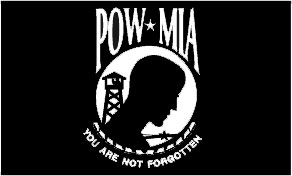


 Among the Aztecs, one northern culture, the Mexica (pronounced me-shee-ka), embodied the Tenochca tribe. Tenochca culture included human sacrifice, and eventually other tribes banded together in an attempt to crush them. The survivors eventually fled. Aztec legend says that their war god, Huitzilopochtli, directed them to found a new city where they would find an eagle sitting on a prickly pear cactus, eating a serpent. Somewhere between 1300 and 1375, on a swampy island at the center of three lakes, they espied the sought-after lunching eagle and so settled and built the city Tenochtitlan, now Mexico City.

 Flag Blog