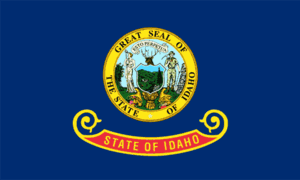
Flag of the State of Idaho


The flag of the state of Idaho was adopted on November 2, 1957. The flag is rectangular with a blue background. The seal of the state of Idaho appears in the center of the flag. Below the seal, a red banner with gold trim appears with the text “STATE OF IDAHO.”

Although the Idaho state flag was not adopted until the second half of the twentieth century, the first Idaho state banner was flown in the Philippines during the Spanish American War in 1898. Just before the First Idaho Volunteer Infantry deployed for the Philippines in 1898, a group of Idaho women presented the first Idaho state flag, which was made by skilled needle-worker in Chicago.

The first flag of Idaho was very similar to the current state flag, containing a blue background and the Idaho state seal in the center. Unlike the current version of the flag, the state seal on the original flag did not include the gold circular border with the text “Great Seal of the State of Idaho” written inside the border. Instead of the text “STATE OF IDAHO” in the red banner at the bottom, the text “1st Idaho Volunteers” appeared on the original flag.

The seal that appears in the center of the Idaho state flag was adopted in 1863 and modified several times before Idaho became an official state in 1890. The seal contains a gold circular border with the text “Great Seal of the State of Idaho” and a white star, representing Idaho as a new light among the U.S. states. Inside the border, a woman representing justice and a Miner, representing Idaho’s chief 19th-century industry are depicted in the foreground. Other images, including those in the seal’s inner shield, contain many images significant to the state of Idaho. These images include a man plowing a field, a pine tree, two cornucopias, the state flower, wheat, and an elk. The Latin text Esto perpetua, or “It is forever,” also appears at the top of the seal.
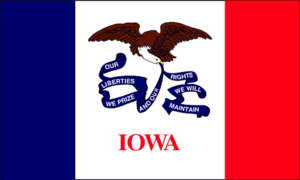
State Flag of Iowa

The flag of Iowa was adopted on March 12, 1921. The flag is rectangular with three vertical stripes: the stripe on the left is blue, the stripe on the right is red, and the larger center stripe is white. A bald eagle appears in flight in the white stripe, holding a blue ribbon with the following white text: “Our liberties we prize and our rights we will maintain.” The word “IOWA” is also included towards the bottom of the white stripe in red capitol letters.

Although the state of Iowa was admitted to the Union on December 28, 1946, it was not until the United States entered World War I that Iowans felt the need for a state flag. It was expected that Iowans would fight in state regiments, as in previous wars, and Iowans finally desired a banner to designate their respective units. Fortunately, the Iowa Society of the Daughters of the American Revolution was interested in designing a state flag.

On May 11, 1917, members of the Society as well as Mrs. Dixie Gephardt, the flag’s designer, presented the flag before the State Council on National Defense. The Council approved the flag, after which the Daughters of the American Revolution manufactured and presented Iowa flags to each of the Iowa National Guard regiments. Unfortunately, shortly after the flag was approved, the U.S. War Department adopted a policy assigning soldiers to military regiments without regard to state residency, and the Iowa flags were not used during the war. Still the Iowa flag was used by the State National Guard and is still used today.

State Flag of Montana

The flag of the state of Montana was originally adopted in 1905. The flag is rectangular with a blue background. The seal of Montana, which was adopted in 1865, is centered on the flag. The seal depicts the beautiful landscape of Montana, complete with mountains, plains, forests, the Great Falls, the Missouri River, and a big sky. The seal also contains important symbols of Montana’s farming and mining industry: a plow, a pick, and a shovel. The state’s territorial motto, Oro y Plata, is written on a banner at the bottom of the seal, which means “Gold and Silver” in Spanish. The text “MONTANA” appears across the top of the flag in gold letters.

The flag of the State of Montana was created in 1898, when the First Montana Infantry volunteers were training for the Spanish American War at Fort Harrison. Although the men had planned to carry a 45-star United States flag into battle, Colonel Kessler, the head of the First Montana Infantry, thought the troops needed a special flag to represent their state. The flag the men carried looked like the current Montana state flag, but instead of the word “MONTANA” across the top, the text “1st Montana Infantry U.S.V.” was stitched above the seal.

After the Spanish American war, Colonel Kessler gave the flag to the Governor, who displayed the banner throughout the state. The residents of Montana began to consider the banner an appropriate representation of their state, and in 1905, the Montana State Legislature officially adopted the first state flag of Montana: a blue banner with the Montana state seal in the center. The text “MONTANA” was added to the flag in 1981.


Flag of Oklahoma

The state flag of Oklahoma was adopted on April 2, 1925. The flag is rectangular with a blue background. In the center of the flag is buffalo-skin shield traditional to the Native American Osage tribe. The shield contains six brown crosses and seven eagle fathers. A Native American peace pipe and an olive branch appear in front of the shield. The text “OKLAHOMA” appears below the shield in white letters.

The flag of Oklahoma is unique to the state and the elements of the flag are significant. The buffalo-skin shield represents the Osage tribe, a group of Native Americans that originated in the Ohio River valley, but moved west to Oklahoma during the mid-1600s. Throughout the 1700s, the Osage tribe was the dominant Native American tribe in the area of the United States that is now Arkansas, Missouri, Kansas, and Oklahoma. Today, the Osage tribe mainly resides in Osage County, Oklahoma.

Six brown crosses—the Native American symbol for stars—appear on the shield and represent high ideals. The Native American peace pipe, or calumet, and the olive branch represent both the Native American and European symbols for peace. The blue background of the flag commemorates the Choctaw, the first Native American Nation to wave an official flag. The Choctaw Nation also served in the Confederate Army during the Civil War. The text “OKLAHOMA,” that appears in white letters below the shield was added to the flag in 1941.

The current flag of Oklahoma is quite different from the state’s original banner, which was adopted in 1911, four years after Oklahoma became an official state in the Union. The original flag was rectangular with a red background. A white, five-pointed star with a blue border appeared in the center of the flag. The number “46” appeared in blue in the center of the star, representing Oklahoma’s entry into the Union as the 46th state.

Flag of the State of Nebraska


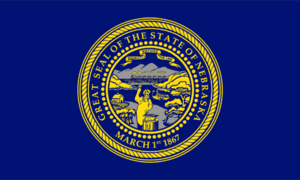
The flag of the state of Nebraska was adopted in 1925 but not made official until July 16, 1963, making Nebraska one of the last states to adopt a state flag. The flag is rectangular with a bright blue background. The Great Seal of the State of Nebraska is featured prominently in gold and silver in the center of the flag.

The Great Seal of the State of Nebraska was adopted in 1867, the same year Nebraska joined the Union as the 37th U.S. state. The seal highlights Nebraska’s agriculture and industry. In the foreground, a blacksmith is pictured, working at his anvil, representing the importance of this industry to the state of Nebraska. Behind the blacksmith, a small log cabin and a few sheaves of harvested wheat are pictured, symbolizing both the importance of agriculture and westward settlers to Nebraska’s state history. A river with a steamboat and a train running along tracks are also pictured in the seal, recognizing the importance of transportation to Nebraska’s industry, culture, and economy. Mountains also appear in the distance behind the train, depicting Nebraska’s skyline.

Two texts appear on the Great Seal of the State of Nebraska. The first text is written on a banner above the train and contains the state motto, “Equality Before the Law,” signifying that all people are equally protected under the same laws. The second text appears around the seal and reads: “Great Seal of the State of Nebraska, March 1, 1867.” This text commemorates the day Nebraska became an official state in the Union.

Flag of South Dakota


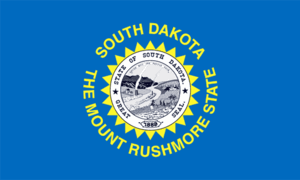
The flag of the state of South Dakota was adopted on November 9, 1992. The flag is rectangular with a bright blue background. The seal of the state of South Dakota appears in the center of the flag surrounded by gold triangles that represent the sun’s rays. The text, “SOUTH DAKOTA” and “THE MOUNT RUSHMORE STATE” appear around the seal, in all capital letters.

The seal of the state of South Dakota was designed in 1885. The seal features hills, a mine, a river and a boat, a farmer, and cattle, a scene representative of South Dakota’s economy, industry, landscape, and natural resources. Above the scene is that state’s motto: “Under God the People Rule.” The text “STATE OF SOUTH DAKOTA” and “GREAT SEAL” appear around the seal. The date “1889” appears at the bottom of the seal, the year South Dakota became an official state in the Union.

The original flag of South Dakota was somewhat different than the state’s current flag. The original flag, which was designed in 1909, featured the same bright blue background but contained different images on the banner’s front and back. The front of the flag featured a large yellow sun with the text “SOUTH DAKOTA” and “THE SUNSHINE STATE.” The back of the flag contained the seal of the state of South Dakota and the same text. Printing a flag with different front and back designs was expensive; however, and the cost of the flag prohibited many homes and businesses from displaying the flag.

In 1963, the South Dakota State Legislature passed a bill to change the state flag to display the state seal on both sides. In 1992, the flag underwent its final modification. Although the state adopted the nickname, “The Sunshine State,” to reflect the many sunny days that occur every year in South Dakota, the state officially adopted “The Mount Rushmore State,” as its official nickname. Subsequently, in the same year, the text on the flag was changed from “THE SUNSHINE STATE” to “THE MOUNT RUSHMORE STATE.”

Flag of North Dakota


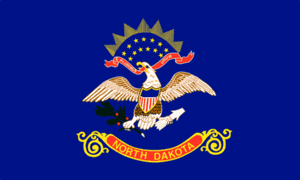
The flag of the state of North Dakota was adopted on March 3, 1911. The flag is rectangular with a dark blue background. The flag features a bald eagle with a red, white, and blue shield. In its feet, the eagle holds an olive branch and a bundle of arrows. A gold sunburst and thirteen gold stars appear above the eagle. The eagle holds a ribbon in its mouth; on the ribbon is the text, “One nation made up of many states.” A red and gold scroll appears below the eagle with the text “North Dakota.”

Rather than containing images symbolic of state, land, and people of North Dakota, the flag of North Dakota contains images important to the United States as a whole. The image of the bald eagle with the olive branch, bundle of arrows, and shield, for example, closely resembles the United States Coat of Arms, Great Seal of the United States, and the Seal of the President of the United States.

The bald eagle symbolizes freedom and the founding fathers often compared the United States to the characteristics of this powerful bird. The shield lies on the eagle’s breast without any support, representing the thought that the United States must rely on its own virtues. The thirteen stripes on the shield—as well as the thirteen gold stars above the eagle—represent the original thirteen colonies of the United States. The olive branch symbolizes the power of peace, while the arrows symbolize the power of war.

The red, white, and blue colors in the shield contain the same symbolic meanings as the colors of the American flag. The white symbolizes innocence and purity; the red represents valor and strength, and the blue represents justice and perseverance.

The flag of the state of North Dakota is nearly identical to the flag the North Dakota infantry carried during both the Spanish American War and the Phillipine-American War. In 1953, a bill was introduced in the North Carolina Legislative Assembly to change the flag on the basis that it too closely resembles the United States Coat of Arms and other national seals; however the bill was promptly defeated in the same year.

Flag of the State of Maine


The current flag of the state of Maine was adopted on February 23, 1909. The flag is rectangular with a blue background. The state flag of Maine features Maine’s coat of arms in the center, two men on either side of the shield, a star above the shield, and the text “MAINE” below the shield.

The coat of arms of the state of Maine, which appears in the center of the flag, reflects Maine’s beautiful northeastern United States scenery: a large pine tree is featured in the center of the shield with a moose resting below near a river. A farmer holding a sickle and a sailor holding an anchor appear on either side of the shield. These two men represent the importance of the agriculture and sea industries for the state’s economic livelihood.

The star that appears radiantly above the shield is the North Star. The text, “DIRIGO,” appears below the North Star. Dirigo, which is Latin for “I direct,” is the state of Maine’s official motto. The text, “MAINE,” appears below the shield on a light blue banner.

Maine’s current flag is somewhat different from the state’s first flag, which was developed in 1901. The original flag was rectangular with a buff or tan-colored background. The flag featured a block image of a green pine tree in the center. The North Star appeared as a blue star in the top left corner of the flag.

Maine and Massachusetts are the only two states in the Union to fly a separate ensign, or flag at sea. Maine’s official ensign is a rectangular flag with a white background. A block image of a green pine tree appears in the center with a blue anchor behind it. The text, “DIRIGO,” appears in blue capital letters above the tree and anchor; and the text, “MAINE,” appears below the tree and anchor in the same font.

Flag of the State of Delaware


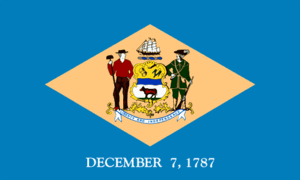
The flag of the state of Delaware was adopted on July 24, 1913. The flag is rectangular with a colonial blue background. The center of the flag features a buff-colored diamond and the Delaware coat of arms appears inside the diamond. The date December 7, 1787 appears on the bottom of the flag below the coat of arms. This date refers to the day on which the state of Delaware was the first state to ratify the United States constitution. This bold action made Delaware the first official state in the Union, and because of this, Delaware holds first position at national events like presidential inaugurations.

The other elements of Delaware’s state flag have important meaning for the state and recall the Revolutionary era. The blue and buff colors on the state flag of Delaware, for example, symbolize the colors of George Washington’s uniform.

The elements of the coat of arms also represent important people and industries of the state of Delaware during the Revolutionary era. The center of the coat of arms features a shield with horizontal red, blue, and white stripes. An ear of corn and sheaf of wheat appear in the red stripe, symbolizing the importance of agriculture in Delaware’s economy. The blue stripe is plain, representing the Delaware River, and the river’s importance to Delaware’s transportation and economy. An ox appears in the white stripe and reflects the importance of animals in Delaware’s economy. A ship appears above the shield, symbolizing the importance of shipbuilding and trade to Delaware’s economic livelihood.

Two men appear on either side of the coat of arms: a farmer with a hoe and a militiaman with a musket. These two men reinforce the importance of farming in Delaware and also emphasize the importance of the militia—an army made up of civilians—in gaining independence during the Revolution. Under the shield and the men are the words “Liberty and Independence,” Delaware’s state motto.

Flag of the State of Connecticut


The flag of the state of Connecticut is rectangular with a blue background. A shield appears in the center of the flag and a banner appears below the flag with the state’s motto: Qui Transtulit Sustinet (“He who transplanted still sustains”). The flag was adopted on September 9, 1897.

The shield on Connecticut’s state flag exemplifies the Rococo design with its many curves and fancy ornamentations. The shield has a gold border and five clusters of oak leaves and acorns. Three grapevines appear in the center of the shield. These natural elements contain important symbolic meaning for the state of Connecticut. Grapes are a symbol of good luck, happiness, and peace, and the vines symbolize strong and lasting friendships. The oak leaves and acorns represent antiquity, faith, endurance, and strength.

The flag of Connecticut’s design dates back to the original seal of Saybrook Colony, which was established in 1639 during the American colonial period. The seal contained 15 grapevines and a hand in the top left corner that contained a scroll. Connecticut’s state motto, Qui Transtulit Sustinet, was written on the scroll. The current state flag of Connecticut contains only three grapevines, which represent Connecticut’s oldest towns: Windsor, Wethersfield, and Hartford. The acorns and white oak leaves were also added to the current state flag, acknowledging that the Charter Oak is Connecticut’s state tree.

Unlike many other states, the Connecticut’s General Assembly adopted the state flag without much controversy or deliberation. When Connecticut had no official state flag in the late 1800s, the Anna Warner Bailey Chapter of the Daughters of the American Revolution received approval from Governor O. William Coffin to design a state flag. After the Daughters of the American Revolution designed the flag, Governor Coffin proposed the design to the Connecticut General Assembly on May 29, 1895, and the Assembly approved the design the same day. The flag was officially adopted in 1897.