Flag of Virginia

The Flag of the Commonwealth of Virginia was adopted on January 31, 1861 at the beginning of the United States Civil War. The flag is rectangular with a blue background. In the center of the flag is the seal of Virginia enclosed in a white circle. Virginia’s seal was designed by George Mason, known as the “Father of the Bill of Rights” and George Wythe, whose signature appears on the United States Declaration of Independence.
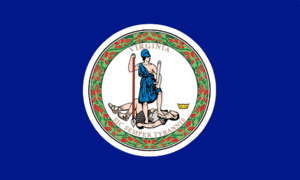
The seal depicted on the flag of Virginia features a woman, personifying Virtus, or virtue in ancient Roman times. Virtus is a symbol of peace, and she stands with her sword in its sheath resting her weight on a long spear, indicating a victorious battle. Her bare foot rests on Tyrannis, or tyranny, represented by a man in a purple robe and sandals with a fallen crown. The scene symbolizes the Virginia’s—and the United States’—defeat of the British government during the American Revolution. The broken chain in Tyranny’s left hand further emphasizes Great Britain’s defeat by the American Colonies. Virginia is the only state besides New York to include a crown in its flag.

The word “Virginia” appears on top of the seal, and the Latin phrase, Sic semper tyrannis, appears at the bottom. The motto literally means “Thus Always to Tyrants,” and describes the scene depicted on the seal. The phrase’s origins, like the image, date back to Roman times whe Marcus Junius Brutus assassinated the tyrant Julius Caesar. The phrase has been used to ill effect as well during notable U.S. assassinations. John Wilkes Booth shouted, Sic semper tyrannis, when he assassinated Abraham Lincoln at Ford’s Theatre on April 14, 1865. Timothy McVeigh wore a T-shirt with the phrase and a picture of President Lincoln when he was arrested after the Oklahom City bombing in April 1995. In Virginia, however, saying Sic semper tyrannis, is a common joke dating back to the Civil War and means “get your foot off my neck.”

Flag of South Carolina

The Flag of the State of South Carolina was adopted on September 28, 1861. The flag is rectangular with a blue background. In the center of the flag is a white palm tree. A white crescent appears in the upper left corner.

The Flag of South Carolina was first designed for use in the Revolutionary War. In 1775, Colonel William Moultrie developed the state’s first flag, a blue rectangular banner with a white crescent in the upper left corner, the blue color matching the militia uniforms. The word “liberty” appeared inside the white crescent on the first version of the flag.

The original Revolutionary War flag remained in use until 1861, when the South Carolina General Assembly adopted a flag with a palmetto tree in front of a white oval background. The flag was only in use for two days—it is thus known as the “two-day flag”—and two days later the palmetto tree was modified to a simpler white tree in front of the blue background.

The addition of the palmetto tree on the South Carolina flag recognizes Colonel Moultrie and his troops, who defended Charleston by constructing a fort from palmetto logs.  Because palmetto logs are soft, the British cannons were unable to destroy the fort, allowing the Americans to win the battle at Charleston on June 28, 1776.

Like many other Southern States, South Carolina flew a different flag after it seceded from the Union during the civil war era. South Carolina’s Sovereignty/Secession Flag was actually flown in several parts of the Union during the Civil War to demonstrate support for the South. The Sovereignty/Secession Flag features a red background with a blue cross. Inside the blue cross are white stars. In the left corner of the flag, the crescent and the palm tree are featured next to each other.

The meaning of the crescent is debatable. South Carolina soldiers may have worn a crescent on their caps during the revolution. The crescent is also thought to be symbolic of a “second son,” one who came to the United States in search of a more prosperous life.

Flag of North Carolina

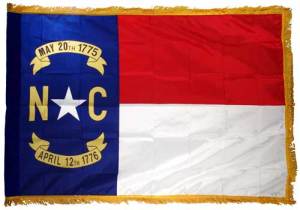
The flag of the State of North Carolina was adopted in 1885. North Carolina was the 12th state to join the United States of America: it gained statehood in 1789.  The flag is rectangular and uses the same colors as the flag of the United States—red, white, and blue—but also includes a golden color to highlight its lettering.

The left side of the flag, closest to the hoist, is blue with a white star in the center. The letter “N” appears to the left of the star, and the letter “C” appears to the right. The date May 20, 1775 appears on golden ribbon above the star, and the date April 12, 1776 appears on another golden ribbon below the star.  To the right of the blue portion of the flag are two equally divided horizontal fields: the top field is red and the bottom is white.

The two dates on the North Carolina flag are important dates in the United States’ battle for independence and are also dates that recognize North Carolina as an important state in the revolutionary movement.  May 20, 1775 recognizes the Mecklenburg Declaration of Independence, which was the first declaration of independence made in the Thirteen Colonies. The citizens of Mecklenburg County signed the declaration on May 20, 1775 in Charlotte, North Carolina.

April 12, 1776 commemorates the Halifax Resolves, which was adopted by the Fourth Provincial Congress of the Province of North Carolina. Like the Mecklenburg Declaration, the Halifax Resolves was named for the town where the document was discussed. The Halifax Resolves motivated North Carolina’s leaders, including Joseph Hewes, William Hooper, and John Penn, to join the other United States colonies and declare independence from Britain.

When North Carolina seceded from the Union on May 20, 1861—just six years after the flag’s adoption—the date of the Halifax Resolves was replaced with North Carolina’s secession date. The blue field on the left was changed to red and included a larger star and the red field on the right side of the flag was changed to blue. The official North Carolina flag was restored after the Civil War.

Flag of Mississippi

The Flag of Mississippi was officially adopted in 1894 following the state’s appointment of a committee to design an appropriate state flag. The flag features a square version of the Confederate Battle Flag in the upper left corner, a red background that includes a blue southern cross and thirteen white stars inside the cross.  The rest of the flag consists of three large horizontal stripes, one each in blue, white, and red.  Mississippi is the only state in the Union that still incorporates the Confederate flag into their state flag.

The meaning of the colors and stars on the Mississippi state flag are not difficult to interpret.  The thirteen stars in the Confederate flag symbolize the thirteen original colonies of the United States.  The red, white, and blue colors are also in accordance with the official colors of the United States.  The use of the Confederate flag in the Mississippi state flag is controversial, however.  Those who support the Confederate flag argue that it is a symbol of southern heritage that is distinctively unique from the Northern traditions.  To others, due to its use in the Civil War, by Neo-Nazis, and the Ku Klux Klan, the Confederate flag is viewed as racist and anti-Union.  For these reasons, most Southern states, schools, and universities that at one time included the Confederate flag in their own state flags or that flew the Confederate flag no longer follow this tradition.

In 1993, the National Association for the Advancement of Colored People (NAACP) filed a lawsuit against the state of Mississippi regarding the Confederate flag’s inclusion in the state’s flag.  After reviewing the case, the Mississippi Supreme Court overruled the NAACP, and in 2000, Mississippi Governor Ronnie Musgrove made the current state flag official.  Although controversy continued to brew over the flag’s use, in 2001, Mississippi residents voted to keep the Confederate flag on their state flag.

Flag of Louisiana

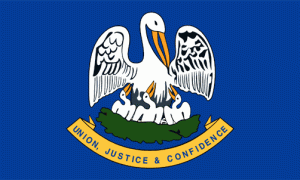
The flag of the State of Louisiana was originally adopted in 1912 and revised in 2006. This rectangular flag features a blue background with a “pelican in her piety” in the center: a mother pelican feeding three baby pelicans in their nest.  The mother pelican has three small drops of blood on her chest and is using the blood to feed her children.  This symbol is also used on the Louisiana state seal.  The state motto is included on a white ribbon below the pelican of piety and reads: “Union, Justice, and Confidence.”

The drops of blood on the pelican of piety on the Louisiana state flag might seem disturbing, and it is not surprising that their inclusion on the flag was inconsistent throughout the nineteenth and twentieth centuries.  It wasn’t until an eighth grade student at Vanderbilt Catholic High School in Houma, Louisiana brought the issue to the attention of the Louisiana State Legislature that it became a requirement that all versions of the Louisiana seal and flag include the three drops of blood on the pelican’s breast.

The pelican of piety has been a Christian symbol of charity since the Middle Ages.  Medieval Europeans thought that pelicans were particularly caring for their babies. Because of the way the pelican presses its bill into its chest when feeding, it was thought that a pelican mother would injure herself to feed her young her own blood in the absence of available food.  Other legends about pelicans hold that the pelican mother kills its young, only to resurrect the babies with her own blood, symbolic of the Passion of the Christ. Both versions of the pelican mother support self-sacrifice and generosity in the Christian faith.  In addition to its use on the Louisiana state flag and seal, the pelican image is featured in Great Britain on the emblems of the Corpus Christi College in both Cambridge and Oxford.

The Arizona State Flag

The Arizona State Flag has its roots in the 1910 National Rifle Matches at Camp Perry, Ohio, even before Arizona was officially a state in the Union. Camp Perry’s shooting matches began in 1907, quickly became popular, and still continue today.  Ideas for the Arizona flag first developed when Arizona rifle team members noticed that many of the states competing in the matches displayed flags or emblems representing their state.   The team captain, Arizona National Guard Colonel Charles Wilred Harris, suggested the idea of a flag for use at the National Rifle Matches.

Arizona State Flag

Harris, along with Carl Hayden, Arizona’s first Congressional Representative, set out to designing a flag.  In patriotic spirit, it was of great importance to Harris and Hayden that the Arizona flag design display historical values in both its design and colors.  Nan Hayden, Carl Hayden’s wife, sewed the first flag, and it was used in the National Rifle Match in 1911.

In 1912, Harris, now Adjunct General of Arizona, designed a similar flag for use as a state flag.  The Arizona State Legislature officially adopted Harris’s flag on February 17, 1917, despite Governor Thomas Campbell’s refusal to sign the bill into law.

The Arizona State Flag consists red and yellow rays on the top half, a blue bottom half, and a copper star in the middle.  There are 13 red and yellow rays, symbolizing the 13 original colonies of the United States and Arizona’s 13 original counties.  The red and yellow symbolize both the colors of Arizona’s beautiful sunsets.  Red and yellow are also the colors on the Spanish flag flown by Francisco Vasquez de Coronado and his conquistadors during their search for the Seven Cities of Cibola in 1540.

The blue bottom half of the flag represents the Liberty Blue found on the U.S. flag.  The copper star in the middle of the flag represents Arizona’s copper-mining industry, which produces the largest amount of copper in the nation.

Arizona indeed has a beautiful flag, and reasons for Thomas Campbell’s refusal to accept the flag are unknown.  As if to spite him, however, a 2001 poll by the North American Vexillological Association voted Arizaon’s state flag as the sixth best flag on the continent.

The Bear Flag – California’s State Flag

The Bear Flag, California’s state flag, was adopted by the California State Legislature in 1911. It is white with a red stripe along the bottom and a red star in its upper left-hand corner. There’s also a California grizzly bear – a species now extinct – at the flag’s center. The bear depicted on the flag is modeled after the last wild Californian grizzly bear to be held in captivity. Named Monarch, the bear was held at Woodwards Gardens in San Francisco. After its death, it was preserved at the Academy of Sciences at Golden Gate Park.

Monarch the Bear

The original Bear Flag was flown during the 1846 Bear Flag Revolt. It was designed by a man named William L. Todd – nephew of Abraham Lincoln’s wife, Mary Todd – using blackberry juice. Todd placed the star on the flag in recognition of the California Lone Star Flag, while the bear was meant to signify strength and unyielding resistance. The flag was raised for the first time in Sonoma, California. Supposedly, when it was hoisted, native Californians were heard saying “Coche,” the common name for a pig. Apparently, Todd had not drawn a very convincing Californian grizzly bear.

The Bear Flag

The colors of which the Bear Flag consists are white, old glory red, maple sugar, seal and Irish green. The color seal is used to shade the dark grizzly bear, the tufts of dirt in the plot of grass, the border of the plot and the words “California Republic.” Old glory red is used for the star, the tongue of the bear and the red stripe at the bottom of the flag. Irish green is used for the grass upon which the grizzly bear stands, and white is used for the bear’s claws.

Flag of Washington, D.C.

The Flag of the District of Columbia has three red stars above two red bars with a white background. George Washington’s family coat of arms inspired the flag for Washington, D.C.. The Coat of Arms features the same three red stars above two red bars and the shield is white.

Flag of Washington, D.C.

For heraldic reasons, the stars should be called mullets. Washington D.C. was without an official flag and they flew several unofficial flags, such as the flag of the D.C. National Guard. Congress established a commission in 1938 to choose an official and original design. There was a public competition and the submission of Charles A.R. Dunn was chosen. He had first proposed his design in 1921; however, with blue stars or “mullets.”

The flag of Washington, D.C. was first flown on October 23, 1938; however, it did not have widespread usage for another 20 or so years. In 2002, the council for D.C. considered a proposal to change the flag in protest of the District’s lack of voting rights in Congress. The new design would have added the language: “Taxation Without Representation.” Additionally, it would have added the letters “D.C.” to the center star on the flag. The proposal did pass in council; however, it was never signed by then mayor Anthony A. Williams.

In a 2004 poll, the design of the Flag of Washington D.C. was voted the best design among United States city flags by members of the North American Vexillological Association. Previously in 2001, the flag had placed eighth.

Flag of New York

The flag of New York was adopted in 1778 and consists of a blue background, with the Great Seal of the State of New York in the center.

Flag of New York

State law from 1778 dictates exactly how the flag and Great Seal are supposed to be designed. The state motto is on the flag, “Excelsior,” meaning “Ever Upward.” The figures on each side of the seal represent Liberty and Justice.

The Laws of New York State

“STATE LAWS – Article 6 – ARMS AND GREAT SEAL OF STATE § 70. Description of the arms of the state and the state flag. The device of arms of this state, as adopted March sixteenth, seventeen hundred and seventy-eight, is hereby declared to be correctly described as follows:

Charge. Azure, in a landscape, the sun in fess, rising in splendor or, behind a range of three mountains, the middle one the highest; in base a ship and sloop under sail, passing and about to meet on a river, bordered below by a grassy shore fringed with shrubs, all proper.

Crest. On a wreath azure and or, an American eagle proper, rising to the dexter from a two-thirds of a globe terrestrial, showing the north Atlantic ocean with outlines of its shores.

Supporters. On a quasi compartment formed by the extension of the scroll.

Dexter. The figure of Liberty proper, her hair disheveled and decorated with pearls, vested azure, sandaled gules, about the waist a cincture or, fringed gules, a mantle of the last depending from the shoulders behind to the feet, in the dexter hand a staff ensigned with a Phrygian cap or, the sinister arm embowed, the hand supporting the shield at the dexter chief point, a royal crown by her sinister foot dejected.

Sinister. The figure of Justice proper, her hair disheveled and decorated with pearls, vested or, about the waist a cincture azure, fringed gules, sandaled and mantled as Liberty, bound about the eyes with a fillet proper, in the dexter hand a straight sword hilted or, erect, resting on the sinister chief point of the shield, the sinister arm embowed, holding before her her scales proper.

Motto. On a scroll below the shield argent, in sable, Excelsior.

State flag. The state flag is hereby declared to be blue, charged with the arms of the state in the colors as described in the blazon of this section.”

Flag of North Carolina

The flag of North Carolina was adopted by the state legislature in March of 1885 to replace the previous flag adopted in June of 1861. The flag of 1861 was adopted because of the state’s secession from the Union on May 20, 1861. The current flag, bears the dates of the Mecklenburg Declaration of Independence, May 20, 1775, and the Halifax Resolves, April 12, 1776, both documents are said to place North Carolina at the forefront of the American independence movement. Both of these dates also appear on the Great Seal of North Carolina.

Flag of North Carolina

The flag design of North Carolina consists of a blue union which has a white star in the center and the letter N in the gilt of the left side and the letter C in the gilt of the right side of the star. The fly portion of the flag consists of two equally proportioned bars; the upper bar is red and the lower bar is white.

Above the star in the center of the union there is a gilt scroll in a semi-circular form inscribed in black letters with May 20th, 1775, and below the star a similar scroll is present containing black letters inscribing April 12th, 1776.

North Carolina flag etiquette requires the flag to be flown on public buildings and institutions as well as at county courthouses in every courtroom.  The flag is to be brought down in cases of inclement weather and it can be flown at half-mast upon the death of any State officer or any prominent citizen.