Flag of New Jersey

The state flag for New Jersey was officially adopted and described in a joint resolution of the legislature in 1896. The colors for the flag were chosen by General George Washington in 1779, after he was headquartered in New Jersey during the Revolutionary war. These were the military colors used by the New Jersey troops. The 1896 resolution reads as follows:
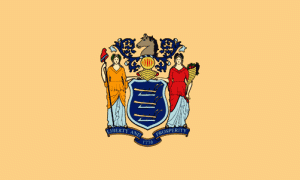
New Jersey Flag

Joint Resolution to Define the State Flag

  1. BE IT RESOLVED by the Senate and General Assembly of the State of New Jersey: The State flag shall be of buff color, having in the center thereof the arms of the State properly emblazoned thereon.
  2. The State flag shall be the headquarters flag for the Governor as Commander-in-Chief, but shall not supersede distinctive flags which are or may hereafter be prescribed for different arms of military or naval service of this State.
  3. This act shall take effect immediately.

In 1965, a law was passed that defines the specific shades of Jersey blue and buff. If you use the Cable color system developed by The Color Association of the United States, Jersey blue is Cable #70087, and buff is Cable #65015.

The flag itself is buff colored and has the state coat of arms in the center, which is where you find the Jersey blue color. The shield has three plows with a horse’s head above it. The two women on the shield represent the goddesses of Liberty and Prosperity which is the state motto. The ribbon on the bottom reads Liberty and Prosperity and includes the year of independence 1776.

Flag of New Hampshire

The flag of New Hampshire was officially adopted in 1909. Prior to that time period, the state of New Hampshire had a number of regimental flags to represent the state. The flag has been modified only once since its adoption in 1909 when the state’s seal was modified in 1931.

Flag of New Hampshire

The body of the New Hampshire flag is blue. Upon the center of the flag rests the state’s seal with the frigate Raleigh. These are surrounded by laurel leaves and nine stars. The frigate Raleigh is tipped on the flag to appear as though it’s floating on water. The nine stars represent New Hampshire as the ninth state to enter the union.

New Hampshire Statutes state, “The state flag shall be of the following color and design: The body or field shall be blue and shall bear upon its center in suitable proportion and colors a representation of the state seal. The seal shall be surrounded by a wreath of laurel leaves with nine stars interspersed. When used for military purposes the flag shall conform to the regulations of the United States.”

In a 2001 survey of members of the North American Vexillological Association, the New Hampshire state flag design was ranked as one of the ten worst flags within the United States, Canadian provinces, or select nations. In 2003, at least one elected official has suggested replacing the state seal in the center of the flag; however, no official action has ever been taken on that proposal.

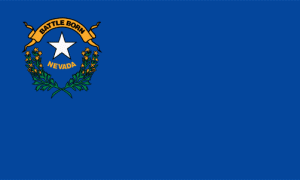
Nevada State Flag

by Sherri Smith

Nevada has been associated with, more or less, four “official” flags with the current design having been made the official in 1991. The current design is very similar to the design adopted in 1929; however, it fixes some errors that were not caught until 60 years later.

Nevada State Flag

During the 1929 session of the Nevada State Legislature, a bill was introduced that repealed the 1915 flag and officially adopted the “Schellbach” design. This bill went through the state senate; however, it was held up in the Assembly because the flag did not include the state name. The Senate and the Assembly could not agree on the placement of the name and a conference committee was designed and a compromise was worked out.

On March 26, 1929, the bill adopting the “Schellbach” flag was signed by then Governor Balzar. However, the bill that was signed by the Governor was not the version that contained the amendment agreed upon by the Senate and the Assembly. This error was discovered by legislative researcher Dana Bennett in 1989 and was confirmed by the State Archives and Records Administrator Guy Rocha.

Senator William Raggio introduced the bill in 1991 to correct the problem. After the Senate and Assembly hearings on the subject, the legislature voted to correct all of the shortcomings of the 1929 flag legislation.

Nevada Revised Statutes state: “The official flag of the State of Nevada is hereby created. The body of the flag must be of solid cobalt blue. On the field in the upper left quarter thereof must be two sprays of sagebrush with the stems crossed at the bottom to form a half wreath. Within the sprays must be a five-pointed silver star with one point up. The word “Nevada” must also be inscribed below the star and above the sprays, in a semicircular pattern with the letters spaced apart in equal increments, in the same style of letters as the words “Battle Born.” Above the wreath, and touching the tips thereof, must be a scroll bearing the words “Battle Born.” The scroll and the word “Nevada” must be golden-yellow. The lettering on the scroll must be black-colored sans serif gothic capital letters.”

Iowa State Flag

On first glance, the Iowa State Flag looks strikingly similar to the design of the French Flag. The background of the Iowa State Flag consists of three stripes of blue, white and red – exactly the same as the design of the Flag of France. However, there is one defining feature that makes the Iowa Flag different from all others – the image of an eagle placed directly in the center.

Iowa State Flag

The design of the Iowa Flag was actually intended to appear very similar to the French Flag. The blue, white and red stripes on the flag are representative of the fact that Iowa was originally part of the French Louisiana Territory.

Unlike the French Flag, the white stripe in the center of the Iowa flag is actually much wider than the other two stripes. Directly in the center sits the image of a bald eagle, one of the symbols of the United States of America. The eagle is holding a banner in its mouth, containing the words “Our liberties we prize and our rights we will maintain”, which is taken directly from the Great Seal of the State of Iowa. The word IOWA is printed in red, directly below the image of the eagle on the flag.

The Flag of Iowa was originally approved in May 1917; however, it was not officially adopted as the state banner until a few years later in 1921. It was first approved by the Iowa State Council for Defense. Just as with many other state flags, the Iowa Flag owes its roots to the Daughters of the American Revolution. The Iowa State Flag was originally designed and created by a Knoxville resident named Mrs. Dixie Cornell Gebhardt, a member of the organization. The Iowa State Flag truly does show deep rooted ties to not only America, but to its original governing country, France, as well.

Kentucky Flag

The Flag of Kentucky was originally adopted in 1918 and was finalized in its present form in 1928. The flag is a relatively simple design; it is made up of little more than the seal of Kentucky placed upon a field of blue. Unbeknown to most, Kentucky is not officially classified as a state in the United States of America. Kentucky is a commonwealth, just as is Pennsylvania, Virginia and Massachusetts.

Kentucky Flag

The Flag of Kentucky was originally designed by an art teacher named Jesse Cox who resided in Frakfort, Kentucky. In the center of Mr. Cox’s flag is the seal of the Commonwealth of Kentucky. Depicted in the Commonwealth’s seal are two men who appear to be shaking hands. By most accounts, the man on the left of the seal is meant to be Daniel Boone, who was most responsible for exploring Kentucky. On the right stands who is believed to be Henry Clay, Kentucky’s most famous statesman. Officially, however, the seal is meant to symbolize all frontiersmen and statesmen, rather than anyone specific. Encircling the two men on the seal are the words “United We Stand, Divided We Fall”, with “United We Stand” positioned on top and “Divided We Fall” on the bottom. These words are derived from “The Liberty Song”, which was a popular patriotic song during the American Revolution.

Dan Boone

Around the entire seal on the Kentucky Flag sit the words “Commonwealth of Kentucky” on top, along with a peculiar design on the bottom. At first glance, the design at the bottom looks utterly meaningless, but it does indeed have a bit of symbolism attached. The design is meant to represent the Goldenrod, the state flower of the state of Kentucky. The Kentucky Flag was officially recognized as the state’s flag on March 26, 1918 by the Kentucky General Assembly.

Maryland State Flag

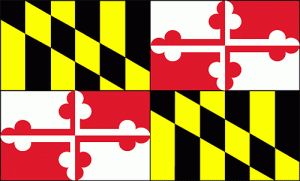
The Maryland Flag was voted one of the top 10 flags in all of the United States and Canada by the North American Vexillogical Association in 2001. The flag was originally flown in 1880, however, it was not officially adopted until much later on March 9, 1904. The Maryland Flag is the only flag of any state in the United States of America to be based upon British Heraldry, as it is based upon the banner of George Calvert, 1st Baron Baltimore.

Maryland State Flag

The Marylang Flag is split up into four quadrants, with two sets of designs. The black and gold design on the flag is based upon the coat of arms of the Calvert family. The banner was originally given to George Calvert in reward for storming a castle in battle. In the black and gold design of the Maryland Flag, a few vertical bars can be noticed – representative of the bars of the palisade from Calvert’s battle.

George Calvert

The red and white design on the Maryland flag is actually another depiction of a coat of arms – it represents the coat of arms of the Crossland family. The Crossland family was the family of George Calvert’s mother, and since his mother was an heiress, Calvert was allowed to use both coats of arms in his banner.

The current flag of Maryland was originally flown on October 11, 1880 at a celebration marking the 150th anniversary of the founding of the city of Baltimore. The Maryland Flag was not however officially adopted as the state’s flag until some 24 years later in 1904. One interesting note about the Maryland Flag is that the state of Maryland is the only flag that has specific guidelines not only about the flag itself, but also guidelines as to how the flagpole should look as well.

Kansas State Flag

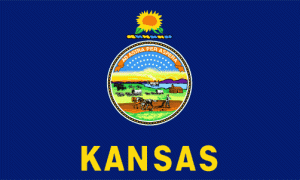
The Flag of Kansas was originally adopted in 1927, and contains one of the most interesting, yet simple designs of any American state flag. The Kansas Flag is made up of a depiction of the Great Seal of Kansas emblazoned atop a blue background, with the image of a sunflower above and the name of the state positioned directly below.

Kansas State Flag

The Kansas Flag was originally designed in the year 1925; however, it would not be officially adopted until two years later in 1927 by the Kansas State Legislature. In the two years between the flag’s design and its adoption, the state of Kansas flew a state banner rather than a flag.

At that time, the Kansas State Banner depicted a design very similar to today’s Kansas State Flag. The Kansas State Banner consisted of the image of a large sunflower and the word “Kansas” placed atop a blue field. Interestingly enough, the Kansas State Banner was originally intended to be hung from a horizontal bar instead of a traditional flag pole. The Kansas State Banner was given a very unique design that was meant to avoid “competition” with the flag of the United States of America. However, the banner was actually rejected for display in Washington, DC, due in part to the flag’s awkward method of hanging.

It was during this time that the Kansas State Legislature began the creation of a new flag for the state. Shortly thereafter, the legislature adopted today’s Kansas Flag, which features many of the same features as the original banner as well as the word “Kansas” on the bottom. Also, the Great Seal of the State of Kansas was added to the center of the flag. Since its original creation, the Flag of Kansas has remained the same, except for the addition of the word “Kansas” in 1961.

Indiana State Flag

The Flag of Indiana was originally designed and created by a man named Paul Hadley. The flag was officially adopted on May 31st, 1917 and interestingly enough, the Indiana Flag has remained completely unchanged ever since.

Indiana State Flag

The design of the flag is a bit peculiar- the Indiana Flag is very much unlike any other flag in the American Union.  The flag depicts a torch burning, emblazoned atop a blue background.  Around the torch are a number of stars – 13 in the outer ring of stars, and 19 stars in total.  The outer ring of stars on the Indiana Flag is meant to symbolize of course the 13 original American Colonies.  There are a total of 19 stars on the entire flag, which is representative of the idea that Indiana was the 19th state to enter into the United States of America.  There are also a number of rays projecting from the torch, which were originally intended to symbolize Indiana’s far-reaching influence.  The torch itself is meant to symbolize liberty and enlightenment, and placed directly about the torch sits the name of the state, “INDIANA”.

The Flag of Indiana was originally created in large part due to the celebration of the state’s centennial anniversary, when the Indiana General Assembly issued a resolution to create and adopt a state flag.  Until this time, the state of Indiana did not yet have a flag to call its own.  A contest was adopted and sponsored by the Daughers of the American Revolution, at the request of the Indiana lawmakers.  More than two hundred submissions were received for consideration by the Daughters, and upon further examination, Paul Hadley’s flag was chosen to be the winner.  The flag of Indiana was officially adopted the very next year by the state’s lawmakers on May 31, 1917.

Illinois State Flag

by Stacey Patrick

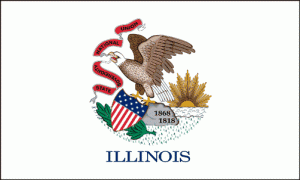
The Illinois Flag was originally designed by Lucy Derwint in 1912, and it consists of a very simple yet straightforward design. The background of the flag is solid white, and placed directly in the center, just as with many other state flags, sits the Great Seal of Illinois.

Illinois State Flag

The Illinois Flag was designed in the year 1912; however, it did not actually become the official state flag until a few years later in 1915. The flag was originally created in response to a contest held by the Daughters of the American Revolution. The contest was intended, of course, to have participants create potential designs for the Illinois Flag, a state that up until that time did not officially have its own banner.

The Great Seal of Illinois, which is emblazoned upon the flag,  features an eagle perched upon a rock holding a banner with the words “State Sovereignty” and “National Union”. The words “State Sovereignty” are placed below “National Union”, and interestingly enough, the word “Sovereignty” is intentionally written backwards, making it more difficult to read. Below the eagle on the seal sit the words “Aug. 26th 1818”, which marks the day that the first constitution was adopted in the state.

Farm Road in Illinois

The eagle is perched upon a grey rock, and on the rock appear two very important dates in Illinois history. The years “1818” and “1868” are displayed on the rock. In 1818, Illinois officially became a state, while 1868 marks the year that the Great Seal of Illinois was originally created. The name of the state, “ILLINOIS” sits directly beneath the Great Seal of Illinois on the flag. The flag of Illinois was finally passed through the House and Senate of Illinois on July 6, 1915.

Maine Flag

The Flag of Maine was originally created and approved in the year 1909. Since then, the flag has remained completely unchanged. The flag consists of an interesting design, made up of little more than the Maine Coat of Arms placed upon a blue background. The exact colors for the Coat of Arms have never been specified; however, the blue background has officially been determined to be the same blue as on the US flag.

Maine Flag

Interestingly enough, the state of Maine was actually and enclave of Massachusetts until the year 1820. As a result of Maine’s sudden growth in population, it became the 23rd state in on March 15th, 1820, due in part to the Missouri Compromise.

In the center of the Maine Flag sit the Maine Coat of Arms. The coat of arms is a peculiar design. On the left of the coat of arms stands a farmer, resting on a scythe. On the right sits a seaman, resting on an anchor. Above the two men sits a star (the North Star) along with the word “DIRIGO”. Dirigo (I lead), is the official state motto of Maine. Below the entire design, just as with many other state flags, sits the name of the state – “MAINE”, written in bold large letters.

At first glance, the flag of Maine doesn’t appear to have any major defining characteristics that make it stand out from other flags. Due to the plainness in design of the Maine Flag, the flag was actually voted one of the worst designs of any flag in North America by the North American Vexillogical Association in 2001. Out of 72 flags surveyed in Canada and the United States, the Maine Flag was voted 13th worst.