Summer Banner Flags

Are you having a summer party this season?  Or do you need a bold way to show Dad you care on Father’s Day?  Or just wanting to celebrate summer? Then you need a Summer Banner Flag from the U.S. Flag Store!  All Summer Banner flags are made of high-quality polyester and feature either appliquéd or embroidered designs.  Flags are popular sellers in the summer and retail stores sell flags like these for up to $30.  Luckily, you can find flags at the Flag Store for as low as $17.95!

If you’re having a party, check out the Flag Store’s new Aloha Banner Flag.  Shaped like a Hawaiian shirt, this flag even has a floral lei on top!  If wine is your specialty, the Flag Store even has a Wine Banner Flag featuring a bottle of wine, a glass, and big purple grapes for only $17.95.  The Flag store also has a festive Pool Party Flag, complete with an image of a swimming pool, diving board, sailboat, beach ball, and sandals.

Need a Father’s Day gift?  Try a Father’s Day Banner Flag!  The new Best Dad Banner Flag features a power drill, screw driver, and other tools and says “Best Dad Lives Here” across the top and bottom.  What better way to show your dad he’s appreciated!  For younger kids, check out the “Beary Special Dad” Banner Flag, featuring poppa bear and baby bear and plenty of big red hearts.

If you just need a way to celebrate summer, the Flag Store has you covered, with plenty of Summer Banner flags.  Designs include all things summer: bugs, bees, butterflies, strawberries, flowers, fish, and much more.  And if you’d just rather be fishing, then you need to order the Flag Store’s “I’d Rather Be Fishing” Banner Flag, complete with a big-mouth fish!
Flag of Japan

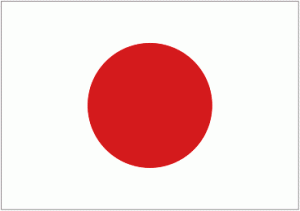
The flag of Japan is simple, but rich with historical and social significance. Japan’s national flag is a white rectangle with a large red circle or disk in the center.  The official name for the flag is Nisshoki, or sun mark flag in Japanese; however, the flag is commonly known as HInomaru, or simply, sun disk.

In 1870, two proclamations by the Daijo-kan, the governing body of the Meiji Era, provided a design for the national flag of Japan. On February 27, 1870, the flag was adopted as the national flag for merchant ships; on October 27, 1870, the flag was adopted as the national flag for the Navy.

The red sun disk has been used for centuries on daimyos and samurai flags.  Using this historical and social connotation, the government of the Meiji Era in the nineteenth and twentieth centuries exploited this image by using it in the armed forces, on propaganda posters, in textbooks, and in films as an emblem of patriotism and national pride.  Japanese citizens were required by law to display the flag on national holidays and any other government-mandated occasion.  After World War II, the American military occupying Japan restricted the flag’s use.

Due to its exploitation in propaganda schemes, the Japanese flag has differing connotations. Although many Japanese feel strongly about the flag’s use, viewing it as a symbol of a strong nation, to others, the flag is a reminder of extreme nationalism.  Use of the flag is a sensitive, unresolved topic in schools and arguments about the flag’s presence have caused protests and lawsuits.

Arguments about the flag’s presence came to the forefront in 1999, when a Hiroshima school principal committed suicide because he could not resolve a disagreement between teachers and his school board about the flag’s use.  Following this incident, the Japanese government passed The Law Regarding the National Flag and National Anthem, officially recognizing the Hinomaru as the national flag of Japan.

Flag of Denmark

The flag of Denmark was adopted in the fourteenth century and its origins trace back to 1219. Officially called the Dannebrog, this flag is the oldest state flag in the world that is still used by an independent nation.  The flag is a red rectangle with a white cross, with the vertical part of the cross close to the hoisting side of the flag.  Following Denmark’s adoption of the Dannebrog, other Nordic countries and regions, including Sweden, Norway, Finland, Iceland, the Faroe Islands, Shetland, and Orkney, adopted the Scandinavian cross design.

Besides being the oldest state flag in the world, Denmark’s flag has an exciting legend behind it.  The Danes were at Battle of Lyndanisse (also known as the Battle of Valdemar), in Estonia on June 15, 1219.  The Danes were losing the battle and about to surrender, when the Dannebrog allegedly fell from the heavens.  The king caught the flag before it could reach the ground, waved it before the troops, and led them to victory.  According to this legend, God gave the flag to the Danes, and the flag remains a sign of a strong and resilient Denmark.

Although there is no historical evidence to support this legend, several written sources from as early as the 16th century tell the tale, and it is widely accepted as the legend behind the Danish flag.

Despite the legend, the earliest literary records of the Dannebrog’s use date back to only to the late fourteenth century.  The Dutch armorial, the Wapenboek Gelre in Dutch, links the red flag with a white cross to a Danish King and includes a picture of a helmet, the Dutch coat of arms, and the Danish flag.  A near-identical image has also been found in a 15th-century coat of arms book to further support the Dutch flag’s origins.

U.S. Flag

Probably one of the most recognized flags in the world, the flag of the United States was officially adopted in 1777, just two years after the U.S. declared independence. The flag is a rectangular shape and has thirteen horizontal stripes, alternating red and white colors, representing the thirteen original colonies that rebelled against the British monarchy in 1775.  The blue rectangle in the upper left corner contains fifty white, five-pointed stars, representing the fifty states.

When the U.S. flag was first created in 1777, it contained thirteen stars instead of the current fifty, representing the thirteen states that existed at the time. Most historians agree that Congressman Francis Hopkinson designed the flag, although popular historical tells us that the Philadelphia seamstress Betsy Ross made the first flag.

In January 1794, a new version of the flag was created with fifteen stripes and fifteen stars.  As the United States of America continued to grow and include more and more states, President Monroe signed the Act of April 4, 1818, mandating that the U.S. flag have the original thirteen stripes and that, on the fourth of July following the admission of a new state, a new star be added to the flag.  The fifty-star version of the flag was officially adopted in the Executive Order of President Eisenhower on August 21, 1959.

The flag has gone by many names, including the Stars and Stripes, the Old Glory, and The Star Spangled Banner.

The U.S. flag is flown at full staff on New Year’s Day (January 1), Martin Luther King Jr. Day (the third Monday in January), the Presidential Inauguration Day (January 20 every four years), Lincoln’s Birthday (February 12), Presidents’ Day (third Monday in February), Armed Forces Day (third Saturday in May), Memorial Day (last Monday in May; the flag is flown at half-staff until noon), Flag Day (June 14), Independence Day (July 4), Labor Day (first Monday in September), Constitution Day (September 17), Columbus Day (second Monday in October), Navy Day (October 27), Veterans Day (November 11), and Thanksgiving (fourth Thursday in November).

The flag is flown at half-staff on Peace Officers Memorial Day (May 15), Memorial Day (until noon), Korean War Veterans Day (July 27), Patriot Day (September 11), Fire Prevention Week (only the first day; first Sunday in October), and National Pearl Harbor Remembrance Day (December 7).

Flag of Nepal

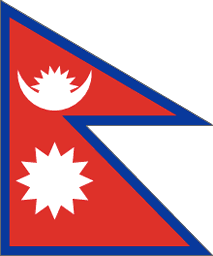
The Nepal flag became official on December 16, 1962. The flag is an odd shape: it’s the only national flag in the world that is not a square or rectangle.  The left side of the flag is straight and there are two points on the right side, almost like two right triangles on top of one another.
The flag’s blue border stands for peace.  The red background of the flag is the same color as Nepal’s national flower, the rhododendron.

There are two white pictures inside the Nepal flag: one a crescent moon, representing the royal house, and the other a sun, members of the Rana family who served as prime ministers of Nepal until 1961.  Today, however, the sun and the moon are also said to symbolize the hope that Nepal will last as long as these two aspects of nature.

In the Hindu religion, however, the Nepalese flag has much deeper meaning.  Both the sun and the moon and the red and the blue colors on the flag create a balance.  The sun, a symbol of fire, provides heat necessary for life, creating nourishment for all living beings.  The sun is linked to ancient Vedic rituals, the twelve months, and the twelve zodiac signs. The moon, in turn, is the symbol of Elixir, which is believed to give eternal life.

In many religions, including Hinduism, rituals are performed with lunar cycles.  Many Hindus see the sun as the center of the planets in our solar system and the moon as the center of the asteroids; similarly, they view the sun as a symbol of the soul and the moon as a symbol of the heart.

The colors in the flag also create a balance.  The red symbolizes closeness and heat, while the blue symbolizes distance and coolness.  Red signifies fire and blood, and the blue creates balance by signifying the sky and sea.  Many Hindus think of red as a color of bravery, love, energy, and good luck, and they think of blue as a color of wisdom, peace, and calmness.

Flag of Pakistan

The flag of Pakistan was adopted on August 14, 1947, the same day that Pakistan declared its independence. It is a rectangular shape divided into two sections: one smaller vertical white section and a larger green section with a white crescent moon and star. The founder of Pakistan, Quaid-i-Azam Muhammad Ali Jinnah designed the flag.

The green area of the flag represents the Muslim majority and the smaller white section represents other religious minorities residing in Pakistan.  The green and white color combination also symbolizes peace and affluence.  The crescent moon signifies progress while the five-pointed star represents light and wisdom.  The flag represents Pakistan’s dedication to the Islamic faith but also the rights of religious minorities.

The flag of Pakistan is flown on five specific days throughout the year as well as on any other government order.  The flag is flown at full mast on Pakistan Day, the anniversary of the adoption of the Lahore Resolution in 1940 and the declaration of the Islamic Republic in 1956.

On April 21, the flag is flown at half-mast, marking the anniversary of the death of Muhammad Iqbal, Pakistan’s national poet, in 1938.  The flag flies at full-mast on Pakistan’s Independence Day, August 14.  On September 11, the flag is flown at half-mast, marking the anniversary of the death of Muhammad Ali Jinnah, the founder of Pakistan and the flag’s designer.  Also commemorating Muhammad Ali Jinnah, the flag is flown at full-mast on December 25, marking the founder’s birthday.

Pakistan holds the world record for producing the largest flag.  At the Pakistan National Stadium in Karachi in August 2004, Pakistanis unveiled a 173,400 square foot national flag.

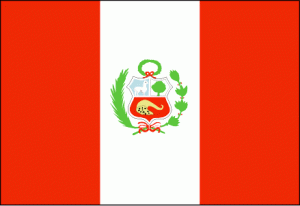
Flag of Peru

The flag of Peru was officially adopted on February 25, 1825. The flag is divided into three vertical sections: two red sections on the left and right sides and a white center section with the coat of arms in the center.  The colors of the flag were chosen by Jose de San Martin, “The Liberator,” and also symbolize the Incas and their influence on Peru’s culture.

This flag is the state flag or national ensign, and is only used by state institutions during ceremonies.  Peruvian citizens may use the national flag of Peru or civil flag, which contains only the red and white vertical stripes and does not feature the coat of arms.

The coat of arms is divided into thirds and contains pictures of a llama, a cinchona tree, and a cornucopia.  The llama is a common pack animal in Peru with deep cultural significance.  Before Incans resided in Peru, the Moche people would often offer llamas and llama body parts as offerings for the afterlife in burials of important people.  During the Incan empire, llamas served as both pack and herding animals, and they continued to be buried with the dead.  The Incan god Urcuchillay was also depicted as a multicolored llama.

The cinchona tree is native to Peru and is used for many medical remedies including treating malaria, killing parasites, relieving pain and fever, regulating heartbeat, and killing bacteria and fungi.  The cornucopia universally symbolizes abundance.

During the flag raising, Peruvians sing the Marcha de Banderas, or March of Flags, written in 1897 by Jose Salas Libornio.  The lyrics are as follows:

Long live, long live, long live Peru
and to its glorious immortal ensign
always carried aloft
the national flag.

They carry it with glory and honor,
Peruvian heroes with invincible ardor.
Up, up whenever the national flag.

This is the flag of Peru,
of white and red,
as a flame of love,
in Ayacucho and Junín
it dawned victorious with the
sun of Liberty.

Support Our Troops Flags

The United States Flag Store’s Support Our Troops Flags, Pins, and Magnets are the perfect way to support our troops, whether or not you have a family member or friend serving in the Armed Forces. All of the Flag Store’s Support Our Troops flags are 3 feet by 5 feet and made from superknit polyester, giving the flag a silky look without compromising durability, and include two brass grommets for easy hanging.  Flags are made exclusively for the Online Stores, Inc. Flag Store and may be hung inside our outside.

If you’re looking for a simple way to express your support for the troops, the Flag Store has several flags to meet your needs.  The Yellow Ribbon Flag features the yellow remembrance ribbon printed on a white background.  These flags sell for just $9.95 and are as low as $7.95 when bought in bulk: a perfect idea for a neighborhood support rally!

The Flag Store also features Support Our Troops Flags with the yellow remembrance ribbon on a blue backdrop in three versions.  All three flags have the text: “Support Our Troops” and list each branch of the armed forces.  One version features the United States bald eagle as well.  Each of these flags are only $11.95 and are as low as $8.95 when bought in larger quantities.

If you want to show your support for a family member serving in the war in Iraq or Afghanistan, the Flag Store sells traditional Service Flags manufactured in the United States from wool blends.  At an unbeatable price of $18.95, flags can have up to five stars and include a wooden dowel, wood gilt spear caps, a chainette tassel, a suction cup, and a pamphlet about the service flag.  You can also customize these Service Flags to include the name of your relative serving in the armed forces.  Certain rules apply to displaying service flags and they can only be used to honor immediate family members on active or reserve duty.

The Flag Store also offers a wide variety of magnets and pins to show your support for the troops on your car, refrigerator, or clothing.  At prices as low as 90 cents, order a few for you and your family members or friends today!

Major League Baseball Flags, Banners, and Pennants

Baseball season is in full swing and The United States Flag Store and what better way to show your home team allegiance with a Major League Baseball flag, banner, or pennant. All flags, banners, and pennants are officially licensed, made of durable high quality material, and are sold at prices that can’t be beat!  Flags, banners, and pennants look great hanging on a wall or window in your house, apartment, or dorm room, outside from your front porch, or in your backyard garden.

The United States Flag Store’s 3ft-by-5ft Major League Baseball Flags are a great way to boldly show your support for your favorite baseball team. The flags are made from durable 100% polyester and are vibrantly colored to withstand outdoor weather conditions.  Hang these flags on a wall for indoor decoration or outside on a flagpole.  You could even take them to the baseball game and drape it over the stands.  Flags are made in the United States and are sold at the unbeatable price of $26.95.  Featuring 31 Major League Baseball teams, these flags would make a great Father’s Day gift.

The Flag Store’s Major League Baseball banner flags are fantastic because they feature sewn, not printed, logos.  Banner flags are 28 inches by 44 inches, hang vertically, and are made from durable 100% nylon.  The team logo is appliquéd, creating a truly authentic, classy look.  The Flag Store features 32 Major League Baseball teams so you’re sure to find your favorite team to support.  At a price of $28.99 each, these flags are a great way to show your team spirit.

Major League Ball yard and wall pennant flags are the classic way to show your baseball spirit.  The Flag Store sells fourteen different Major League Baseball team’s pennants, each measuring 14 inches by 34 inches and made from 420 Denier Nylon, a durable, weather-resistant material.  At only $12.95 each, don’t hesitate to display your team spirit on your wall, in a window, or with a garden flagpole in your yard.

We’ve Got Temporary Tattoos – Enough Said!

Patriotic Temporary Tattoos!

If you’re like me, you hate permanence. I mean, who wants to do anything that’s permanent? Take getting married, for instance—strictly for the birds. That’s why I nearly hit the roof when I found out that my employer, the U.S. Flag Store, sells temporary tattoos! Temporary tattoos are by far one of the coolest inventions ever, especially if you’re a child or enjoy acting like one!

Some of our most popular temporary tattoos are those featuring the American flag. These temporary tattoos are easy to apply, last for days and can be easily removed whenever you’re ready. They’re also safe for children, so don’t be afraid to pass them around to the little ones. We also offer a set of temporary tattoos that are perfect for the 4th of July, which is just around the corner. These Patriotic Temporary Body Tattoos come in a set of 24, are easily applied with a bit of water and a wet towel, and are just all around cool! Check them out!

Temporary tattoos from countries besides the United States are also available. Our Mexican Flag Temporary Tattoos are very popular, and the Canadian Flag Temporary Tattoos are equally awesome!

If you or someone you know is in the military, we’ve also got military temporary tattoos! Is daddy in the Marine Corps? Why not give his son a U.S. Marines Temporary Tattoo? Maybe the little guy’s big brother just joined the Navy. Why not hook him up with a U.S. Navy Temporary Tattoo? Did mom just enlist in the Air Force? Well, the best thing you could give her child is a brand new U.S. Air Force Temporary Tattoo!

Other temporary tattoos offered by the U.S. Flag Store include those featuring the pirate skull and bones, the Texas flag, and the 1st Navy Jack! Don’t miss out on a great opportunity to score some great temporary tattoos! Order today!