American Flag Care and Disposal

by Kristi Ries

People buy new American flags for various reasons: to honor a loved one, to show patriotism, in observance of a national holiday or to replace an older flag that has grown worn by years of use. Yet many Americans may not be aware of existing “flag protocol” – that is, how to properly dispose of a flag.

Because of its inherent symbolism, the U.S. flag carries special meaning and should be treated accordingly. Flags should never be defaced or be allowed to become tattered, faded or dirty. Once this occurs, the time has come to retire the flag in a respectful manner. The U.S. Flag Code states, “The flag, when it is in such condition that it is no longer a fitting emblem for display, should be destroyed in a dignified way, preferably by burning”.
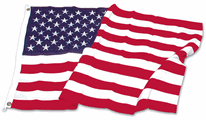
Many organizations, such as veterans associations, the Boy Scouts and Girl Scouts of America, and other patriotic organizations are equipped to perform flag retirement ceremonies. Turning over your discarded flag to one of these groups ensures a fitting final tribute to your symbol of patriotism.

A few tips on flag selection and maintenance:

Many consumers seek out all-weather flags that are specifically created to withstand prolonged exposure to sunlight, wind and rain. This is recommended for those who wish to fly the flag outdoors, as in some areas pollution as well as inclement weather conditions will affect the fabric. If you live in an area of extreme weather (high winds) or plan to fly the flag daily, pay attention to the material used to construct the flag. These flags will often be more expensive than those created for indoor purposes or more infrequent display outside.

To help make your flag last longer in good condition, consider rotating flags every six months. This will cut down on any exposure to the elements and will guarantee that you always have a replacement flag on hand if one should become too damaged to display.
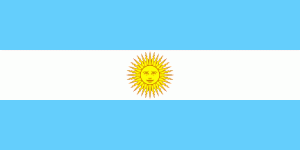
Flag of Argentina

The flag of Argentina is light blue and white and features a golden sun at its center. In Spanish, the sun is known as the Sol de Mayo (Sun of May) and is modeled after the symbol of the Incan Sun God, Inti. Before the national flag, the Sol de Mayo was used on the first Argentine coin in 1813. As for the colors of the flag, there are several theories about reasons behind them. Traditionally it is believed that a man named General Manuel Belgrano created the flag of Argentina with the colors used by the Criollos in the May Revolution of 1810. However, it is apparently more likely that the colors were based on the coat of arms of the House of Bourbon, Spain’s royal family. Other theorists believe the colors represent the sky, clouds and sun.

Flag of Argentina

Belgrano created the flag of Argentina during the Argentine War of Independence. As commanded a battle near Rosario, Argentina, Belgrano noticed that the colors of the Crown’s forces and the independence forces were the same, the yellow and red of Spain. Upon realizing this, Belgrano had the flag of Argentina created. However, Belgrano’s flag was still much different than the one used today. Instead of three horizontal stripes, it had two vertical stripes, one light blue and the other white. Belgrano’s soldiers first swore allegiance to this flag on February 27, 1812, on the Batería Libertad by the Paraná River. On that day, Belgrano is supposed to have said the following:

Soldados de la Patria, en este punto hemos tenido la gloria de vestir la escarapela nacional; en aquél (señalando la batería Independencia) nuestras armas aumentarán sus glorias. Juremos vencer a nuestros enemigos interiores y exteriores y la América del Sud será el templo de la Independencia y de la Libertad. En fe de que así lo juráis decid conmigo: ¡Viva la Patria!” Señor capitán y tropa destinada por la primera vez a la batería Independencia: id, posesionaos de ella y cumplid el juramento que acabáis de hacer.”

Which, according to Wikipedia, can be translated as:

Soldiers of the Fatherland, we have heretofore had the glory of wearing the national cockade; there (pointing to the Independence battery) shall our weapons enlarge their glory. Let us swear to defeat our enemies, internal and external, and South America will become the temple of Independence and Freedom. In testament that you so swear it, say with me: Long life to the Homeland!” (after the oath) “Lord Captain and troops chosen for the first time for the battery Independence: go, take possession of it and fulfill the oath you have just sworn”.

In Buenos Aires, the nation’s capital, the flag of Argentina was flown for the first time on August 23, 1821, atop the Saint Nicolas of Bari Church, where the Obelisco currently sits. The Argentine National Congress adopted it as its symbol on July 9, 1816, after the declaration of impendence. Since that time, the flag of Argentina has been the inspiration for the flags of other nations, such Uruguay and Paraguay.

The Bear Flag – California’s State Flag

The Bear Flag, California’s state flag, was adopted by the California State Legislature in 1911. It is white with a red stripe along the bottom and a red star in its upper left-hand corner. There’s also a California grizzly bear – a species now extinct – at the flag’s center. The bear depicted on the flag is modeled after the last wild Californian grizzly bear to be held in captivity. Named Monarch, the bear was held at Woodwards Gardens in San Francisco. After its death, it was preserved at the Academy of Sciences at Golden Gate Park.

Monarch the Bear

The original Bear Flag was flown during the 1846 Bear Flag Revolt. It was designed by a man named William L. Todd – nephew of Abraham Lincoln’s wife, Mary Todd – using blackberry juice. Todd placed the star on the flag in recognition of the California Lone Star Flag, while the bear was meant to signify strength and unyielding resistance. The flag was raised for the first time in Sonoma, California. Supposedly, when it was hoisted, native Californians were heard saying “Coche,” the common name for a pig. Apparently, Todd had not drawn a very convincing Californian grizzly bear.

The Bear Flag

The colors of which the Bear Flag consists are white, old glory red, maple sugar, seal and Irish green. The color seal is used to shade the dark grizzly bear, the tufts of dirt in the plot of grass, the border of the plot and the words “California Republic.” Old glory red is used for the star, the tongue of the bear and the red stripe at the bottom of the flag. Irish green is used for the grass upon which the grizzly bear stands, and white is used for the bear’s claws.

Chilean Flag

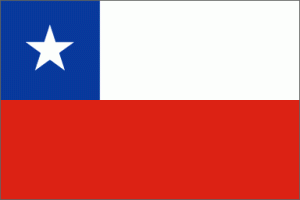
The Chilean flag is often referred to in Spanish as la estrella solitaria (the lone star) because of the fact that it bears a single, five-pointed star. The star represents a guide to honor and progress, while the field of blue that surrounds it is meant to symbolize the Chilean sky and the Pacific Ocean. The white and red portions of the flag represent the magnificent snow-covered Andes and the Chilean blood spilled during the fight for independence.

Chilean Andes

However, as is often the case, Chile’s flag has undergone a few changes over the years. In fact, the first Chilean flag looked nothing like its modern-day counterpart, as it consisted of three horizontal stripes that were blue, white and yellow respectively. This initial Chilean flag was created during the country’s struggle for independence, when the government of José Miguel Carrrera ordered that it be created. The flag was raised for the first time on July 4, 1812, at a banquet celebrating the independence of the United States. Apparently, the American Revolution had greatly influenced Chileans and motivated them in the struggle for independence.

The second Chilean flag was adopted after the triumph of Chacabuco on May 28, 1817. It was called la Bandera de la Transición (the Flag of the Transition). La Bandera de la Transición was very similar the first Chilean flag, simply replacing the yellow horizontal stripe with a red one. Juan Gregorio Las Heras is credited with designing it, but the colors themselves originate in the verses of a poet named Alonso de Ercilla. Blue, white and red were also the colors of the French Revolution, which, like the American Revolution, inspired Chileans. However, la Bandera de la Transición was never actually made official and it simply disappeared after about five months.

Chilean Flag

The disappearance of la Bandera de la Transición cleared the way for Chile’s current flag, la estrella solitaria, to be adopted. The flag itself was conceived by a man named José Ignacio Zenteno and designed by Antonio Arcos, although some Chileans claim that Gregorio de Andía y Varela actually drew it up. The flag was made official on Oct. 18, 1817, but it wasn’t until 1854 that the official proportions of each color were set, while the star’s diameter didn’t become official until 1912. Many people consider the Chilean national flag to be one of the world’s most beautiful; it’s even rumored that the Chilean flag actually won a “Most Beautiful National Flag in the World” contest in Belgium.

Afghanistan Flag

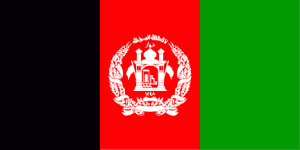
The flag of Afghanistan underwent more changes during the 20th century than any other flag in the world. By my count, the design of the flag was change some twenty times in that time period. Since 2000 it has been modified three more times. The first of these flags, flown under the rule Abdur Rahman Khan, was completely black. Today’s Afghanistan flag, on the other hand, consists of three stripes and the emblem of Afghanistan.

Afghanistan Flag

The Afghanistan flag’s colors – black, red and green – are meant to represent different chapters in the nation’s history. Black represents the 19th century, when a series of wars led to British occupation. Red represents the Afghans fight for independence, and green is meant to show that independence has been achieved. These colors were also part of the Afghanistan flag from 1928 to 1978, running either vertically or horizontally. Back then, black represented the previous monochrome version of Afghan flags, which in turn represented the sovereign. It’s believed that the red was taken from the Soviet flag and meant to represent modernity and progress. Green stood for Islam.

The emblem of Afghanistan, which is found at the center of the current design, consists of several things. At the very top of the emblem, one finds the Shahadah. The Shahadah is the Muslim declaration of belief in the oneness of God and the acceptance of Muhammad as his prophet. Depending on whom you ask, in English it more or less reads, “There is no god but God, and Muhammad is the Messenger of God.” Below the Shahadah, there’s an image of a mosque with its mihrab facing Mecca. A mihrab is a niche in the wall of a mosque that indicates the direction of the Kaaba, a cube-shaped building in the city of Mecca, and hence the direction all Muslims should pray. Two flags are also attached to the mosque, which are taken to be Afghanistan flags. Below the mosque is an Arabic inscription stating the name of the nation.

MLB Flags

The World Series is set to begin tonight with the New York Yankees squaring off against the Philadelphia Phillies in what promises to be one of the greatest Fall Classics in recent memory. The Phils are reigning world champs, their lineup is solid, and they’ve got the ace of their pitching staff, Cliff Lee, going in Game 1. In the other dugout, the Yankee lineup is equally as strong, if not more so, especially since Alex Rodriguez has started earning his pay checks by actually hitting in the post season.

Phillies Flag

With the exceptions of 1904 and 1994, the World Series has been played every year since 1903. The Yanks have won twenty-six championships in that time, while the Phils have won just two. The name “World Series” is derived from the term “World’s Championship Series,” which was used until the early 1900s. The Series is normally decided by a best-of-seven playoff, but in 1903, 1919, 1920 and 1921 the winner was determined by a best-of-nine playoff. At the end of it all, when it’s all said and done, the winners are awarded the Commissioner’s Trophy as well as World Series rings. The winning team also gets a larger portion of the gate receipt than the loser.

Yankees Flag

Whether you plan on cheering for the Yankees of Phillies this year, there’s no better way of doing so than with a beautiful MLB flag. 3’ x 5’ Yankees and Phillies flags made from 100 percent printed polyester are available at the United States Flag Store. These flags would look great inside or outside your home and make great gifts for any true baseball fan. A New York Yankees embroidered yard and wall pennant is also available. Pick yours up today, and don’t forget to watch the game tonight!

Flag of Washington, D.C.

The Flag of the District of Columbia has three red stars above two red bars with a white background. George Washington’s family coat of arms inspired the flag for Washington, D.C.. The Coat of Arms features the same three red stars above two red bars and the shield is white.

Flag of Washington, D.C.

For heraldic reasons, the stars should be called mullets. Washington D.C. was without an official flag and they flew several unofficial flags, such as the flag of the D.C. National Guard. Congress established a commission in 1938 to choose an official and original design. There was a public competition and the submission of Charles A.R. Dunn was chosen. He had first proposed his design in 1921; however, with blue stars or “mullets.”

The flag of Washington, D.C. was first flown on October 23, 1938; however, it did not have widespread usage for another 20 or so years. In 2002, the council for D.C. considered a proposal to change the flag in protest of the District’s lack of voting rights in Congress. The new design would have added the language: “Taxation Without Representation.” Additionally, it would have added the letters “D.C.” to the center star on the flag. The proposal did pass in council; however, it was never signed by then mayor Anthony A. Williams.

In a 2004 poll, the design of the Flag of Washington D.C. was voted the best design among United States city flags by members of the North American Vexillological Association. Previously in 2001, the flag had placed eighth.

Gadsden Flag: Its Place in Today’s Society

Since the horrific attacks of September 11, 2001, the Gadsden flag has been flown throughout the United States by a great number of people.

Gadsden Flag

Customs officials at US ports as well as military personnel in every part of the country hoist the Gadsden flag on a daily basis. In fact, it’s now flown on all active naval ships, and the snake from the flag’s imagery now appears on the US Army Drill Sergeant Identification Badge.

US soccer fans have also begun using the Gadsden flag to support the nation’s team. Nike even uses the image of a snake wrapped around a soccer ball for its patriotic “Don’t Tread on Me” campaign, which supports the US men’s national team.

The Free State Project presented the town manager of Killington, Vermont, with a Gadsden flag after Killington decided to pursue secession from the state. The Free State Project also customized the Gadsden flag by switching out the rattlesnake for a porcupine, which is the organization’s official mascot.

The Gadsden flag is also flown for historical reasons in places like Charleston, South Carolina, where the flag’s designer, Christopher Gadsden, first presented the flag.

Band’s such as Metallica, who put the Gadsden flag’s snake of the cover of their “Black Album”, and 311 have used the flag as inspiration. The Gadsden flag can also be seen in the film, “The Patriot”.

Most recently, the Gadsden flag has been used during the 2009 Tea Party protests.

Flag of New York

The flag of New York was adopted in 1778 and consists of a blue background, with the Great Seal of the State of New York in the center.

Flag of New York

State law from 1778 dictates exactly how the flag and Great Seal are supposed to be designed. The state motto is on the flag, “Excelsior,” meaning “Ever Upward.” The figures on each side of the seal represent Liberty and Justice.

The Laws of New York State

“STATE LAWS – Article 6 – ARMS AND GREAT SEAL OF STATE § 70. Description of the arms of the state and the state flag. The device of arms of this state, as adopted March sixteenth, seventeen hundred and seventy-eight, is hereby declared to be correctly described as follows:

Charge. Azure, in a landscape, the sun in fess, rising in splendor or, behind a range of three mountains, the middle one the highest; in base a ship and sloop under sail, passing and about to meet on a river, bordered below by a grassy shore fringed with shrubs, all proper.

Crest. On a wreath azure and or, an American eagle proper, rising to the dexter from a two-thirds of a globe terrestrial, showing the north Atlantic ocean with outlines of its shores.

Supporters. On a quasi compartment formed by the extension of the scroll.

Dexter. The figure of Liberty proper, her hair disheveled and decorated with pearls, vested azure, sandaled gules, about the waist a cincture or, fringed gules, a mantle of the last depending from the shoulders behind to the feet, in the dexter hand a staff ensigned with a Phrygian cap or, the sinister arm embowed, the hand supporting the shield at the dexter chief point, a royal crown by her sinister foot dejected.

Sinister. The figure of Justice proper, her hair disheveled and decorated with pearls, vested or, about the waist a cincture azure, fringed gules, sandaled and mantled as Liberty, bound about the eyes with a fillet proper, in the dexter hand a straight sword hilted or, erect, resting on the sinister chief point of the shield, the sinister arm embowed, holding before her her scales proper.

Motto. On a scroll below the shield argent, in sable, Excelsior.

State flag. The state flag is hereby declared to be blue, charged with the arms of the state in the colors as described in the blazon of this section.”

Flag of North Carolina

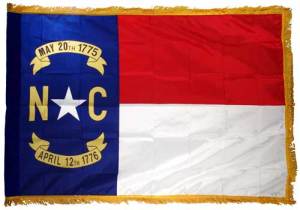
The flag of North Carolina was adopted by the state legislature in March of 1885 to replace the previous flag adopted in June of 1861. The flag of 1861 was adopted because of the state’s secession from the Union on May 20, 1861. The current flag, bears the dates of the Mecklenburg Declaration of Independence, May 20, 1775, and the Halifax Resolves, April 12, 1776, both documents are said to place North Carolina at the forefront of the American independence movement. Both of these dates also appear on the Great Seal of North Carolina.

Flag of North Carolina

The flag design of North Carolina consists of a blue union which has a white star in the center and the letter N in the gilt of the left side and the letter C in the gilt of the right side of the star. The fly portion of the flag consists of two equally proportioned bars; the upper bar is red and the lower bar is white.

Above the star in the center of the union there is a gilt scroll in a semi-circular form inscribed in black letters with May 20th, 1775, and below the star a similar scroll is present containing black letters inscribing April 12th, 1776.

North Carolina flag etiquette requires the flag to be flown on public buildings and institutions as well as at county courthouses in every courtroom.  The flag is to be brought down in cases of inclement weather and it can be flown at half-mast upon the death of any State officer or any prominent citizen.