
The flag of New Mexico was adopted in 1925 after the Daughters of the American Revolution pushed New Mexico to design a contemporary and unique flag. A contest was held and the design chosen was created by Dr. Harry Mera of Santa Fe, New Mexico. The design has a red sun symbol of the Zia on a field of yellow. The colors honor Isabella of Castile.
 The symbol has definite meaning; four is a sacred number which symbolizes the Circle of Life: four winds, four seasons, four directions, and four sacred obligations. In a 2001 survey by the North American Vexillological Association, the New Mexico flag was chosen the best designed of any US state, territory, or Canadian province.
New Mexico statute says, “New Mexico Statutes Annotated 12-3-2. [Adoption of flag for state of New Mexico.] That a flag be and the same is hereby adopted to be used on all occasions when the state is officially and publicly represented, with the privilege of use by all citizens upon such occasions as they may deem fitting and appropriate. Said flag shall be the ancient Zia sun symbol of red in the center of a field of yellow. The colors shall be the red and yellow of old Spain. The proportion of the flag shall be a width of two-thirds its length. The sun symbol shall be one-third of the length of the flag. Said symbol shall have four groups of rays set at right angles; each group shall consist of four rays, the two inner rays of the group shall be one-fifth longer than the outer rays of the group. The diameter of the circle in the center of the symbol shall be one-third of the width of the symbol. Said flag shall conform in color and design described herein.”
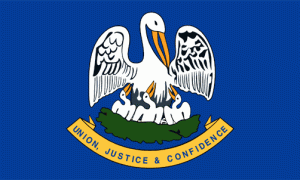 The image in the center of the Louisiana Flag is commonly referred to as a “pelican in her piety”. It depicts a mother pelican intentionally wounding herself in order to feed her babies with her own blood. On the
 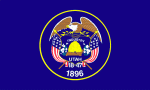 The seal is the focus of the flag and is an integral part of the design of the flag. The great seal is described in Utah Code Annotated, 1953, Volume 7a, section 67-2-9 as follows:
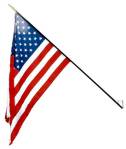 In classrooms throughout the United States,
  On Sunday evening, like two little children looking through a toy catalog and circling things we want for Christmas, my husband and I grabbed the latest issue of sports illustrated (which has a great breakdown of what players they think will be the top performers this year) and headed into the living room for kickoff.
 Flags have come a long way and represent various things such as states, countries, sport teams, military units, religious symbols and much more. In addition to great variety, flags are now available in various sizes. One of my favorite items is the
 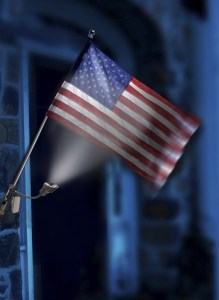 Proud Americans will often show their stubborn respect for this nation’s history by displaying that flag in his or her own home. But sometimes, that’s just not enough. If you look at a US flag posted outside a government building, you’ll notice that the flag is lit up, even at night.
 The flag was previously the flag of the Irish Free State and it was adopted in 1919 unilaterally during the war of independence by the Irish Republic. Subsequently, the Irish Free State also adopted the flag and later it was given constitutional status in 1937 by the Constitution of Ireland. Many nationalists feel the flag is the national flag of Ireland and as such is flown (controversially) in Northern Ireland by nationalists and the Gaelic Athletic Association.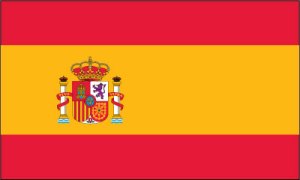

 Flag Blog