History of the POW/MIA Flag

As Memorial Day nears, Americans all across the country are encouraged to remember America’s fallen heroes, both within our borders and abroad. This past week, we join many other Americans in the mourning of Newt Heisley – the original designer of the POW/MIA Flag, who passed away on May 14th, 2009. Mr. Heisley’s POW/MIA flag is arguably the 2nd most popular flag in all of America behind none other than the Stars and Stripes herself.

Newt HeisleyIn his early years, Newt Heisley was a pilot in the South Pacific Theater during World War II. During the Vietnam War, however, Mr. Heisley became a professional art director at Annin and Company, the country’s largest flag manufacturer. In 1971 he was asked to create a flag for the National League of Families of American Prisoners and Missing in Southeast Asia. Heisley, as he himself was a veteran of the South Pacific Theater of World War II, had a personal concern for the many who served in the Vietnam War.

The design for Newt Heisley’s POW/MIA flag shows a silhouette of a soldier’s head in the foreground, with a watchtower and a guard surrounded by an intimidating barbed wire fence behind. Mr. Heisley’s design was reportedly inspired by his own son Jeffery, who at the time had been training with the United States Marine Corps to fight in Vietnam.

Jeffery Heisley never even made it out of training; he immediately became very ill during his training at the Marine Corps base in Quantico, Virginia. Jeffery was reportedly diagnosed with hepatitis – a disease that ravaged his body, completely emaciating his face and body structure.

When Jeffery returned home, medically discharged and unable to continue in the United States Marine Corps, his father Newt looked on in horror at what had once been a strong and able young man. Then, as Newt Heisley looked closer at his son’s haggard features, he began to imagine what life must be like for those prisoners being held behind barbed wire fences on foreign shores. Slowly, he began to sketch the profile of his son, working in pencil to create the now familiar black and white silhouette of the POW/MIA flag.
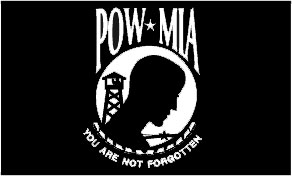
POW MIA Flag

Perhaps the most symbolic part of the entire POW/MIA flag — more important than just the sketch of a distraught and malnourished prisoner, and more meaningful than the intimidation of the barbed wire background — are the words emblazoned in bold white letters across the bottom of the flag.

You Are Not Forgotten“, the flag boldly exclaims – and it is this statement, profound in its simplicity, that epitomizes the very heart and soul of the American people.  This short 4 word sentence characterizes the American people’s unending love and appreciation for all those who have chosen to sacrifice their lives so that we may live – and live well at that – in the best country this world has ever known.

–Tommy McLaughlin

Alabama Flag

Most historians believe that the Alabama Flag was originally designed to resemble the blue saltire of the Confederate Battle Flag. The Battle Flag was square-shaped, and often times, the Alabama flag is displayed as a square as well.

Alabama Flag

Interestingly enough, there is a long standing debate as to the proper shape of the Alabama Flag. The legislation that originally created the Alabama state flag never actually specified if the flag was meant to be square or rectangular.

According to the authors of a 1917 article in National Geographic, the Alabama flag should be square, as it was originally meant to be based upon the Confederate Battle Flag. In 1987, however, the office of Alabama Attorney General Don Siegelman issued a differing opinion. Attorney General Siegelman concluded that the proper shape of the Alabama flag should be rectangular, just as it had been depicted numerous times in official publications.

Unbeknownst to most, the saltire design of the Alabama flag bears a striking resemblance to several other flags. The Alabama flag is actually identical to the flag of Saint Patrick, which has since been incorporated into the Union Flag of the UK. Also, some historians believe that the Alabama flag owes its origins to a simplification of the Cross of Burgundy Flag. This flag was used by the Spanish in the New Spain, and also was the basis of many military flags.

Alabama 7th Cavalry Flag
Alabama 7th Cavalry Brigade Flag

Another remote, but possible inspiration for the Alabama flag was that of the flag carried by The Alabama 7th Cavalry. The regiment was the only Alabama regiment in Rucker’s Brigade that was commanded by Col. Edmund Rucker of Tennessee, who would later command troops in Alabama as well. The brigade flag consisted of a white background with a red saltire that was decorated with 13 bluish-green stars upon it. This flag was meant to be used as Col. Rucker’s Color Guard. It is currently held as part of the Alabama Civil War Period Flag Collection by the Alabama Department of Archives and History.

For more information about the Alabama flag, be sure to check out www.united-states-flag.com for the lowest prices and latest flag news information anywhere!

POW MIA Flag

“You are Not Forgotten”

During the early 1970’s, after friends and families of MIAs and POWs in Vietnam plowed the ground and sowed the seeds, a popular movement took hold in the grass roots of the American landscape.

Seemingly lost among the war protests of the time, prisoners of war and those missing in action went uncounted and unremembered—but only by the general public.

Their friends and families had not forgotten them and launched an effort to remind the broader American public that whatever one’s opinion about the Vietnam Conflict, these men existed, every day paying the price to prevent the spread of communism; or maybe in reality, they were simply paying the price for being drafted and seduced into what many deemed an imperialist conflict in a little country thousands of miles from home.

POW MIA Flag
The National League of Families of American Prisoners and Missing in Southeast Asia formed as a result of their families’ anguish, and soon, a flag was commissioned. Mrs. Michael Hoff, wife of a soldier missing in action, contacted a flag company who then contacted advertising executive Newton Heisley, a veteran of World War II and the father of Jeffery Heisley who had served in the Marines but had been sent home from a Corp training program, gaunt and emaciated, with hepatitis.

It is his silhouette that graces the black and white flag designed by his father and that has flown since 1971. We have known it as the nation’s officially recognized POW/MIA Flag since 1990 when U.S. Public Law 101-355 passed. It is the only flag that flies continuously in the United States Capitol’s rotunda, and it is also the only flag other than the Stars and Stripes that has ever flown over the White House.

Today, the POW/MIA Flag represents all of the more than 89,000 post-WWII missing soldiers, and all who fly it remain committed to the remembrance and full accounting of all soldiers still missing in action.

–Carol Frome

Top 500 Internet Retailer Award

Online Stores, Inc. Ranked Among America’s Top 500 Internet Retailers

New Stanton, PA May 12, 2009 – Online Stores, Inc. announced today that they have again been included amongst America’s top 500 internet retailers in the Internet Retailer Top 500 Guide. 2009 will be Online Stores, Inc.’s third year on the prestigious list; the company has received the award annually since 2007.

See the full press release here

The Mexican Flag

The Mexican flag represents an ancient history that travels forward through time into modern day sensibilities—and one of the biggest cities in the world, Mexico City,  is home to just shy of twenty-three million inhabitants.

Mexican Flag

Adopted in 1968, today’s Mexican flag is the descendant of earlier, similar versions that have been around since 1821, when Mexico won independence from Spain after an eleven-year struggle. Mexican-born Spainards, Mestizos, and Amerindians were among the rebels who fought for independence, but it is the Amerindians, the Aztecs, a culture dating from the early 1100’s, who gave Mexico its primary patriotic symbol, a pictogram of a snake-eating eagle.
Mexican Coat of ArmsAmong the Aztecs, one northern culture, the Mexica (pronounced me-shee-ka), embodied the Tenochca tribe. Tenochca culture included human sacrifice, and eventually other tribes banded together in an attempt to crush them. The survivors eventually fled. Aztec legend says that their war god, Huitzilopochtli, directed them to found a new city where they would find an eagle sitting on a prickly pear cactus, eating a serpent. Somewhere between 1300 and 1375, on a swampy island at the center of three lakes, they espied the sought-after lunching eagle and so settled and built the city Tenochtitlan, now Mexico City.
First, then, a symbol of Aztec culture, the fearsome coat of arms now represents all of Mexico and figures prominently in the Mexican flag, positioned on a central white vertical band with a green band on the hoist side and red band on the fly side.

In 1821, the green portion of the Mexican flag signified independence, white the Catholic faith, and red the union of North Americans and Europeans. But during the mid-1800’s (a period of secularization), the colors’ meanings were reassigned, with green representing hope, white representing unity, and red the blood of national heroes.

When the Mexican flag is displayed, civilian Mexicans stand at attention with their right arm placed in a salute over their chests, just under the heart, with the palm facing downward. A military salute is used by the armed forces. When the Mexican president presides over military functions, he too, uses the military salute, but on civil occasions, he uses the civil salute. With its fascinating history, the Mexican Flag is a flag that honors both a country and a rich heritage.

–Carol Frome

The Tricolor French Flag

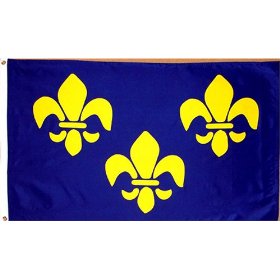
Over the centuries, since long before Charlemagne, France has flown many flags. Typically, when conjuring up an image of the French Flag, we think of the Fleurs-dis-Lis- three gold lilies on a blue shield. However, the ‘drapeau tricolore’ or ‘drapeau bleu-blanc-rouge’ is now the official French flag.

Fleur De Lys
Fleur De Lys

With its vertical blue, white, and red bands, the Tricolor French Flag was adopted in 1790, after the French Revolution of 1789, and then made the official flag by the French National Convention on February 15, 1794. But it has not represented the country without disruption.

Under the Tricolor French Flag, Napoleon I led France through war and battle after battle until the nation dominated parts of North Africa and most of the western world. Then in 1814, the Bourbon’s re-seized power and all symbols of the revolution were replaced with those of the Bourbons. After intrigues and betrayal, the July Revolution of 1830, put King Louis-Philippe on the throne, who resurrected the ‘drapeau tricolore’.

French Flag
The order of the colors has sometimes changed, and explanations for the colors vary. Blue and red are the traditional colors of the arms of Paris, and, ironically, white is color of the Bourbon dynasty. The blue is sometimes referred to as strong blue, or, again ironically, as King’s blue.

Its simple design, with the blue band at the hoist, followed by two more equal-sized bands, one of white, then a red “fly” (the outer band), is said to represent the common people, a reaction to the monarchy and the elaborate royal coats of arms found on pre-revolutionary flags. The revolutionary motto, liberté, égalité, fraternité , or liberty, equality and brotherhood, is closely associated with the Tricolor French Flag.

According to Whitney Smith, flag scholar and founder of the Flag Research Center in Winchester Massachusetts, the Tricolor French Flag “has no specific symbolism attached to the individual colors and shapes in its design” and that all symbolism was attached to it in retrospect. Yet, speculation abounds.

Sometimes the colors are thought to be influenced by those of the American Revolution, and also by Holland, but there are other explanations. With France being traditionally Catholic, blue is said to be the color of Saint Martin, a Gallo-Roman officer who ripped his blue cloak with his sword to give one half of it to a poor cold beggar. Red is the color of Saint Denis, the patron saint of Paris, and white, in this manner of thinking, represents the Virgin Mary.

Prime Minister Jean-Pierre Raffarin (2002-2005) consistently and poetically referred to the colors as “the blue of our history, the white of our hopes, and the red of the blood of our ancestors”. As influenced as it may be by ideas and idealism, the Tricolor is equally influential, with post-colonial and post-revolutionary countries all over world either using either the blue, white, and red, or the Tricolor French Flag‘s banded style to represent freedom from tyranny.

–Carol Frome

The Lion Rampant

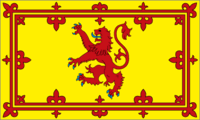
In addition to the national flag of Scotland, known as the Flag of St. Andrew (or the Saltire), a second flag of Scotland exists. It flies over Balmoral Castle and Holyrood Palace, but only when the monarch is not in residence: The Royal Standard of Scotland is also known as the Lion Rampant.

On a gold field and framed by a red double tressure flory counter-flory, the red lion rampant with its blue tongue and claws is aggressively confrontational on its hind legs, one of them also appearing to rise with forelegs extended, ready to strike.

Lion Rampant
According to a register in the College of Arms in London, King William I of Scotland, the Kyng of Scotz (1165-1214), first introduced the fearsome figure to his battle standard and coat of arms. Interestingly, he and some of his descendants may possibly have been accompanied by a real lion while in residence at the castles Stirling and Edinburgh, for indeed, both have buildings within the castle walls that are called “the Lion’s Den”.

As well as adopting the Lion Rampant as the royal coat of arms, it was incorporated into the Great Seal of Scotland and used on all official documents. As the personal banner of the Crown, its use is restricted under a 1672 act of Parliament, The Lyon King of Arms Act. It may be used lawfully only by the monarch, by the Royal Regiment, on state occasions, and by a handful of the monarch’s official representatives.

Lion Rampant Flying
Since then, however, a Royal Warrant has been issued allowing it to be used, under certain circumstances, as a token of loyalty to the Crown. When official Scots teams are playing, hand-held banners fill the stands at soccer matches. It may also be hung from private homes and businesses. But there are limits. Even today, unlawfully using the Royal Coat of Arms can result in heavy fines: in 1978, linen merchant Denis Pamphilon was fined £100 daily until he stopped using the standard on decorative bedspreads.

The Royal Coat of Arms, as it was designed, is associated with the latin motto “Nemo me impune lacessit,” which means “no one attacks me with impunity.” In Scots, it reads, “Wha daur meddle wi’ me?” The Lion Rampant is an ancient and enduring symbol of bravery, valor, strength, and loyalty, and a banner as meaningful to Scots today as it was in the twelfth century.

–Carol Frome

History of the Flag of Scotland

The official flag of Scotland, also called the Saltire, is believed to be one of the oldest national flags in the world, dating back to the 12th century. It is composed of a white cross on a vivid blue field. The word “saltire”, is in fact, a reference to an “X” shaped Christian cross, in this case, specifically to the one on which St. Andrew is said to have been crucified by the Romans.

Flag of Scotland

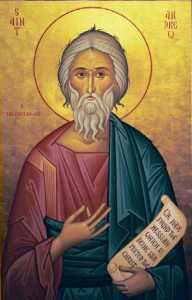
St. Andrew is believed by Christians to be one of the original apostles and the brother of Simon Peter. He is also the patron saint of Scotland. Hence the flag of Scotland is also referred to as the Cross of St. Andrew.

Saint Andrew
Saint Andrew

St. Andrew is connected to Scotland through legends surrounding the travels of bits and pieces of his remains, also known as “relics”. Two different stories forge a link between St. Andrew and Scotland. One says that the relics were carried to Scotland by Acca, the Bishop of Hexham, in the year 733.

In the other, more colorful story, about 300 years after his crucifixion, St. Andrew’s remains were moved to Constantinople by Constantine the Great. Sometime later, a monk, known as St. Rule (or St. Regulus) dreamed that he should remove the remains and take them to the ends of the earth for safekeeping. He did so by pillaging the body, taking a kneecap, a tooth, an arm bone, a tooth and some fingers. It is believed that he shipwrecked and came ashore on the east coast of Scotland, and so it is that the relics became associated with Scotland.

In another story, the Saltire was conceived in the year 832 when battling Scots at Athelstaneford saw what they believed to be a favorable sign—clouds collected in the X-shape of the cross that St. Andrew had been crucified on, against the blue sky. They won the battle, and flew the flag of St. Andrew forever afterward.

The Union Jack, the flag of Great Britain, is comprised of symbols from the flag of England, the flag of Ireland, and the flag of Scotland: the Saltire.

–Carol Frome

SEEKING: Bloggers for Flag Blog

Do you have an interest in flags? Do you enjoy writing?

Seeking Bloggers

You are in luck! We are seeking talented bloggers to write for the Flag Blog, a partner site of the United States Flag Store (http://www.united-states-flag.com)!

All writers, if selected, will be generously compensated for their time and efforts – and what’s better than getting paid to write about something you love anyways?

If you are interested, email us today with the following information:

  • Name and e-mail address.
  • Why are you interested in this position?
  • Do you have experience blogging?

The Gadsden Flag: Symbol of Freedom

Today American taxpayers in more than 300 locations in all 50 states will hold rallies – dubbed “tea parties” – to protest higher taxes and out-of-control government spending. And the banner uniting all of these concerned Americans? Well, the Gadsden Flag of course!

The Gadsden Flag has traditionally been seen as a symbol of American patriotism.  The traditional imagery associated with the Gadsden Flag was first seen in the year 1775.  The Second Continental Congress had just authorized the first Gadsden Flagever mission for the new American Navy, and among the first marines to enlist during this time were men from Philadephia.  These marines are best known for carrying their symbolic yellow drums depicting a coiled rattlesnake with 13 rattles, with “Don’t Tread On Me” being their now famous motto.

It is commonly believed that the flag itself had been inspired by these symbolic drum-carrying Marines from Philadelphia, with Continental Colonel Christopher Gadsden of South Carolina as its creator.  At the second Continental Congress, Gadsden submitted his flag to then commander in chief of the Navy Esek Hopkins, and the rest was history!

The Gadsden Flag is still flown in Charleston, South Carolina – the city where Chrisopher Gadsden first presented the flag.  It was flown in the wake of the September 11th attacks, most notably by US Customs officials and harbor patrol boats in US ports.  The Gadsden Flag is also commonly flown by many Boy Scouts troops, and has even been featured in a few movies and television shows, most notably in the 2000 film The PatriotBut now, the Gadsden Flag is prepared to take on its new role — as the banner of the Tax Day Tea Party rallies popping up all over America.

According to The Wall Street Journal,

“The protests began with bloggers in Seattle, Wash., who organized a demonstration on Feb. 16. As word of this spread, rallies in Denver and Mesa, Ariz., were quickly organized for the next day. Then came CNBC talker Rick Santelli’s Feb. 19 “rant heard round the world” in which he called for a “Chicago tea party” on July Fourth. The tea-party moniker stuck, but angry taxpayers weren’t willing to wait until July. Soon, tea-party protests were appearing in one city after another, drawing at first hundreds, and then thousands, to marches in cities from Orlando to Kansas City to Cincinnati.”

Tax Day Tea Party

There are currently between 300 and 500 protests planned to occur in various cities around the world today, and there is sure to be a tea party near you.  For more information or for tea party locations, be sure to check out www.taxdayteaparty.com

If you’re planning on attending one of the many Tax Day Tea Parties across the country, or if you already have, feel free to drop off a comment and let us know how it went!