
The first Icelandic flag has its roots in the mid-14th century when Iceland’s coat of arms included a silver stockfish with a gold crown. Iceland had no real need for a flag until 1809, when a British sea captain from Denmark, Jörgen Jörgensen usurped Iceland and declared himself king. In doing this, he announced Iceland’s first flag, a blue banner with three stockfish in the upper left corner. Jörgensen was arrested shortly after doing this, but it wasn’t until 1870 that an Icelandic artist, Sigurdur Gudmundsson, created a new flag with still the same blue background, but this time with a silver falcon in the center.

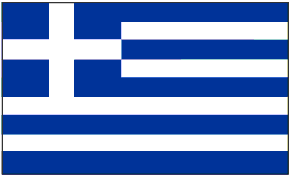
The earliest version of the Icelandic flag as we know it today was created by Icelandic poet Einar Benediktsson in 1897. In a newspaper article, he claimed that the falcon flag needed to be replaced because it didn’t follow international traditions. His version of the flag featured a darker blue background with a large white cross. The King of Iceland at the time didn’t approve of this flag, however, claiming it was too similar to the Greek flag. The blue and white flag continued to be used unofficially until June 12, 1913, when Einar Petursson was arrested after rowing a boat and flying a small blue and white Icelandic flag around the Reykjavik harbor. Icelanders were outraged by the incident and began flying the blue and white flags everwhere.
This incident prompted a meeting to create an Icelandic flag that would be officially adopted. Although the parliament wanted the blue flag with the white cross, Danish authorities that were ruling Iceland at the time, would not allow this due to its similarities to the Green flag. The committee decided on an official flag containing a blue background with a red cross bordered in white on June 19, 1915. The King of Iceland officially accepted the flag on November 30, 1918, just one day before Iceland became a separate kingdom from Denmark.
The flag of Iceland as we know it today was adopted on June 17, 1944 when Iceland became a republic. It is the same as the early 20th-century flag, only the shade of blue is slightly darker. Iceland has strict rules about when and how its flag can be flown, including that the flag is not to be flown before 7:00AM and should be flown until after sunset but not beyond midnight. The flag is always fully drawn on the President of Iceland’s birthday, New Year’s Day, Easter, the first day of Summer, May 1, Pentecost, Sailor’s Day, June 17, December 1, and Christmas.


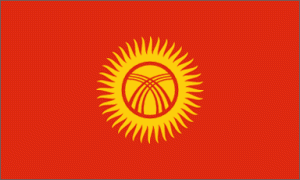
 The 2010 FIFA World Cup will be getting under way in less time than you think. It’s scheduled to start on June 11, and whether you’re planning to cheer for the good old U.S. of A. or some other country, a good way of showing your support is by wearing a classy, patriotic patch or pin from the
  Of course, flags for each of the countries taking part in the 2010 World Cup are also available. There’s no better way to let the entire neighborhood know where you stand than hanging a beautiful
 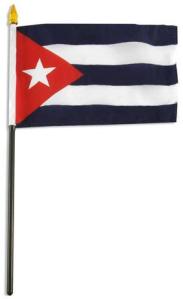 The flag of Cuba was officially adopted on May 20, 1902, when the United States granted the island, which it had seized control of during the Spanish-American War, its independence. The flag of Cuba’s origins however go back much further than 1902.
 The color green is meant to signify the Libyan people’s devotion to Islam, the state religion. Green is also the national color of Libya and is symbolic of the “Green Revolution” of
  The earliest known drawing of a
  The tulips are beginning to shoot up, grass is getting greener, birds are chirping and the sunshine seems to be permeating the world these days. Yes, spring is almost upon us, and with that comes all of the great things we look forward to at this time of year: warmer weather, beautiful blossoms and the Easter holiday!
 Flag Blog