NFL Flags

by Crystal Hammersley

There’s always a special feeling in the air around this of the year. It’s a feeling of excitement, anxiousness, and thrill of competition. Why? Because this past Sunday was the first NFL pre-season game, which means that the regular football season is only a few more weeks away!

Steelers Garden FlagOn Sunday evening, like two little children looking through a toy catalog and circling things we want for Christmas, my husband and I grabbed the latest issue of sports illustrated (which has a great breakdown of what players they think will be the top performers this year) and headed into the living room for kickoff.

We watched to see who looks good, who doesn’t, and what rookies look promising, all in an attempt to decide who we should draft for our fantasy football teams this year.

Living near Pittsburgh and being a Steelers fan is great. Just going to the grocery store to pick up dinner, I pass numerous displays of Steelers mugs, windows stickers, hats, jerseys and tons of other Steelers merchandise.

My Husband, however, is a San Francisco 49ers fan. Being over 2,000 miles away from his favorite team’s city means not only does he rarely ever get to watch them play, but we also never see his team’s merchandise in stores. We have to rely on shopping over the internet to help him support his team.

The United States Flag Store has a lot of great NFL products, including these new NFL flags. I couldn’t help myself and bought 2 of them, one for each of our teams, since I’ve never seen these in stores. The flags look great hanging on our wall, and are a great addition to my husband’s NFL hard hat and the other 49ers memorabilia he has on display. We’re also considering getting the garden flags for our front yard!

Whether your team is the face of your town or all the way across the country, you should check out these unique NFL items. You should especially take a minute to check out the tailgating flagpole which allows you to fly your flag during tailgate parties! They make great gifts too!

Garden Flags

by Ed Horne

If you’re anything like me, when someone says the word “flag”, you automatically think of the American flag with its beautiful fifty stars and red and white strips. Well, if that’s true, it’s time we both started thinking outside the box!

Fall FlagFlags have come a long way and represent various things such as states, countries, sport teams, military units, religious symbols and much more. In addition to great variety, flags are now available in various sizes. One of my favorite items is the garden flag because it’s relatively small – they’re usually in the range of 12” x 18”. I find that their smaller size also makes them more affordable, which means I can purchase more flags for my money! Garden flags, like traditional flags, are available in a variety of themes. It has never been easier to show my support for my favorite football team (Go Steelers!) or to celebrate when all the neighborhood kids return to school. Soon, it will be time to pull out my Fall flags – at my house we love pumpkins and Halloween – and start decorating for the season! Another great garden flag feature is that the flags hang on an attractive garden pole, which I can pick up and move to any location in my garden. The flags are easy to swap out and are easy to store.

If you aren’t the type of person who likes these “miniature” flags, many of the same themes are available in a larger decorative banner style. Banners are typically 28” x 40” in size and are slightly more expensive than garden flags. Still bold and beautiful, these flags are hung using a flag pole kit which includes a bracket that mounts to the side of your home. These decorative flags are the perfect size to celebrate any occasion.

If you don’t already have a flag collection of your own there is no better time to start one! With Summer coming to a close, new Fall and back to school flags are sure to be in high demand.

The Montana State Flag

The Flag of Montana was adopted in 1905 and the word “Montana” was added in 1981. In 1985, the flag was modified again to specify the font used for “Montana.” Prior to its use as the state flag, it was used by Montana troops deploying to the Spanish/American War.

Montana State Flag
Montana State Flag

The flag has a dark blue background/ensign with a seal in the middle of the flag. The seal has a plow, shovel, and pick rest in a field in front of the Great Falls of the Missouri River. The ribbon on the seal contains the state motto, “Oro y Plata” (Gold and Silver). The flag can have a gold fringe on the top and bottom edges. The seal represents some of Montana’s beautiful scenery and reflects the pioneering history of the state. The tools represent Montana’s mining and farming both in the past and present.

The following information was excerpted from the Montana Code Annotated 2005, Title 1, Chapter 1, Part 5.

TITLE 1. GENERAL LAWS AND DEFINITIONS.
CHAPTER 1. GENERAL PROVISIONS.
Part 5. State Symbols — Official Designations.

1-1-502. State flag. There is hereby established a state flag of Montana. The state flag of Montana shall be a flag having a blue field with a representation of the great seal of the state in the center and with golden fringe along the upper and lower borders of the flag; the same being the flag borne by the 1st Montana Infantry, U.S.V., in the Spanish-American War, with the exception of the device, “1st Montana Infantry, U.S.V.”; and above the great seal of the state shall be the word “MONTANA” in helvetica bold letters of gold color equal in height to one-tenth of the total vertical measurement of the blue field.

Jamaican Flag

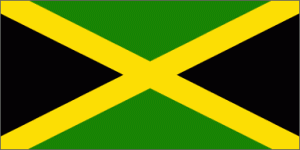
The Jamaican flag was adopted on August 6, 1962, the original Jamaican Independence Day. It was then that Jamaica gained its independence from the British-protected Federation of the West Indies.

Jamaican Flag
Jamaican Flag

The flag features a diagonal cross which divides the flag into four sections, two of which are green and two of which are black. The black is said to symbolize the strength and creativity of the people, which has allowed them to overcome great obstacles. The yellow stands for sunshine and Jamaica’s natural wealth. The green is for the lush and rich vegetation of the island. This current design was the result of a national competition where ideas were sent in from the public. These colors are all Pan-African colors and are used to pay tribute to Jamaica’s significant African heritage.

Jamaican flag etiquette requires that primary flag etiquette be used. It should always be the primary flag flown and in good condition. The Jamaican government provides the following etiquette:

Code for use of the Jamaican Flag
• The Jamaican flag should never be allowed to touch the ground or floor. It should not be flown or used only for decorative purposes on anything that is for temporary use and is likely to be discarded, except on state occasions.
• The flag should never be smaller than any other flag flown at the same time.
• When the flag becomes worn and must be replaced, burn it.
• Do not place any other flag above or to the right of the Jamaican flag, except at foreign embassies, consulates and missions.
• Do not raise any foreign flag publicly, unless the Jamaican flag is also flown, except at foreign embassies, consulates and missions.
• The flag shouldn’t be draped over vehicles, except on military, police and state occasions.”

The Venezuelan Flag

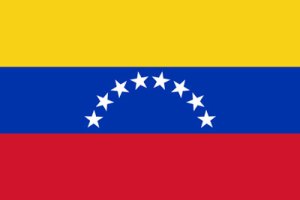
The Flag of Venezuela was officially adopted on March 12, 2006; however, it dates back to 1811 and the nation’s struggle for independence. The design includes a horizontal tricolor of yellow, blue, and red. Modifications added a set of stars, changed the placement of the stars, and the number of stars, as well as adding an optional coat of arms in the upper-left corner.

Venezuelan Flag
Venezuelan Flag

The flag is pretty much one that was designed by Francisco de Miranda. His flag was also the inspiration for the flags of Columbia and Ecuador. The original design was first flown on March 12, 1806 in Jacmel, Haiti during the final leg of Miranda’s voyage to Venezuela. The flag was first flown on Venezuelan soil on August 3, 1806 at Ka Vela de Coro.  Until August 3, 2006, Flag Day was celebrated on March 12. Since then, it has been celebrated on August 3rd.

Traditionally, the color yellow represents wealth of the land, the blue is for courage, and the red is for independence from Spain. The stars represent colonial provinces of Barcelona, Barinas, Caracas, Cumana, Margarita, Merida, Trujillo, and Guayana.

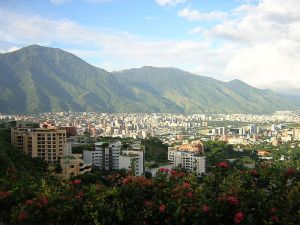
Caracas, Venezuela
Caracas, Venezuela

In 1954, the Law of the National Flag, Coat of Arms, and Anthem added the Coat of Arms to the flag. The coat was not incorporated into the Civil or Maritime Flag as they are intended for non-governmental purposes. The flag is to be flown every day by legally registered public institutions from 7:00 am to 6:00 pm.

First American Flag on Mount Everest

by Catie Watson

The year 1963 was one of the most significant in American history, marked by the assassination of President Kennedy and Dr. Martin Luther King’s I Have a Dream speech. It was also in 1963 that an American climber first reached the summit of Mount Everest and placed an American flag there.

Mt. Everest
Mt. Everest

In May of 1963, the National Geographic Society sponsored an expedition to Everest and asked Barry Bishop to serve as photographer for the team.  Bishop was an experienced mountaineer, geographer and photographer.  An American mountaineer named Jim Whittaker was the first American member of the team to reach the summit of Mount Everest, where he planted an American flag.  A few weeks later, Bishop ascended to the peak with his climbing partner Lute Jerstad and took a now-famous photo of the U.S. flag planted by Jim Whittaker.  The spot where the photo was taken is still known as Barry Bishop ledge.

On the descent, Bishop and Jerstad fell into a crevasse but were rescued by other members of the expedition.  Bishop suffered frostbite and subsequently lost all of his toes.  In July of 1963, President Kennedy presented Whittaker, Bishop and the rest of the team with the National Geographic Society’s highest award, the Hubbard Medal.  In 1994, Barry Bishop’s son Brent also ascended Everest, making the Bishops the first father and son to have both climbed to the top of Mount Everest.

Barry Bishop tragically died in an auto accident that same year.  Jim Whittaker went on to become CEO of REI and is currently Chairman of the Board of Magellan Navigation.

Dominican Republic Flag

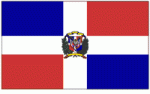
Article 96 of the Dominican Constitution describes the flag of the Dominican Republic. It features a white cross centered on the flag that extends to the edges and divides the flag into four rectangles; the top left and right bottom are blue and the top right and bottom left are red.

Dominican Republic Flag

Found at the center of the Dominican Flag is the small coat or arms. It has four Dominican flags, a bible, a cross of gold, and two spears. There’s also an olive branch on one side and a palm on the other. The ribbon above the shield reads “Dios, Patria, Libertad,” which means “God, Fatherland, Liberty.” Below the shield is a red ribbon bearing the name of the country, “Republica Dominicana.”

The bible on the shield is open to John 8:32 which reads, “Y la verdad nos hará libre” (And the truth shall set us free.)

The blue on the flag represents liberty. The white on the flag embodies salvation. And the red on the flag stands for the blood of its heroes.

The civil ensign follows the same design; however, it does not include the charge in the center. On land and on sea the civil flag doesn’t carry the coat of arms. Only the state flag has the coat of arms, which was adopted in 1844 and placed on the state flag for distinction.

According to some historians, the Dominican Republic’s capital of Santo Domingo claims the oldest university in the New World as well as the oldest hospital, house, street, and Cathedral. Many people from all over the world come to Santo Domingo to visit the delightful city.

Oregon Flag

Oregon Flag - Front
Oregon Flag - Front
Oregon Flag - Back
Oregon Flag - Back

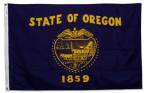
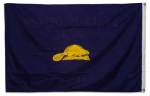
The Oregon state flag is the only one with a different picture on each side. The only countries with a two-sided flag are Paraguay and Moldova.  The reverse side (back) has a beaver, which is Oregon’s state animal. For this reason, the state is often called the Beaver State. Both sides of the flag have a field of navy blue with a gold design.  The state’s motto is “She Flies With Her Own Wings” and “The Union.”

The front picture is of a heart shaped shield with an eagle on top surrounded by thirty-three stars representing Oregon’s admission to the Union as the 33rd state. The shield depicts the sun setting over the Pacific Ocean, mountains, a covered wagon, and forests. The covered wagon represents the Oregonians who traveled on the Oregon Trail to settle the West. A plow, pickax, and wheat symbolize the farming and mining of the state. The eagle denotes the United States.

It also has a British ship leaving and an American ship arriving. This is to symbolize the transfer of the Oregon Territory from British to US control in 1846, when President Polk signed a treaty with England.

Oregon became a state in 1859; however, its current flag didn’t become official until  February, 1925. It does have STATE OF OREGON on the top of the flag and 1859 on the bottom to represent the year Oregon became a state in the union.

For parade or dress usage, gold fringe on the flag may be used; however, for standard usage no fringe is required.  Other protocols listed in state law require the flag to be flown on all public buildings during normal hours except during harsh weather.  A public building is defined as :

(a) State institutions.

(b) All other state buildings upon which the Oregon Department of Administrative Services determines it is suitable to display the Oregon State flag.

(c) County courthouses.

Washington Flag

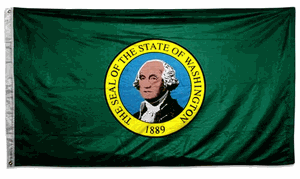
Washington State’s flag design was not officially adopted until 1923, which was more than 30 years after the state was permitted entry to the union. Until the flag was adopted and around the turn of the century, many of the cities and towns displayed a military flag that bore a gold profile of George Washington on blue bunting. There was another design used, which is similar to what is in use today, where a gold state seal was featured on a purple or green background. Displayed in the State Reception Room of the Legislative Building in the state capital of Olympia is a ceremonial banner of this type of flag.

washington flag

The Washington State Secretary of State’s website states, “According to law (RCW 1.20.010), “The official flag of the state of Washington shall be of dark green silk or bunting and shall bear in its center a reproduction of the seal of the state of Washington embroidered, printed, painted or stamped thereon. The edges of the flag may, or may not, be fringed. If a fringe is used the same shall be of gold or yellow color of the same shade as the seal. The dimensions of the flag may vary.”

When displaying the Washington flag outdoors, it should not be flown earlier than sunrise or later than sunset; however, flying the flag 24 hours a day is permitted if directly illuminated during the hours of darkness. The flag should not be flown on days of inclement weather, unless an all weather flag is used.

The Washington state flag is required to be displayed on or near the administration building of every state facility. RCW (Revised Code of Washington) 1.20.15 states, “The flag of the United States and the flag of the state shall be prominently installed, displayed and maintain in schools, court rooms, and state buildings.”

Italian Flag

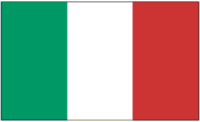
The Italian flag as it is known today was adopted January 1, 1948; however, it has been in use since June 19, 1946. Often it is referred to in Italian as Il Tricolore because of its tricolor features of three equally sized vertical pales of green, white, and red.

italian flag

Various people have ascribed particular ideals to the colors of the flag. Common interpretations have the green symbolizing the country’s plains and the hills. The white signifies the snow-capped Alps. Lastly, the red denotes the blood spilt in the Wars of Italian Independence.  A religious interpretation is that the green is for hope, the white is for faith, and the red is for charity.

The protocol for the Italian flag is written in Article 12 of the Constitution. It follows Italy’s membership of the European Union and states the general provisions governing the use and display of the flag. When the flag is displayed alongside other flags, the national flag of Italy shall take the place of honor and it should be raised first and lowered last. Other national flags are arranged in an alphabetical order.  Additional rules include that the flag should always be regarded with dignity and should never touch the ground or water.

The flag is flown from sunrise to sunset like many other country’s flags. It is not permitted to be displayed in bad weather and can only be flown at night if it is properly illuminated. A flag displayed outside can be flown at half-mast as a sign of mourning; however, other flags can have two black ribbons attached to show the sign of mourning.