
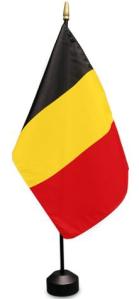
 The flag of Belgium was adopted on January 23, 1831. The flag is rectangular with three vertical stripes: a black stripe on the left, a yellow stripe in the center, and a red stripe on the right. The official ratio of the Belgian flag is 13:15 (almost square, but not quite), but due to its unusual proportions, the flag is rarely produced this way and is usually seen in a 2:3 ratio.
The colors of the Belgian flag are based on the colors of Duchy of Brabant’s coat of arms, which features a black shield and a yellow lion with red claws and a red tongue. The Duchy of Brabant was located in the historic “Low Countries,” and is now known as three present-day Belgian provinces: Flemish Brabant, Walloon Brabant, and Antwerp. The colors of the Belgian flag are the same as those in the German flag and the vertical tricolor design of the flag is most similar to that of France.
Several flags preceded the current Belgian flag. When Belgium was part of Lotharingia in the ninth century, the territory flew a rectangular flag with two horizontal red stripes, one across the top and one across the bottom, and a white area in the center. When the area came under Spanish rule in the 1500s, a yellow stripe was added to the flag. During this time period, Belgium’s official colors became red, white, and yellow.
When Belgium was under Austria’s rule in the eighteenth century, the Emperor required Belgium to fly the Austrian flag, which was red and white. Belgians were opposed to this, however, and citizens began wearing red, black, and yellow cockades, knots of colored ribbons to display national pride.
The Belgian Revolution began in August 1830 when a French flag was waved at the Brussels City Hall. Shortly after this incident, some Belgian revolutionaries created a horizontal-striped red, yellow, and black flag at a fabric store. By January of 1831, the stripes were changed to vertical and the flag was made official.
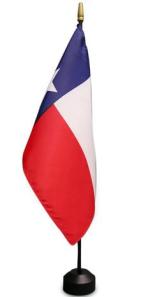 The Flag of Chile was adopted on October 18, 1817, during Chile’s battle for independence from Spain. The flag of Chile is called La Estrella Solitaria, or “The Lone Star.” The flag is divided into two horizontal regions. In the top portion, there is a blue square in the left corner with a white five-pointed star in the center. The remainder of the top half is occupied by a white stripe. The bottom half of the flag consists of a red stripe.
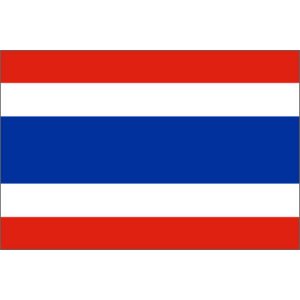 The colors of the flag represent an unofficial motto of Thailand, “nation-religion-king:” red represents the Thai nation, white represents religion, and blue represents the Thai monarchy. Some sources claim that the blue represents support of the Allies of World War I, as many other countries in the alliance had red, white, and blue flags. Thailand adopted a naval flag in 1917 in addition to the national flag, which includes a red circle in the center of the national flag. In the center of the red circle is a white elephant, a symbol of royalty. The Kingdom of Thailand has many other military flags currently in use as well, which include the colors of the Thai flag and relevant military emblems.
 The flag of Bolivia was adopted in 1851. The civil flag consists of a rectangular shape with three horizontal stripes: the top stripe is red, the middle stripe is yellow, and the bottom stripe is green. The state flag consists of the three-striped civil flag with the Bolivian coat of arms in the center.
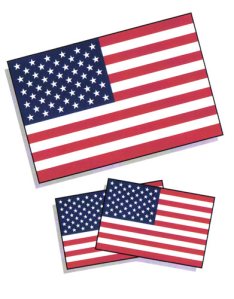 Temporary tattoos are a great and fun way to show your pride without the cost and permanence of getting the real thing! The U.S. Flag Store has a great selection of temporary tattoos that are non-toxic, safe, and fun to wear. These tattoos are easy to apply, last for several days—even with showering and swimming—and are easily removed. Most tattoo packages include 1 large version and two smaller versions of the design.
 embroidered by machine to enable for exact replication of the tiny details found on many country’s flags. All world flag patches have a vinyl backing, allowing them to be stitched or ironed on to clothing. Shield-shaped patches approximately are 3” x 2.5” and rectangular patches are 3.5” by 2.25”. Most patches are available at a low price of $2.49 each, but discounts are available for purchasing quantities of ten or more. Order your favorite patches today!
 Six Cuban revolutionaries—
 Flag Blog