The Serbian Flag

The Serbian flag, in one form or another, has been around for quite some time. The earliest known description of a Serbian flag dates from the year 1281. It comes from a list of treasures belonging to a Serbian king. The description says, “vexillum unum de zendato rubeo et blavo,” which apparently means, “a flag of fabric red and blue.” There is, however, no indication as to how the colors were patterned.

The earliest known drawing of a Serbian flag goes all the way back to the year 1339. The drawing appears on a map made by a famous Majorcan cartographer, Angelino Dulcert. According to the drawing, at that point in history, the Serbian flag featured a two-headed eagle against a yellow field.

During the time of the First Serbian Uprising, several other flags were made use of. One of these flag, featuring a cross and the colors red, white and blue, may be linked to the Serbian flag used today. Other Serbian flags flown during this time period consisted of such combinations of color as red and yellow, red, white and blue, and red and blue. The army taking part in the uprising also used light yellow flags with various symbols upon them, including a black, two-headed eagle.

Today’s Serbian flag is a tricolor made up of what are known as “Pan-Slavic” colors, which are red, blue and white. The colors are arranged in three horizontal bands of equal width. The modern Serbian State flag also features the coat of arms of Serbia, which consists of a double-headed eagle on red shield. The eagle’s wings and body are silver, while its tongues, beaks, legs and claws are golden.

The current Serbian flag was adopted as part of the new Constitution of Serbia on November 8, 2006. On that date, its usage, along with that of the coat of arms and the national anthem, became constitutionally sanctioned.
Celebrate Easter with Festive Flags!

By Kristi Ries

The tulips are beginning to shoot up, grass is getting greener, birds are chirping and the sunshine seems to be permeating the world these days. Yes, spring is almost upon us, and with that comes all of the great things we look forward to at this time of year: warmer weather, beautiful blossoms and the Easter holiday!
But it’s not quite here yet. Yes, the days are getting longer, and the college kids are already breaking out their flip-flops and tossing Frisbees. But this is a bit premature, my friends. It will still take a few weeks for the sun to work its magic on the area’s foliage. Forests are still mostly brown and though buds are showing, there’s no sign of leaves blooming anytime soon. It feels as though winter has taken a strong hold of the world and aside from a few early bees, there’s no end to it in sight.

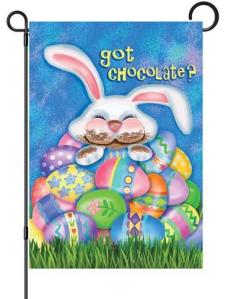
Until then, you’ll have to usher in spring on your own. Luckily, there are a few quick and easy ways to brighten up your home. Hang an Easter windsock from your porch to add some pizzazz to your favorite outdoor hangout. Or post a festive garden flag with white Easter bunnies to liven things up. (After all, you’ll be picnicking and grilling out sooner than you think!) It’s a fun and affordable way to make you’re your home is decorated inside and out. And there’s nothing like a cheerful spring chick or Easter bunny to get grown-ups and kids alike in the spirit of spring!

Maybe you have little ones who’ll be searching for their own baskets come Easter Sunday, or perhaps the grandkids are heading to your house for the annual egg hunt.

Either way, these bright, colorful Easter flags will be a fun-filled addition to your yard or garden!

The Bosnian Flag – Symbol of Peace

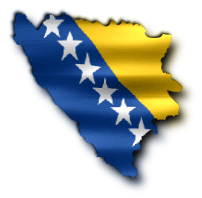
The Bosnian flag is blue with a yellow isosceles triangle. The flag also features seven full stars and two half stars along the hypotenuse of the triangle (I just like using words like isosceles and hypotenuse).

The colors of the Bosnian flag—blue, yellow and white—are usually associated with neutrality and peace throughout the world. In fact, the kings of neutrality and peace, Switzerland and Costa Rica, both feature at least one of these colors on their respective flags. The colors of the Bosnian flag may have also been inspired by those found on the flag of Europe as well as that of the United Nations.

The three points of the Bosnian flag’s isosceles triangle are thought to stand for the three constituent peoples of Bosnia and Herzegovina: the Bosniaks, the Croats, and the Serbs. The triangle is also meant to represent the map of Bosnia, which resembles a heart. Many people even call Bosnia the “Heart-Shaped Nation.”

The stars which run diagonally across the Bosnian flag represent Europe, and are meant to be infinite in number, thus continuing from top to bottom. Many people have speculated as to why the stars are infinite in number, but, much like the mystery surrounding how many licks it takes to reach the center of a Blow Pop, the world may never know—just kidding; I’m sure there’s a good reason behind the stars.

The Bosnian flag was created when the country won its independence from Yugoslavia in 1992. Before choosing the current design, other alternatives were proposed, including one which featured an olive branch. Other designs included the map of Bosnia as well as a lighter shade of blue.

Gadsden Flag T-Shirts – Don’t Tread On Me

The Gadsden flag: it’s a symbol of freedom, a sign of resistance, a warning shot fired across the bow of those that might think it fit to infringe upon the freedoms of the citizens of this great nation. It bears but few simple words, but within their meaning lie the force of a great hurricane, and all those that gaze upon it cannot help but understand its most singular message: Don’t Tread on Me. Those that carry the Gadsden flag, whether it be with their hands or in their hearts, believe in the principles upon which the United States of America was founded, and upon which she shall continue to thrive.
In light of these immutable truths, the United States Flag Store has decided to offer its customers the chance to not only own the Gadsden flag, but to wear it upon their chests as well. Created by our own team of local designers, these Gadsden flag t-shirts are available exclusively on our Website. Choose between six original designs, each one unique from the next, and which have been given such fitting names as Patriots, Guns, and Fire.

The Gadsden flag was created by Christopher Gadsden in 1775. At the time, Gadsden was taking part in the Second Continental Congress, which had just created the United States Navy to keep British ships from reaching the colonies. A small group Marines, which happened to carry yellow drums with a rattlesnake and the words “Don’t Tread on Me” painted upon them, was given the mission of accompanying the Navy on its first mission.

Whether Gadsden was inspired by the drums or in fact created them himself is the subject of some debate. However, it’s an undeniable fact that Gadsden soon presented the Navy’s commander with a flag bearing the same design, and, as the saying goes, the rest is history.

Celebrate the Gadsden and all that it stands for by picking up a Gadsden t-shirt today!

The Flag of Haiti: A Call to Action

By Kristi Ries

Unlike the country it represents, the official flag of Haiti is young, having been adopted in 1987. A tiny island country in the Western Caribbean, Haiti has existed for hundreds of years. Indigenous tribes who were later ‘discovered’ by the great Spanish explorer Christopher Columbus were the island’s first inhabitants. Following this, both Spain and France colonized what is now modern-day Haiti. Eventually, however, the island’s emerging multicultural population fought and won its independence in 1804. A new nation was born.

On the afternoon of January 12, 2010, the small nation’s history and life of its citizens was turned upside down. Haiti was struck by a magnitude-7.0 earthquake, the country’s most severe earthquake in more than two centuries. The epicenter of the quake was just off the Haitian capital Port-au-Prince. Entire communities have been leveled and countless lives have ended prematurely.

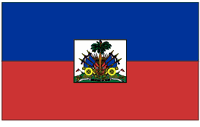
What this nation’s flag symbolizes and the feelings it evokes are what makes it so singularly powerful. It recognizes the country’s European heritage through its vibrant blue and red colors. This new design was based on a torn French Tricolore flag and features Haiti’s Coat of Arms centered in a white square.

For all who see and recognize it today, however, the flag of Haiti serves as a reminder that help is urgently needed and that a major humanitarian crisis is occurring as we go about our daily lives.

Once Americans are away from their television sets, laptops and radios, it is somehow easier to forget the overwhelming devastation to this impoverished Caribbean nation. Yet people all over the world are showing a unified front by displaying the flag of Haiti in office windows, on their cars or outside their homes. Numerous skyscrapers in major cities have been lit in the Haitian colors of blue and red to pay respect to the multitude of lives lost in the recent tragedy.

As the unbelievable destruction and rising death toll become more apparent, many organizations and individuals have come to Haiti’s aid. Displaying the Flag of Haiti is a quiet call to action; one that clearly declares ‘you are not forgotten or forsaken’ to those bereft of their homes, family, or worst of all—hope.

Visit the American Red Cross for information on donating money to Haiti.

Lapel Pins – Show Your Pride

By Kristi Ries

Does the lapel of your sport coat or blazer look a little bare these days? Have nothing to add to your school backpack or messenger bag? Maybe you could add a little decoration—and at that, one that has meaning as well—by adding a lapel pin or two. Lapel pins have become not just a subtle fashion statement, but also a fashion staple. From news anchors to sports analysts to business executives, many are showing their patriotism by wearing a US. Flag lapel pin.

You can showcase your political leanings (a donkey for Democrats, of course, and an elephant for Republicans), or pay homage to the 44th president of the United States, Barack Obama, with a commemorative pin memorializing his historical 2008 campaign and resulting win. Christians can show proud support of their religion when wearing the Christian lapel pin, which consists of a white flag with a cross symbol. Show your faith by wearing one to your next church service, outreach function, or school.
For military veterans and their families, there exists a bevy of pins, including all five areas of the armed forces: U.S. Army, U.S. Marine Corps, U.S. Air Force, U.S. Navy and U.S. Coast Guard. Troops’ family members can proudly display a Service Unity Lapel Pin, which features the U.S. Flag in the form of a ribbon and the emblematic navy blue star signifying a loved one in active service. Why not show support of your loved one who fights for our country’s freedom?
Lapel pins also serve as a sign of unity. Flag pins (as well as nearly any red, white and blue items) became extremely popular following the terrorist attacks of 911. As a loyal and proud American, your flag pin shows your allegiance to this nation and all of the values for which it stands—including liberty and justice for all.

Send a powerful message about your beliefs while adding a decorative enhancement to your wardrobe through these durable symbols of pride!

Grenada National Flag

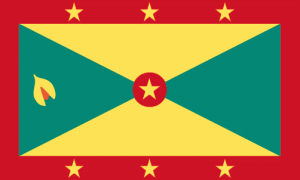
Ostensibly simple, the Grenadian National Flag carries rich historical and cultural significance within its fairly plain design. It was officially recognized in 1974 following its conception at the hands of Anthony C. George. The flag commemorates Grenada’s independence from the United Kingdom, which began in February of that year. Its color scheme and design depict the pride in that independence, and represent much that defines Grenada as a nation.

The color scheme of red, gold and green is representative of the country’s African origins. Each color stands as a symbol of something valued in Grenadian society.

Green, for instance, signifies the Grenadian land’s fertility, which brings about its vast agriculture industry and abundant plant life. Agriculture serves as Grenada’s economic driving force.

Red is indicative of the bravery, vivacity and a desire for independence that is found in the heart of each Grenadian citizen. The history of the Grenadian people is one filled with struggle, civil discord and adversity, all of which they were able to persevere, refusing to give up the hope of a unified independent nation.

Gold is the color of wisdom. It also embodies the warmth and kindness of the Grenadian people. Additionally, the gold serves to symbolize the bright sunshine of the Grenadian islands, which adds to its beauty and fertility.

The flag’s symbols hold a great deal of significance, as well. Three yellow stars align along the upper portion of the flag, while three more are found across the bottom. Collectively, they represent the nation’s six parishes; Saint Mark, Saint John, Saint George, Saint Patrick, Saint Andrew, and Saint David. They also represent the ideas and ambitions upon which the nation was founded.

Another single yellow star lies at the center of the flag, surrounded by a red circle. This star signifies the nation’s capital city of Saint George’s. This beautiful city lies on the southwestern portion of the country and sits upon a horseshoe-shaped Caribbean harbor next to a volcano crater. Despite becoming a developing tourism destination in recent years, the city still holds on to much of Grenada’s rich cultural history.

The hoist of the flag displays a clove shaped emblem. This represents a clove of nutmeg, one of the nation’s primary crops. Grenada produces the second largest amount of nutmeg in the world, and is often referred to as the “Isle of Spice.” Grenadians are proud of their reputation for agricultural distinction, and their flag displays this pride.

The Grenadian National Flag is a symbol of the strength and vitality of a people unified under the idea of independence. It flies as a tribute to a rich cultural history and a promising future of continued independence, growth and development.

Winter Decorative Flags show Holiday Spirit

By Kristi Ries

It’s that time of year again: evergreen wreaths hang on doorways, homemade cookies are baking and fireplaces are aglow all across America. There’s a chill with a scent of chimney smoke in the air, and freshly cut evergreens can be found atop minivans everywhere.

In the throes of winter, the darkest and bleakest months of the year, countless Americans venture out to adorn their lawns and houses in a festive display for the season. Neighbors crane their necks to see intricate light patterns and tall nutcracker cut-outs; elaborate decorations offer an excellent excuse for long holiday joyrides after dark to see lights, reindeer, sleighs and bright candles on a winter’s eve.

Such decorations have become a personal expression of pride in one’s home and in celebration of various religious holidays. Colorful lights and nativity displays, menorahs in windows and garland on doorways are just another way to welcome friends and loved ones to your home during this especially chilly time of year.

As people struggle to untangle last year’s Christmas lights, they might also consider another type of decoration this winter: holiday flags. You can hang a 3D Santa banner flag to honor the wonder of Old Saint Nick; a red poinsettia flower and the words “Seasons Greetings” invite all to share in the joys of the season. You can herald in the Christmas holiday with a trumpeting angel, or display banners of a Christmas tree, a jolly snowman or the Three Wise Men. Hannukah begins this Friday, December 11 at sundown, and several elegant Hannukah flags showcase a Dreidel, the Star of David and a menorah to celebrate the eight-day Festival of Light.

Easy to hang and available in a range of designs, these jubilant flags make a great statement outside your home. They’re also a great gift for your friends and family.

Once these joyous occasions have come to a close, there are still more colorful ways to brighten up the season. Snowflake flags are great all-purpose winter greetings for your snow-covered yard, and New Year’s flags are the perfect way to show you’re ready to ring in 2010! Consider adding one to the beauty and warmth of your home today.

Storm Flags Serve as Warning Signs

By Kristi Ries

Hurricane season in the Atlantic Ocean officially begins on June 1 of each year, and lasts for nearly six tumultuous months before it comes to a close. On average, over 100 tropical storms form over the Atlantic.

Due to this high rate of activity, mariners have historically depended on warning flags displayed at their harbors and Coast Guard Stations to warn of approaching ocean storm systems.
In 2007, the U.S. Coast Guard re-established a Coastal Warning Display (Storm Flag) program at selected Coast Guard boat stations throughout the U.S to warn the public of approaching storm conditions. Coast Guard stations had participated in the National Weather Service’s official Coastal Warning Display program for over 100 years, along with yacht clubs and marinas, until it was discontinued in 1989. Today, experienced boaters can easily identify the meaning of such nautical flags, whose geometric shapes and colors represent the severity of impending weather conditions.

The flags serve to warn mariners of small craft advisories, gale warnings, storm warnings and hurricane warnings. And these flags are being used more often than ever. Scientists claim that rising air and water temperatures worldwide are creating more frequent and severe hurricanes.

A hurricane is a tropical storm with winds that have reached a constant speed of at least 74 miles per hour. The eye of such a storm is vast, usually measuring 20-30 miles wide, and can envelope more than 400 miles. Dangers of a hurricane include torrential rains, high winds and storm surges that leave major destruction in their wake. At sea, hurricanes can last for 2 weeks or more and can run a path across the entire length of the United States’ Eastern Seaboard before dissipating.

In addition to hurricane flags, there are also international maritime signal flags—one for each letter of the alphabet—that mariners can use to spell out messages or can be combined to form a code word. Boating enthusiasts and Atlantic coastline dwellers can breathe a sigh of relief this year, as the 2009 hurricane season ended uneventfully on November 30 with just three storms reaching destructive hurricane status instead of the average six.

Tailgating

By Kristi Ries

Tailgating has become a time-honored tradition in the United States. For decades, sports and music fans across the country have gathered around their trucks, minivans, SUVs and RVs in parking lots outside of stadiums and concert venues. College football fans have created cities out of both empty pastures and asphalt, with makeshift barbeques and pick-up Frisbee games the order of the day.

The term ‘tailgating’ arose from the term for a truck bed’s door, or tailgate, which served as a meeting point and surface area for food and beverages. Nowadays these ‘gatherings’ can include hundreds of thousands of people, producing a veritable sea of vehicles that has become increasingly difficult to navigate. (Try to meet up with friends at a Penn State game in Happy Valley and you’ll be grateful for the 20th century invention of the cell phone.) Yet even the most clearly articulated directions yield confusion, as “third RV on the left, 12 aisles down” can become convoluted. Because of this, avid fans have discovered a new way to differentiate themselves from the masses through the use of tailgating flags.

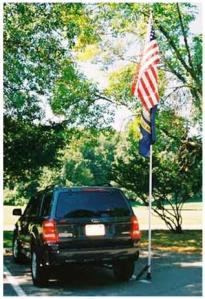
Brightly colored and typically adorned with a team logo, tailgating flags appear in a number of places. They can be placed on car windows, hung as banners from RV awnings—or, for the extremely ardent fan—flown on tailgating flagpole sets. Not only do these serve as a high-flying beacon for family and friends, but they’re also as a symbol of personal pride and commitment to a team. Telescoping pole sets tower over surrounding trucks and SUVs at 16 feet high. Using these poles, dedicated fans can fly two flags at once to showcase a university and professional team, state flag or armed forces flag, for example.

All things considered, no better way exists to show that you’re the biggest fan than to display it proudly with a several tailgating flags!