We’ve Got Temporary Tattoos – Enough Said!

Patriotic Temporary Tattoos!

If you’re like me, you hate permanence. I mean, who wants to do anything that’s permanent? Take getting married, for instance—strictly for the birds. That’s why I nearly hit the roof when I found out that my employer, the U.S. Flag Store, sells temporary tattoos! Temporary tattoos are by far one of the coolest inventions ever, especially if you’re a child or enjoy acting like one!

Some of our most popular temporary tattoos are those featuring the American flag. These temporary tattoos are easy to apply, last for days and can be easily removed whenever you’re ready. They’re also safe for children, so don’t be afraid to pass them around to the little ones. We also offer a set of temporary tattoos that are perfect for the 4th of July, which is just around the corner. These Patriotic Temporary Body Tattoos come in a set of 24, are easily applied with a bit of water and a wet towel, and are just all around cool! Check them out!

Temporary tattoos from countries besides the United States are also available. Our Mexican Flag Temporary Tattoos are very popular, and the Canadian Flag Temporary Tattoos are equally awesome!

If you or someone you know is in the military, we’ve also got military temporary tattoos! Is daddy in the Marine Corps? Why not give his son a U.S. Marines Temporary Tattoo? Maybe the little guy’s big brother just joined the Navy. Why not hook him up with a U.S. Navy Temporary Tattoo? Did mom just enlist in the Air Force? Well, the best thing you could give her child is a brand new U.S. Air Force Temporary Tattoo!

Other temporary tattoos offered by the U.S. Flag Store include those featuring the pirate skull and bones, the Texas flag, and the 1st Navy Jack! Don’t miss out on a great opportunity to score some great temporary tattoos! Order today!
Flag Patches – From America to Armenia

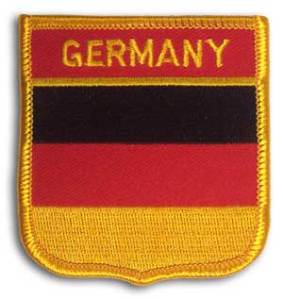
If for some reason you’re unable to fly a flag, flag patches are another great way of throwing your support behind a country. The U.S. Flag Store sells more flag patches than anyone else in the world today. We offer over 70 flag patches from such countries as Bolivia, Vietnam, India, Ireland and, of course, the good old United States of America, so no matter where you’re from, we’ve got the flag patch you’re looking for.
Putting one of our embroidered flag patches on your backpack, computer bag or coat is a great way of letting everyone know where your allegiance lies. And the flag patch doesn’t necessarily have to be from the United States. Did your family come here from the old country years ago? Why not show everyone that you embrace your European roots by using an Italian or Irish flag patch? Maybe it was Germany that your folks came from, or perhaps Poland? Wherever they came from, you’ll find any and all the flag patches you could ever need at the U.S. Flag Store.

As we all know, many of the people living in the U.S. these days are of Mexican decent. Mexico is truly one of the greatest countries on the face of the earth. Its people are kind, generous, and welcoming. Anyone that is lucky enough to say they’re Mexican should do themselves a favor and get a Mexican flag patch. Many people also come from other great places in Latin America such as El Salvador and Honduras. The U.S. Flag also has great flag patches from those countries.

The FIFA World Cup is also just around the corner. Support your team by picking up a few flag patches from the U.S. Flag Store. Flag patches are the perfect way to support your team throughout the entire tournament. I already have a patch on my coat, which is my way of the supporting the U.S. team. You should do the same. Don’t miss out!

Kyrgyzstan Flag

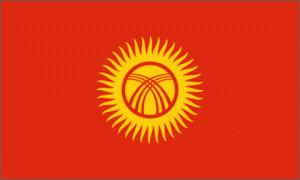
In light of the recent uprising in Kyrgyzstan, we’ve decided to supply you the public with a bit of information concerning the nation’s flag. Truth be told, the Kyrgyzstan flag is rather attractive, featuring of a glorious red field upon which is placed a brilliant yellow sun with forty uniformly spaced golden rays emanating from it.

The red background of the Kyrgyzstan flag is meant to represent bravery and valor, while the flag’s sun represents peace and wealth. The tunduk, which can be seen at the flag’s center, is a symbol replicated in much of the architecture of Kyrgyzstan and is based on the “crown” of traditional Kyrgyz yurts, or houses. On the Kyrgyzstan flag it’s meant to represent the family home or, by extension, the universe.

As for the forty uniformly spaced golden rays emanating from the brilliant sun, word has it that they represent the forty Kyrgyz tribes that were united against the Mongols by Manas, the epic hero of Kyrgyzstan.

The flag was adopted on March 3, 1992 by the Supreme Council of Kyrgyzstan, after the nation had become the very last Soviet republic to secede. Today Kyrgyzstan is home to an American military base which is key to our efforts in Afghanistan. The recent uprising in Kyrgyzstan has therefore come as some cause for concern, but we’re sure everything will work out just fine in the end.

World Cup 2010 – Support Your Team!

The 2010 FIFA World Cup will be getting under way in less time than you think. It’s scheduled to start on June 11, and whether you’re planning to cheer for the good old U.S. of A. or some other country, a good way of showing your support is by wearing a classy, patriotic patch or pin from the United States Flag Store.

Pins and patches from most of the top teams participating in this year’s World Cup are available, including Brazil, Spain, England, Portugal, Mexico and the United States. If you can’t decide who to cheer for, you can always have pins the feature two country flags custom made. You could, for instance, make a pin featuring the U.S. and British flags.

Many different patches are available at the United States Flag Store as well. Throwing your support behind the French this year? Make sure to check out the French patch, which is machine embroidered and very detailed. Best of all, the patch has a vinyl back, meaning it can be either ironed of sown to just about anything, including backpacks, shirts, pants and hats.

French PatchOf course, flags for each of the countries taking part in the 2010 World Cup are also available. There’s no better way to let the entire neighborhood know where you stand than hanging a beautiful 3×5 flag outside your home. Those from Mexico are particularly attractive if you ask me.
If you’re heading out for the evening to watch the games amongst friends, why get yourself some of our hand flags. Available in both 4×6 inch and 12×18 inch sizes, these flags are perfect for waving in the streets or bars of your hometown. They’re also great for anyone that is actually planning on attending the World Cup, as they can be easily waved from the stands.

The Flag of Cuba

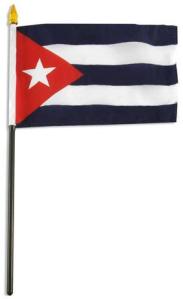
The flag of Cuba was officially adopted on May 20, 1902, when the United States granted the island, which it had seized control of during the Spanish-American War, its independence. The flag of Cuba’s origins however go back much further than 1902.

The flag of Cuba was designed in 1849 by a poet named Miguel Teurbe Tolón. Tolón’s design included three blue stripes, representing the three parts of the county that were divided from one another during the wars for independence, and two white stripes, which represented the purity of the patriotic cause. The design’s red triangle is meant to stand for the blood that was shed in order to free the nation, while the white star at its center is representative of the island’s independence.

This flag of Cuba was carried into battle by a Venezuelan military leader named Narciso López during his attempt to liberate Cuba. Although López was not victorious, it was indeed the first instance in the flag of Cuba was flown.

According the current government of Cuba (the Castro regime), the meaning behind the flag of Cuba is as follows: the blue strips represent the old divisions of the island; the white stripes represent the strength of the independent ideal; the red triangle symbolizes equality, fraternity and freedom, as well as the blood that was shed during the wars for independence.

Aside from this official flag of Cuba, Fidel Castro’s “26th of July Movement” also created a flag of Cuba which is equally divided into red and black portions, usually in the form of horizontal stripes. The flag often bears inscriptions as well. This flag of Cuba is often flown on public building on the island.

The Flag of Libya

There are 195 countries in the world today, each of which, presumably, has a unique national flag. Of all those flags, however, there is only one which is made up of one color and one color only, with no designs, insignias or other details whatsoever. The Flag of Libya consists of nothing more than a beautiful field of green. No eagles, coat of arms, rising suns or quarter moons. Just the simplicity that is the color green.

The color green is meant to signify the Libyan people’s devotion to Islam, the state religion. Green is also the national color of Libya and is symbolic of the “Green Revolution” of Muammar al-Gaddafi, Libya’s current leader. However, the flag of Libya was not always green. In fact, it once had a leafy palm tree at its center.

The history of the flag of Libya begins in the year 1918, when the short-lived Tripolitanian Republic in Western Libya had its own flag. The flag had a light-blue field and a green palm tree in its center. The palm tree also had a star on top of it, just like a Christmas tree. However, when the Tripolitanian Republic fell in 1923, this version of the flag of Libya was done away with.

Later, in 1951, when Libya gained its independence from Italy, the first flag of modern Libya was adopted. It featured a white crescent and star atop a field of red, black and green. This design was based on the Senussi flag, and is still used to this day abroad by the Libyan opposition movement.

After the 1969 Revolution, the official name of Libya was changed to Al-Jumhuriya al-Arabiya al-Libiya, or the Libyan Arab Republic. This new Republic abolished the previous flag of Libya and replaced it with the Arab Liberation Flag, which was first flown over Egypt after the Revolution of 1952. This particular flag was a tricolor with the colors red, white and black.

In 1972, Libya joined the Federation of Arab Republics and briefly adopted the flag of that organization. It featured a golden hawk holding a scroll with Arabic name of the Federation, Ittihad al-Jumhuriyat al-Arabiya, written upon it.

Finally, in 1977 Libya once again changed its name to Al-Jamahiriya al-Arabiya al-Libiya ash-Sha`biya al-Ishtirakiya, or the Socialist People’s Libyan Arab Jamahiriya. When this change took place, the all-green flag which continues to be flown today in Libya was also adopted.

The Serbian Flag

The Serbian flag, in one form or another, has been around for quite some time. The earliest known description of a Serbian flag dates from the year 1281. It comes from a list of treasures belonging to a Serbian king. The description says, “vexillum unum de zendato rubeo et blavo,” which apparently means, “a flag of fabric red and blue.” There is, however, no indication as to how the colors were patterned.

The earliest known drawing of a Serbian flag goes all the way back to the year 1339. The drawing appears on a map made by a famous Majorcan cartographer, Angelino Dulcert. According to the drawing, at that point in history, the Serbian flag featured a two-headed eagle against a yellow field.

During the time of the First Serbian Uprising, several other flags were made use of. One of these flag, featuring a cross and the colors red, white and blue, may be linked to the Serbian flag used today. Other Serbian flags flown during this time period consisted of such combinations of color as red and yellow, red, white and blue, and red and blue. The army taking part in the uprising also used light yellow flags with various symbols upon them, including a black, two-headed eagle.

Today’s Serbian flag is a tricolor made up of what are known as “Pan-Slavic” colors, which are red, blue and white. The colors are arranged in three horizontal bands of equal width. The modern Serbian State flag also features the coat of arms of Serbia, which consists of a double-headed eagle on red shield. The eagle’s wings and body are silver, while its tongues, beaks, legs and claws are golden.

The current Serbian flag was adopted as part of the new Constitution of Serbia on November 8, 2006. On that date, its usage, along with that of the coat of arms and the national anthem, became constitutionally sanctioned.

Celebrate Easter with Festive Flags!

By Kristi Ries

The tulips are beginning to shoot up, grass is getting greener, birds are chirping and the sunshine seems to be permeating the world these days. Yes, spring is almost upon us, and with that comes all of the great things we look forward to at this time of year: warmer weather, beautiful blossoms and the Easter holiday!
But it’s not quite here yet. Yes, the days are getting longer, and the college kids are already breaking out their flip-flops and tossing Frisbees. But this is a bit premature, my friends. It will still take a few weeks for the sun to work its magic on the area’s foliage. Forests are still mostly brown and though buds are showing, there’s no sign of leaves blooming anytime soon. It feels as though winter has taken a strong hold of the world and aside from a few early bees, there’s no end to it in sight.

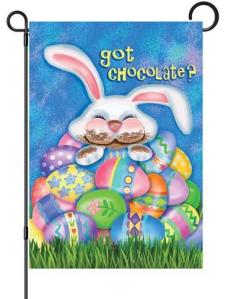
Until then, you’ll have to usher in spring on your own. Luckily, there are a few quick and easy ways to brighten up your home. Hang an Easter windsock from your porch to add some pizzazz to your favorite outdoor hangout. Or post a festive garden flag with white Easter bunnies to liven things up. (After all, you’ll be picnicking and grilling out sooner than you think!) It’s a fun and affordable way to make you’re your home is decorated inside and out. And there’s nothing like a cheerful spring chick or Easter bunny to get grown-ups and kids alike in the spirit of spring!

Maybe you have little ones who’ll be searching for their own baskets come Easter Sunday, or perhaps the grandkids are heading to your house for the annual egg hunt.

Either way, these bright, colorful Easter flags will be a fun-filled addition to your yard or garden!

The Bosnian Flag – Symbol of Peace

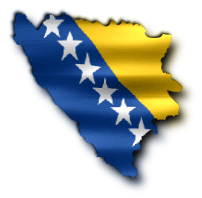
The Bosnian flag is blue with a yellow isosceles triangle. The flag also features seven full stars and two half stars along the hypotenuse of the triangle (I just like using words like isosceles and hypotenuse).

The colors of the Bosnian flag—blue, yellow and white—are usually associated with neutrality and peace throughout the world. In fact, the kings of neutrality and peace, Switzerland and Costa Rica, both feature at least one of these colors on their respective flags. The colors of the Bosnian flag may have also been inspired by those found on the flag of Europe as well as that of the United Nations.

The three points of the Bosnian flag’s isosceles triangle are thought to stand for the three constituent peoples of Bosnia and Herzegovina: the Bosniaks, the Croats, and the Serbs. The triangle is also meant to represent the map of Bosnia, which resembles a heart. Many people even call Bosnia the “Heart-Shaped Nation.”

The stars which run diagonally across the Bosnian flag represent Europe, and are meant to be infinite in number, thus continuing from top to bottom. Many people have speculated as to why the stars are infinite in number, but, much like the mystery surrounding how many licks it takes to reach the center of a Blow Pop, the world may never know—just kidding; I’m sure there’s a good reason behind the stars.

The Bosnian flag was created when the country won its independence from Yugoslavia in 1992. Before choosing the current design, other alternatives were proposed, including one which featured an olive branch. Other designs included the map of Bosnia as well as a lighter shade of blue.

Gadsden Flag T-Shirts – Don’t Tread On Me

The Gadsden flag: it’s a symbol of freedom, a sign of resistance, a warning shot fired across the bow of those that might think it fit to infringe upon the freedoms of the citizens of this great nation. It bears but few simple words, but within their meaning lie the force of a great hurricane, and all those that gaze upon it cannot help but understand its most singular message: Don’t Tread on Me. Those that carry the Gadsden flag, whether it be with their hands or in their hearts, believe in the principles upon which the United States of America was founded, and upon which she shall continue to thrive.

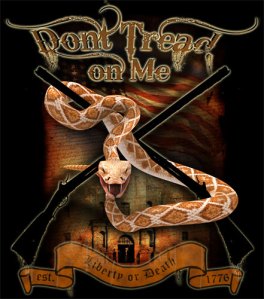
In light of these immutable truths, the United States Flag Store has decided to offer its customers the chance to not only own the Gadsden flag, but to wear it upon their chests as well. Created by our own team of local designers, these Gadsden flag t-shirts are available exclusively on our Website. Choose between six original designs, each one unique from the next, and which have been given such fitting names as Patriots, Guns, and Fire.

The Gadsden flag was created by Christopher Gadsden in 1775. At the time, Gadsden was taking part in the Second Continental Congress, which had just created the United States Navy to keep British ships from reaching the colonies. A small group Marines, which happened to carry yellow drums with a rattlesnake and the words “Don’t Tread on Me” painted upon them, was given the mission of accompanying the Navy on its first mission.

Whether Gadsden was inspired by the drums or in fact created them himself is the subject of some debate. However, it’s an undeniable fact that Gadsden soon presented the Navy’s commander with a flag bearing the same design, and, as the saying goes, the rest is history.

Celebrate the Gadsden and all that it stands for by picking up a Gadsden t-shirt today!